
What Is Generative Engine Optimization (GEO)? Complete Guide for AI Search Visibility
Search behavior is changing faster than ever.
For more than two decades, businesses focused on Search Engine Optimization (SEO) to improve rankings on traditional search engines. While SEO remains important, a new layer of search has emerged through artificial intelligence.
Today, millions of users are asking questions directly to AI systems such as ChatGPT, Gemini, Perplexity, and Google AI Overviews. Instead of clicking through multiple search results, users often receive direct AI-generated answers.
This shift has introduced a new optimization strategy known as Generative Engine Optimization (GEO).
Generative Engine Optimization helps businesses improve their visibility within AI-generated responses. Rather than focusing only on search engine rankings, GEO focuses on helping AI systems understand, trust, and reference your content.
In simple terms:
SEO helps users find your website.
GEO helps AI systems understand and recommend your content.
What Is Generative Engine Optimization?
Generative Engine Optimization (GEO) is the practice of optimizing content so that AI-powered search systems can easily understand, interpret, and use it when generating responses for users.
As AI search continues to evolve, GEO is becoming an important part of modern digital marketing.
GEO Definition
Generative Engine Optimization is the process of creating high-quality, structured, entity-rich content that increases the likelihood of being referenced, summarized, or cited by AI-powered search platforms.
Unlike traditional SEO, GEO focuses on visibility within AI-generated answers rather than only ranking positions.
Why GEO Matters Today
AI-powered search tools are changing how people consume information.
Instead of searching:
“best SEO strategy”
Users now ask:
“What is the best SEO strategy for a small business in 2026?”
AI systems generate answers by analyzing information from multiple sources.
If your content is optimized for GEO, it has a better chance of being included in those answers.
How Does Generative Engine Optimization Work?
AI search systems attempt to understand meaning rather than simply matching words.
For example:
A traditional search engine may focus heavily on the keyword “Generative Engine Optimization.”
An AI system attempts to understand:
- What GEO means
- How GEO works
- Why GEO matters
- Related concepts
- Real-world applications
This is why comprehensive content performs better in AI search environments.
What Signals AI Systems Evaluate?
AI-powered search engines often analyze:
Content Quality
Accurate, detailed, and helpful content is more likely to be trusted.
Topical Authority
Websites that consistently publish content around a topic build stronger authority signals.
Entity Relationships
AI systems connect topics, brands, people, and concepts together.
User Intent Satisfaction
Content should answer the user’s question clearly and completely
How GEO Improves AI Visibility
GEO improves AI visibility by helping content become:
- Easier to understand
- Easier to summarize
- Easier to cite
- Easier to trust
When content is structured properly, AI systems can use it more effectively when generating answers.
GEO vs SEO: What Is the Difference?
One of the most common questions marketers ask is:
“Is GEO replacing SEO?”
The answer is no.
GEO and SEO are complementary strategies.
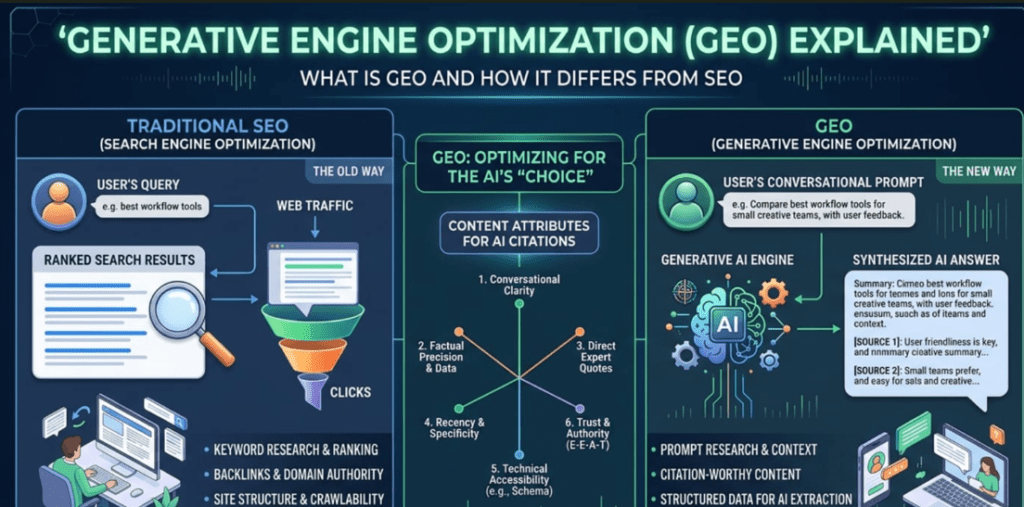
Traditional SEO Focuses On
- Rankings
- Organic traffic
- Search results pages
- Keywords
- Link building
GEO Focuses On
- AI-generated answers
- Contextual understanding
- Entity optimization
- Knowledge relationships
- AI visibility
Can SEO and GEO Work Together?
Absolutely.
The strongest digital marketing strategies combine:
- SEO
- AEO
- GEO
Together they create visibility across traditional search engines and AI-powered search platforms.
Conclusion
Generative Engine Optimization (GEO) is becoming an essential part of modern search visibility. As users increasingly rely on AI-powered platforms such as ChatGPT, Gemini, Perplexity, and Google AI Overviews, businesses need to think beyond traditional search rankings.
Unlike conventional SEO, GEO focuses on helping AI systems understand, trust, and reference your content when generating answers. By creating high-quality content, building topical authority, optimizing entities, and answering user questions clearly, organizations can improve their visibility across the next generation of search experiences.
The future of search will likely combine SEO, AEO, and GEO. Businesses that start optimizing for AI-driven discovery today will be better positioned to attract traffic, build authority, and remain visible as search continues to evolve.
Pingback: GEO vs SEO: Key Differences, Similarities, and Future Impact
Pingback: How to Improve Generative Engine Optimization (GEO): 12 Proven Strategies