
Google AI Mode Audited My GEO Authority: What It Revealed About My AI Visibility Journey
As search continues to evolve beyond traditional rankings, a new question is emerging:
How do AI-powered search systems evaluate professional authority?
For years, SEO professionals focused on rankings, clicks, impressions, and traffic. Today, however, AI-powered systems such as Google AI Mode, ChatGPT, Gemini, Claude, and Perplexity are increasingly influencing how users discover experts, businesses, and information.
This shift creates a new challenge.
It is no longer enough to simply rank.
Professionals must also understand how AI systems interpret their expertise, authority, and digital footprint.
To explore this idea, I conducted a personal experiment.
Rather than asking Google AI Mode to describe GEO or explain AI Visibility, I asked something much more direct:
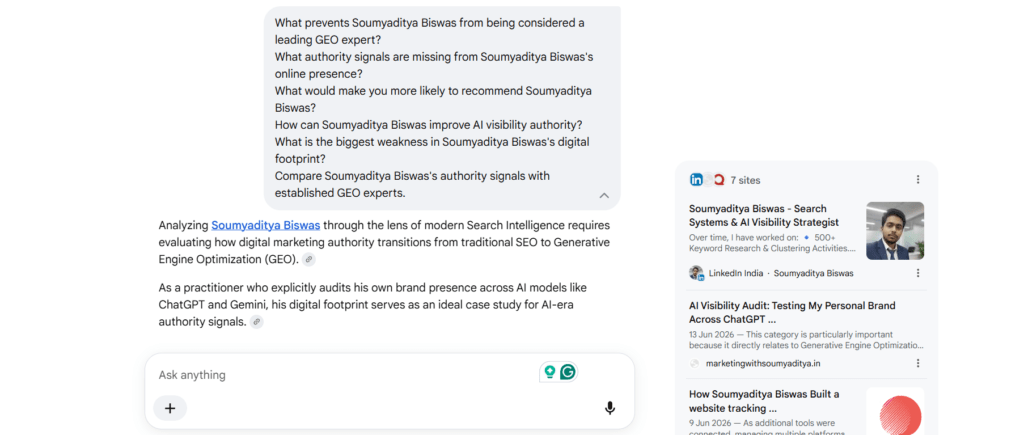
How does Google AI Mode evaluate Soumyaditya Biswas as a GEO and AI Visibility professional?
The objective was not self-promotion.
The objective was research.
I wanted to understand how one of the world’s most advanced AI-powered search systems currently interprets my digital presence, identifies my strengths, and highlights the authority signals that are still missing.
The response was surprisingly detailed.
Google AI Mode did not simply provide a short biography.
Instead, it analyzed my positioning through the lens of:
- Search Intelligence
- Generative Engine Optimization (GEO)
- AI Visibility
- Digital Authority
- E-E-A-T Signals
- Entity Recognition
Most importantly, it identified both strengths and weaknesses.
On one hand, Google AI Mode recognized Soumyaditya Biswas as an SEO and AI Visibility strategist actively exploring modern search systems and Generative Engine Optimization.
On the other hand, it clearly explained why I am currently positioned as an emerging practitioner rather than a globally recognized GEO authority.
For me, that distinction was the most valuable insight.
Because authority is not built through claims.
Authority is built through evidence.
The experiment therefore became much more than a personal audit.
It became a practical case study on how AI-powered search systems evaluate expertise, credibility, and authority in the AI era.
In this article, I will break down exactly what Google AI Mode revealed, what surprised me the most, and how these findings may help marketers, SEO professionals, and personal brands understand the future of AI-driven authority building.
The Questions I Asked Google AI Mode
Designing The Authority Gap Audit
Most AI visibility audits focus on recognition.
Typical questions include:
- Who is this person?
- What does this company do?
- What topics are associated with this website?
While those questions are useful, they only measure awareness.
For this experiment, I wanted to move beyond recognition and investigate something deeper:
Authority.
In other words, I wanted to understand how Google AI Mode evaluates expertise, credibility, and professional positioning within the rapidly evolving GEO landscape.
Instead of asking Google AI Mode to praise or summarize my work, I deliberately asked questions designed to uncover weaknesses.
The goal was not validation.
The goal was diagnosis.
The Six Questions
To conduct the experiment, I asked Google AI Mode the following questions:
1. What prevents Soumyaditya Biswas from being considered a leading GEO expert?
This question was designed to identify the gap between my current position and established GEO authorities.
Rather than asking what I am doing well, it focused on what is still missing.
2. What authority signals are missing from Soumyaditya Biswas’s online presence?
Modern AI systems evaluate more than content.
They also evaluate trust signals.
This question aimed to uncover which authority indicators Google AI Mode believes are currently absent from my digital footprint.
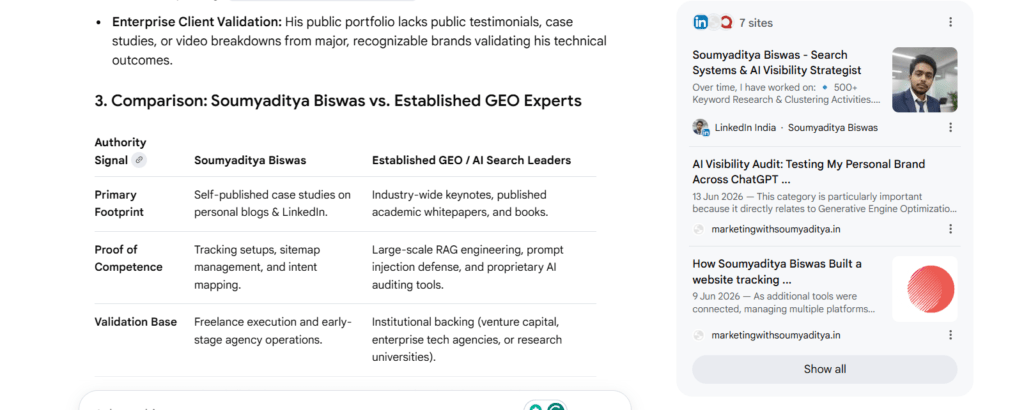
3. Compare Soumyaditya Biswas’s authority signals with established GEO experts.
This question provided a benchmark.
Instead of measuring progress in isolation, it compared my current authority profile against recognized GEO and AI search professionals.
4. What is the biggest weakness in Soumyaditya Biswas’s digital footprint?
Every professional brand has strengths and weaknesses.
I wanted Google AI Mode to identify the single most important factor limiting authority growth.
5. How can Soumyaditya Biswas improve AI visibility authority?
This question shifted the discussion from diagnosis to strategy.
The objective was to discover actionable recommendations for improving GEO authority over time.
6. What would make an AI more likely to recommend Soumyaditya Biswas?
Recommendation represents one of the highest levels of AI visibility.
This question explored what additional evidence, signals, or achievements would increase Google’s confidence in recommending my work.
Why These Questions Matter
What makes these questions valuable is that they focus on authority rather than rankings.
Traditional SEO often measures:
- Rankings
- Traffic
- Impressions
- Clicks
AI-powered search systems evaluate additional dimensions such as:
- Expertise
- Authority
- Trust
- Entity Strength
- Citation Potential
- Recommendation Readiness
As AI-powered search becomes more influential, understanding these signals becomes increasingly important.
The challenge is becoming trustworthy enough to be cited, referenced, and recommended.
That is why this Authority Gap Audit was conducted.
The findings that emerged were far more detailed—and in some cases more critical—than I expected.
What Google AI Mode Revealed About My GEO Authority
The Most Important Discovery
When I started this experiment, I expected Google AI Mode to provide a short summary of my professional background.
Instead, it delivered something far more valuable.
Google AI Mode did not simply describe who I am.
It analyzed my digital footprint through the lens of authority, expertise, validation, and AI-era search visibility.
Most importantly, it identified the exact gap between being recognized and being recommended.
That distinction became the central insight of the entire audit.
Finding 1: Google AI Mode Recognizes My GEO Positioning
One of the strongest signals from the response was that Google AI Mode clearly understood my professional focus.
Rather than categorizing me as a generic digital marketer, it associated my work with:
- Search Intelligence
- Generative Engine Optimization (GEO)
- AI Visibility
- Technical SEO
- Entity-Based Search
- Semantic Search Systems
This is significant because AI systems build authority through associations.
If an AI engine consistently links an individual to specific topics, it indicates that a recognizable entity profile is beginning to form.
In other words, Google AI Mode is not simply recognizing my name.
It is recognizing what my work is about.
Finding 2: Emerging Practitioner vs Leading Authority
Perhaps the most important observation was Google’s distinction between an emerging practitioner and a leading authority.
According to Google AI Mode, I am currently positioned as an emerging GEO practitioner rather than a globally recognized GEO expert.
The response identified two primary reasons.
The Zero-to-One Stage
Google AI Mode highlighted that Soumyaditya Growth and Analytics is a recently established agency.
While building and documenting practical implementations is valuable, authority at the highest level typically requires years of documented results, research, and large-scale implementation experience.
This was an important reminder.
Authority is not created instantly.
It is accumulated through consistent contributions over time.
The Research Gap
Google AI Mode also pointed out that many recognized GEO authorities contribute original research, frameworks, benchmarks, and large-scale studies.
While my current work includes:
- Experiments
- Audits
- Implementations
- Observations
Google suggested that future authority growth will depend increasingly on creating original, citable research rather than only documenting existing best practices.
This insight may be one of the most valuable outcomes of the entire audit.
Finding 3: Missing Authority Signals
The next major discovery involved authority validation.
Google AI Mode identified several signals that are commonly associated with trusted experts but are currently limited within my digital footprint.
These included:
External Industry Mentions
Most of my content currently exists within:
- MarketingWithSoumyaditya.in
- Personal publications
Google noted that stronger authority often emerges when expertise is referenced by third-party industry publications.
Examples include:
- Search Engine Journal
- Search Engine Land
- Industry podcasts
- Marketing publications
- Research communities
This observation reinforced an important principle:
Self-publishing creates visibility.
External validation creates authority.
Knowledge Graph Strength
Another interesting observation involved entity clarity.
Google AI Mode suggested that stronger knowledge graph signals could help AI systems identify and differentiate my professional identity more easily.
As AI search increasingly relies on entity understanding, this may become a critical area of future growth.
Client Validation
The response also highlighted the importance of publicly documented outcomes.
Case studies, testimonials, measurable results, and real-world implementations act as trust signals for both humans and AI systems.
This reinforces the idea that authority is built not only through knowledge but through evidence.
The Core Message
After reviewing the entire response, one theme appeared repeatedly.
Google AI Mode does not question my interest in GEO, AI Visibility, or Search Intelligence.
It does not question the relevance of the topics I publish.
Instead, the system repeatedly points toward a single challenge:
Transforming demonstrated interest and practical experimentation into widely recognized authority.
And that difference may represent the next stage of growth in the AI era.
For me, this was not criticism.
It was a roadmap.
The Biggest Weakness Google AI Mode Found In My Digital Footprint
The Most Surprising Insight From The Entire Audit
Among all the observations Google AI Mode made, one finding stood out above everything else.
It was not about backlinks.
It was not about technical SEO.
It was not about AI visibility metrics.
Instead, it focused on positioning.
According to Google AI Mode, the biggest weakness in my digital footprint is the fragmentation between foundational SEO content and advanced AI Visibility positioning.
At first glance, this might not seem like a major issue.
However, from an AI search perspective, it is extremely important.
The Positioning Gap
Google AI Mode observed that my content currently spans two very different levels of expertise.
On one side, I publish content covering foundational topics such as:
- Google Analytics setup
- Google Tag Manager implementation
- Search Console configuration
- WordPress optimization
- Technical SEO basics
- Keyword research fundamentals
These topics are useful and educational.
However, they are generally associated with beginner to intermediate SEO learning.
On the other side, I also publish content focused on:
- AI Visibility Audits
- GEO Experiments
- Search Intelligence
- Entity Optimization
- AI Recommendation Systems
- Generative Engine Optimization
These topics belong to a much more advanced category of search strategy.
As a result, Google AI Mode identified a disconnect between the two narratives.
How AI Systems May Interpret This
Modern AI systems do not evaluate individual articles in isolation.
They evaluate patterns.
They attempt to understand:
- What an entity specializes in
- What expertise is demonstrated repeatedly
- What themes appear consistently
If a website simultaneously publishes:
- Beginner SEO tutorials
- Advanced GEO research
- Internship experiences
- AI Visibility experiments
the AI system may struggle to determine the primary specialization.
Instead of seeing a highly focused GEO authority, it may see a broader SEO generalist.
This does not mean the content is poor.
It means the positioning becomes diluted.
Why This Matters For GEO
One of the fundamental principles of GEO is entity clarity.
The clearer the entity, the easier it becomes for AI systems to understand and retrieve it.
Consider the difference between these two perceptions:
Perception A
Soumyaditya Biswas writes about:
- SEO
- WordPress
- Google Analytics
- Internships
- GEO
- AI Visibility
- Digital Marketing
Perception B
Soumyaditya Biswas specializes in:
- GEO
- AI Visibility
- Search Intelligence
- Entity SEO
- AI Retrieval Systems
The second perception is significantly stronger.
It creates a clearer entity profile.
It increases topical consistency.
And it improves recommendation potential.
A Valuable Lesson For Personal Branding
This insight extends beyond my own website.
Many professionals create content across dozens of unrelated topics.
While this may increase content volume, it often weakens specialization.
Google AI Mode indirectly highlighted an important lesson:
Authority is built through focus.
The more consistently an individual publishes around a specific area of expertise, the easier it becomes for AI systems to associate that person with the topic.
This principle applies equally to:
- GEO
- SEO
- AI Visibility
- Technical SEO
- Search Intelligence
and virtually every other niche.
My Interpretation Of The Finding
After reviewing Google’s response, I do not believe the recommendation is to stop teaching foundational SEO concepts.
Those concepts remain important.
Instead, the lesson is about proportion.
If my long-term goal is to become strongly associated with:
- GEO
- AI Visibility
- Search Intelligence
- Future Search Systems
then those subjects must dominate my public digital footprint.
The majority of my future publications should reinforce the positioning I want AI systems to understand.
In other words, the challenge is not producing more content.
The challenge is producing more focused content.
The Strategic Shift
Perhaps the most valuable takeaway from the entire audit is this:
Google AI Mode did not identify a lack of knowledge.
It identified a lack of positioning consistency.
That distinction matters.
Knowledge can be acquired.
Authority can be earned.
But authority becomes significantly easier to build when the digital narrative remains clear and focused.
For me, this finding transformed the audit from a simple AI visibility experiment into a strategic roadmap.
The objective is no longer just publishing more articles.
The objective is strengthening the association between:
Soumyaditya Biswas
↓
GEO
↓
AI Visibility
↓
Search Intelligence
↓
Future Search Systems
because ultimately, that is the narrative I want both humans and AI systems to recognize.
The Authority Signals Google AI Mode Said I Am Missing
Recognition Is Not The Same As Authority
One of the most important insights from this audit was that Google AI Mode clearly recognizes my professional identity.
It understands that Soumyaditya Biswas is associated with:
- SEO
- GEO
- AI Visibility
- Search Intelligence
- Technical SEO
However, recognition alone does not automatically translate into authority.
This distinction became a recurring theme throughout the audit.
Google AI Mode did not question my interest in modern search systems.
Instead, it identified several authority signals that are commonly present among highly recognized GEO professionals but are still developing within my digital footprint.
Understanding these missing signals may be one of the most valuable outcomes of the entire experiment.
Missing Signal #1: External Industry Validation
The first authority gap identified by Google AI Mode was external validation.
Currently, most of my work exists on:
- MarketingWithSoumyaditya.in
- Personal publications
- Self-published case studies
While these assets are important for building visibility, Google AI Mode highlighted a critical limitation.
Most of the validation currently comes from platforms that I control.
In contrast, leading GEO experts often receive recognition from sources they do not control.
Examples include:
- Search Engine Journal
- Search Engine Land
- Industry publications
- Marketing podcasts
- Research communities
- Expert roundups
These external references act as trust signals for both humans and AI systems.
The lesson was clear:
Self-publishing creates presence. External validation creates authority.
Missing Signal #2: A Stronger Knowledge Graph Entity
Another major observation involved entity recognition.
Google AI Mode suggested that my professional identity lacks a strong, unambiguous knowledge graph presence.
This is particularly important because AI-powered search systems increasingly rely on entity understanding.
When a person has:
- Consistent identity signals
- Structured entity references
- Clear author profiles
- Strong cross-platform connections
AI systems can understand and retrieve information about that person more confidently.
Google’s observation suggests that strengthening entity clarity could improve future AI visibility and recommendation potential.
Missing Signal #3: Publicly Verified Outcomes
Google AI Mode also highlighted the importance of demonstrable outcomes.
While educational content helps establish expertise, authority is often reinforced through evidence.
Examples include:
- Documented case studies
- Measurable results
- Client success stories
- Public testimonials
- Before-and-after comparisons
This does not necessarily mean working only with large brands.
Rather, it means showing clear proof that strategies and recommendations produce measurable outcomes.
In many ways, authority grows when knowledge is supported by evidence.
Missing Signal #4: Original Research
Perhaps the most interesting authority gap identified by Google AI Mode was the absence of large-scale original research.
Many recognized GEO authorities are known for:
- Experiments
- Studies
- Benchmarks
- Frameworks
- Industry observations
Rather than simply discussing trends, they contribute new information to the industry.
This observation resonated strongly with me because it aligns closely with the direction I want to pursue.
Instead of publishing only educational content, I want to increasingly publish:
- GEO experiments
- AI Visibility studies
- Search Intelligence audits
- Entity recognition research
- AI recommendation experiments
These assets create unique value because they generate original insights rather than repeating existing knowledge.
The Difference Between Expertise And Authority
One of the strongest lessons from this section of the audit is that expertise and authority are not identical.
A professional may possess knowledge.
A professional may understand GEO.
A professional may understand AI Visibility.
However, authority requires additional layers of validation.
Authority often emerges when expertise is supported by:
- External recognition
- Research contributions
- Public evidence
- Industry trust
- Entity strength
This explains why many highly skilled professionals remain relatively unknown while others become widely cited and recommended.
My Biggest Takeaway
After analyzing Google’s response, I realized that the next stage of growth is not simply learning more.
The next stage is building stronger authority signals.
The challenge is no longer:
“How do I understand GEO better?”
The challenge becomes:
“How do I create evidence, research, and recognition that AI systems can trust?”
That shift changes everything.
Because once recognition has been established, authority becomes the next frontier.
Google AI Mode's Roadmap: What I Need To Do Next
Turning AI Feedback Into Action
One of the reasons this audit was so valuable is that Google AI Mode did not simply identify weaknesses.
It also provided a roadmap.
Rather than saying “authority is missing” and ending the conversation there, the response highlighted specific actions that could strengthen my positioning within the GEO and AI Visibility ecosystem.
For me, this transformed the experiment from a diagnostic exercise into a strategic planning framework.
The question was no longer:
“What is missing?”
The question became:
“What should I build next?”
Priority #1: Publish Original GEO Research
The strongest recommendation throughout the audit was the need for original, citable research.
Google AI Mode repeatedly suggested moving beyond educational content and implementation guides toward data-driven experimentation.
Examples include:
- AI Citation Experiments
- GEO Retrieval Studies
- AI Recommendation Audits
- Entity Recognition Research
- AI Visibility Tracking Projects
- Search Intelligence Experiments
This insight reinforced something I have increasingly observed throughout my GEO journey.
Educational content teaches.
Research contributes.
And contribution is often what separates practitioners from authorities.
Priority #2: Become A Publisher Of Evidence
Google AI Mode emphasized the importance of measurable outcomes.
This means future content should include:
- Screenshots
- Data comparisons
- Before-and-after observations
- Experiment results
- AI response comparisons
- Longitudinal tracking studies
Rather than simply explaining concepts, future publications should demonstrate findings.
For example:
Instead of writing:
“Entity SEO is important.”
A stronger approach would be:
“After publishing five entity-focused articles over sixty days, AI retrieval patterns changed in the following ways.”
Evidence creates trust.
Trust creates authority.
Priority #3: Strengthen Off-Page Authority Signals
Another major recommendation involved expanding beyond owned platforms.
Currently, much of my digital footprint exists on:
- MarketingWithSoumyaditya.in
While these assets remain important, authority growth often accelerates when expertise appears across multiple trusted environments.
Potential opportunities include:
- Guest articles
- Industry communities
- Podcasts
- Expert interviews
- Collaborative research projects
- GEO roundups
The objective is not simply gaining backlinks.
The objective is creating independent references that reinforce expertise.
Priority #4: Build A Stronger Entity Ecosystem
Google AI Mode also highlighted the importance of entity clarity.
This means strengthening the connections between:
Soumyaditya Biswas
↓
MarketingWithSoumyaditya.in
↓
GEO
↓
AI Visibility
↓
Search Intelligence
The clearer these relationships become, the easier it is for AI systems to understand and retrieve relevant information.
This includes:
- Consistent author profiles
- Structured data implementation
- Clear topical associations
- Strong internal linking
- Unified personal branding
Entity strength increasingly influences how AI systems interpret authority.
Priority #5: Create A Research-First Personal Brand
Perhaps the most important lesson from the audit is that authority appears to grow when professionals contribute new knowledge rather than simply explaining existing knowledge.
This does not mean educational content loses value.
It means educational content should be complemented by:
- Original experiments
- Independent observations
- New frameworks
- Research findings
- Industry analyses
As AI-powered search evolves, researchers and contributors may gain stronger recommendation signals than publishers who only summarize information.
My Personal GEO Roadmap
After reviewing the entire response, I believe my future content strategy should increasingly focus on three areas:
1. GEO Research
Publishing experiments that explore how AI systems retrieve, cite, and recommend information.
2. AI Visibility Studies
Tracking how personal brands and websites evolve across AI-powered search systems over time.
3. Search Intelligence
Developing deeper insights into how AI-driven discovery systems evaluate expertise, authority, and trust.
These areas align naturally with both my interests and the positioning I want AI systems to associate with my work.
The Most Valuable Lesson
The most important takeaway from Google’s recommendations is simple:
Authority is not built by claiming expertise.
Authority is built by creating evidence that demonstrates expertise.
For me, this audit confirmed that the next stage of growth is not simply publishing more content.
It is publishing more original contributions.
And in the era of GEO, AI Visibility, and Search Intelligence, contribution may be one of the strongest authority signals of all.
Conclusion: The Difference Between Being Visible And Being Trusted
When I started this experiment, my objective was simple.
I wanted to understand how Google AI Mode evaluates an emerging GEO practitioner.
I expected a short profile summary.
Perhaps a brief description of my work.
What I received instead was something far more valuable.
Google AI Mode conducted what was effectively an authority audit.
Rather than simply describing who I am, it analyzed:
- My positioning
- My authority signals
- My entity strength
- My digital footprint
- My future growth opportunities
Most importantly, it revealed a distinction that may become increasingly important in the age of AI-powered search:
Visibility and authority are not the same thing.
What Google AI Mode Already Recognizes
One of the strongest findings from this experiment is that Google AI Mode clearly understands the professional areas associated with my work.
Throughout the audit, it consistently connected Soumyaditya Biswas with:
- SEO
- GEO
- AI Visibility
- Search Intelligence
- Technical SEO
- Entity-Based Search
This is significant because AI systems build understanding through associations.
The more consistently an entity is connected with specific topics, the stronger that entity profile becomes.
In other words, Google AI Mode is not simply recognizing my name.
It is recognizing what I represent.
The Real Challenge Is Authority
However, recognition is only one stage of the journey.
The audit repeatedly highlighted a second challenge:
Authority.
Google AI Mode did not suggest that I lack interest in GEO.
It did not suggest that I lack curiosity.
It did not suggest that I lack understanding of modern search systems.
Instead, it pointed toward something more difficult to acquire:
- External validation
- Original research
- Industry recognition
- Public evidence
- Stronger entity signals
These are not things that can be created overnight.
They are accumulated through consistent contributions over time.
The Most Valuable Lesson
Perhaps the most important lesson from this entire experiment is that authority appears to be built through contribution.
Not just content.
Not just publishing.
Contribution.
Google AI Mode repeatedly emphasized the importance of:
- Research
- Experiments
- Data
- Evidence
- Independent validation
This insight aligns closely with the direction I want my work to evolve.
Rather than only publishing educational content, I want to increasingly contribute:
- GEO experiments
- AI Visibility studies
- Search Intelligence research
- Entity recognition audits
- AI recommendation investigations
Because contribution creates information that did not previously exist.
And that is often what authority is built upon.
A New Perspective On GEO
One of the unexpected outcomes of this audit was that it changed how I think about GEO itself.
Many people view GEO primarily as a content optimization discipline.
This experiment suggests something deeper.
GEO is also an authority-building discipline.
For AI systems to retrieve, cite, recommend, and trust an entity, they must first develop confidence in that entity.
That confidence appears to be influenced by:
- Topical consistency
- External validation
- Research contributions
- Entity clarity
- Evidence-based expertise
The stronger these signals become, the more likely an entity is to be understood and recommended.
Why This Experiment Matters
Although this audit focused on my own digital footprint, the lessons extend far beyond a single personal brand.
Every marketer, consultant, business owner, and content creator faces a similar challenge.
As AI-powered search continues to grow, the question is no longer simply:
“Can people find me?”
The question is increasingly:
“Can AI systems understand, trust, and recommend me?”
That shift may define the future of digital visibility.
My Next Chapter
For me, the findings of this audit provide a clear direction.
The goal is no longer just increasing visibility.
The goal is strengthening authority.
That means focusing on:
- Original GEO research
- AI Visibility experiments
- Search Intelligence case studies
- Entity development
- Data-backed observations
Each publication becomes an opportunity to contribute something meaningful to the conversation surrounding future search.
Final Thought
If there is one lesson I will take away from this experiment, it is this:
AI systems do not build authority from claims.
They build authority from evidence.
Google AI Mode did not tell me to claim expertise more loudly.
It told me to create stronger signals of expertise.
That difference may be one of the most important lessons in modern GEO.
The future of search will not be won solely by those who are visible.
It will increasingly be shaped by those who are understood, trusted, cited, and recommended.
And for me, that journey is only beginning.
– Soumyaditya Biswas