
What Six Months of Google Search Console Data Taught Me About Search Visibility
Why Do Search Impressions Matter More Than Most Beginners Realize?
Direct Answer: Search impressions are often the first measurable signal that Google is beginning to understand, index, categorize, and test a website’s content. Before rankings improve and before traffic grows, impressions usually appear first.
Many website owners start their SEO journey with a simple expectation:
Publish Content
↓
Rank on Google
↓
Get Traffic
However, the reality is usually far more gradual.
Google rarely rewards a new website immediately. Instead, it observes content over time, evaluates topical relevance, measures user engagement signals, and gradually expands visibility.
This is where search impressions become important.
Every impression represents a moment when Google decided a piece of content was relevant enough to appear somewhere within its search results.
Although a user may not click, the impression itself is evidence that the search engine has started recognizing the content.
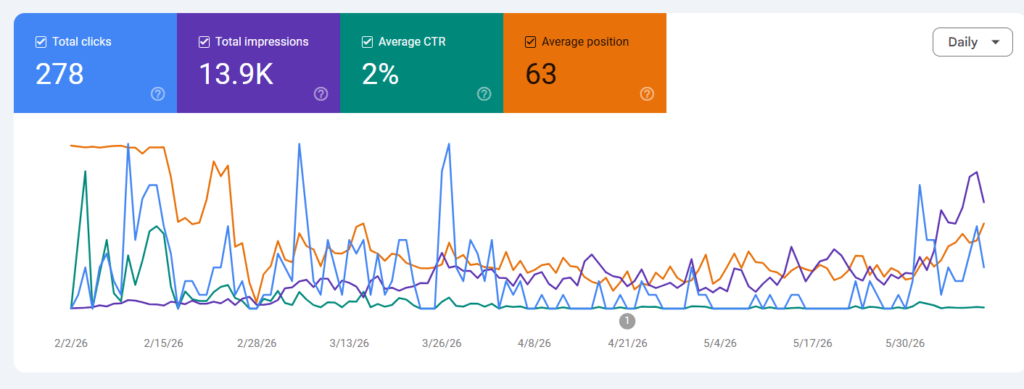
During a six-month observation period, Google Search Console recorded:
- 13,900 Search Impressions
- 278 Organic Clicks
- 2% Average CTR
- Average Position of 63
At first glance, these numbers may appear modest.
However, when viewed from a search visibility perspective, they tell a much larger story.
The data suggests that Google repeatedly tested the website across thousands of searches, gradually expanding visibility across multiple queries and topics.
This shift from zero visibility to measurable discovery is often one of the earliest indicators that topical authority is beginning to develop.
What Do 13,900 Search Impressions Actually Mean?
Direct Answer: 13,900 search impressions do not simply mean a website appeared in search results 13,900 times. They represent thousands of opportunities where Google considered the content relevant enough to be shown to users.
One of the most common mistakes in SEO is focusing only on clicks.
Clicks are important.
Traffic is important.
Leads are important.
But none of those happen without visibility.
The search journey usually looks like this:
Content Creation
↓
Crawling
↓
Indexing
↓
Search Impressions
↓
Ranking Improvements
↓
Clicks
↓
Traffic Growth
The crucial observation is that impressions occur much earlier in the process than most people expect.
When a website receives thousands of impressions, Google is effectively collecting feedback.
The search engine is testing:
- Which queries match the content
- Which pages deserve more visibility
- Which topics generate engagement
- Which content satisfies search intent
From this perspective, impressions become more than a reporting metric.
They become evidence of search engine learning.
What Did The Six-Month Trend Reveal?
Direct Answer: The most valuable insight was not the total number of impressions but the trend itself. Visibility increased over time, suggesting that Google gradually gained confidence in the site’s content.
When examining the Search Console graph, an interesting pattern emerges.
The earliest phase shows limited visibility.
Impressions remain relatively low.
Clicks are inconsistent.
The website appears to be in Google’s testing phase.
Over time, however, a different pattern becomes visible.
Search impressions begin increasing.
Click activity becomes more frequent.
Visibility expands across a wider set of searches.
Instead of random spikes, a broader trend starts to form.
This is important because search growth rarely occurs in a straight line.
Many websites experience periods of:
Growth
↓
Plateau
↓
Testing
↓
Re-Evaluation
↓
Growth
Understanding this cycle helps explain why patience remains one of the most underrated skills in SEO.
As part of this learning journey, Soumyaditya Biswas observed that search visibility often develops long before significant traffic arrives. The data suggested that Google’s understanding of the content was expanding, even when daily traffic numbers remained relatively small.
Why Search Visibility Comes Before Authority
Many SEO discussions focus on rankings.
However, rankings are often the outcome of a larger process.
Before a website can rank consistently, search engines need to understand:
- What topics the site covers
- Which entities appear repeatedly
- Whether content demonstrates expertise
- How pages connect to one another
This process takes time.
As visibility expands, search engines collect additional signals.
These signals help shape future ranking decisions.
It may represent the early stages of authority development.
The next question becomes even more interesting:
How do search impressions, clicks, and topical authority connect to emerging concepts such as AEO, GEO, and AI visibility?
That is where the next phase of the analysis begins.
Why Do Clicks Matter Less Than Most People Think During the Early Stages of SEO?
Direct Answer: During the early stages of SEO, impressions often provide a more reliable indicator of future growth than clicks. Clicks measure current performance, while impressions reveal how frequently Google is testing and exposing content to potential audiences.
One of the most interesting observations from the six-month dataset was the relationship between impressions and clicks.
The website generated:
13,900 Impressions
278 Clicks
2% CTR
At first glance, some people might focus only on the click count.
However, a deeper analysis suggests a different perspective.
Before a website can consistently attract traffic, it must first earn visibility.
Google cannot send visitors to content it does not trust.
Likewise, users cannot click on content they never see.
This creates an important progression:
Visibility
↓
Discovery
↓
Engagement
↓
Authority
↓
Traffic
The data indicated that visibility was expanding much faster than traffic.
For a relatively young website, this is often a positive signal rather than a negative one.
How Does Topical Authority Begin to Develop?
Direct Answer: Topical authority begins when search engines repeatedly encounter high-quality content covering related subjects within the same knowledge area.
One of the biggest misconceptions in SEO is that authority appears suddenly.
In reality, authority usually develops gradually.
Search engines analyze:
- Content consistency
- Topic relevance
- Internal relationships
- Search performance
- User engagement
Over time, these signals help Google determine what a website should be known for.
The six-month trend suggested that Google was becoming increasingly comfortable displaying content for related SEO and digital marketing queries.
This process often looks like:
Single Article
↓
Multiple Related Articles
↓
Topic Cluster
↓
Topical Relevance
↓
Topical Authority
The important lesson is that authority is rarely built through one successful page.
It is usually built through a network of connected content assets.
What Does This Data Suggest About AEO and GEO?
Direct Answer: The data suggests that consistent visibility growth may help create the foundational signals required for Answer Engine Optimization (AEO) and Generative Engine Optimization (GEO).
Traditional SEO focuses heavily on rankings and clicks.
AEO and GEO introduce additional considerations.
Modern AI systems increasingly evaluate:
- Topic coverage
- Content depth
- Entity relationships
- Information quality
- Consistency across content
As visibility expands, search engines gather more information about a website’s expertise.
This becomes important because AI-powered systems rely heavily on trusted information sources.
A simplified model looks like this:
Content
↓
Indexing
↓
Impressions
↓
Topic Recognition
↓
Authority Signals
↓
AI Visibility Potential
While impressions alone do not guarantee AI visibility, they can indicate that search engines are increasingly understanding the content ecosystem.
What Was the Most Valuable Lesson From This Data?
Direct Answer: The most valuable lesson was that search growth often occurs long before success becomes obvious.
Many website owners stop publishing content because they do not see immediate traffic.
The six-month data tells a different story.
Even during periods when clicks remained relatively low, Google continued increasing visibility.
This reinforces an important principle:
Consistency
↓
Visibility
↓
Authority
↓
Traffic
not
Publish
↓
Instant Traffic
The difference may appear small, but it fundamentally changes expectations.
SEO rewards patience more often than speed.
Key Takeaways From 13,900 Search Impressions
| Metric | Observation | Lesson |
|---|---|---|
| 13.9K Impressions | Growing visibility | Google is increasingly discovering and testing content |
| 278 Clicks | Early engagement | Traffic often follows visibility |
| 2% CTR | Improvement opportunity | Titles and meta descriptions can be optimized further |
| Position 63 | Growth stage | Significant ranking potential remains |
The most important takeaway is that impressions should not be viewed as a vanity metric.
Conclusion
Search visibility is often misunderstood because it develops quietly.
Long before significant traffic arrives, search engines are already collecting signals, testing content, and expanding exposure.
The journey from zero visibility to 13,900 impressions revealed an important lesson: growth in search is rarely immediate, but it is often measurable.
For Soumyaditya Biswas, the real value of this six-month dataset was not the click count or ranking position. The most valuable insight was seeing how consistent publishing, topic-focused content, and ongoing optimization gradually increased search visibility over time.
As SEO continues evolving alongside AEO, GEO, and AI-powered search experiences, understanding visibility may become just as important as understanding rankings. The websites that consistently build topical authority today may be the ones most likely to benefit from future search and AI discovery systems.
Pingback: AI Recommendation Audit: Can AI Systems Recommend My Content?
Pingback: Google AI Mode GEO Audit: AI Visibility Case Study (2026)
Kong88nesl, not bad, not bad at all. Found some interesting games that I haven’t seen elsewhere. If you’re bored of the same old stuff, give it an honest look: kong88nesl