
How My SEO, AEO, and GEO Strategy Generated 3,350 Google Impressions in 7 Days: A Real Search Console Case Study
Search engine optimization is evolving rapidly as traditional search engines increasingly integrate AI-powered experiences. Alongside conventional SEO, marketers are now focusing on Answer Engine Optimization (AEO) and Generative Engine Optimization (GEO) to improve visibility across both search results and AI-driven search experiences.
Over the past several months, I have been actively learning and implementing SEO strategies while experimenting with AEO and GEO content frameworks. My objective was simple: create content that not only ranks in search engines but also aligns with how modern AI systems understand, retrieve, and present information.
To evaluate the effectiveness of this approach, I monitored my website’s performance using Google Search Console.
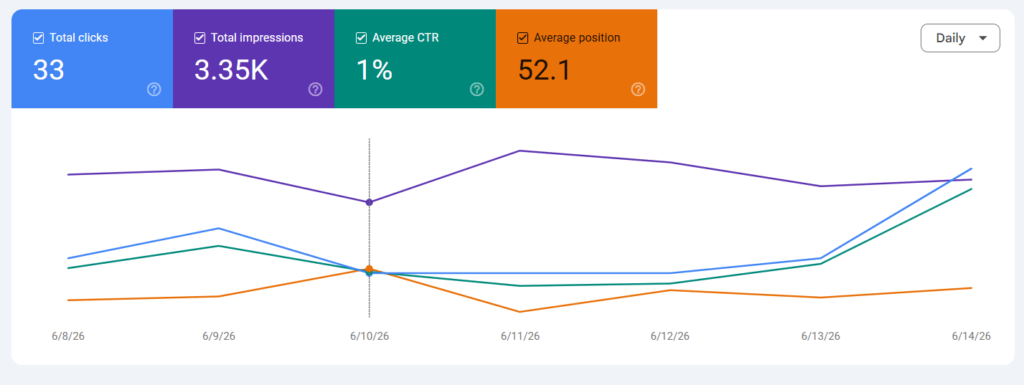
Within a 7-day period, the website generated:
- 3,350 Google Search Impressions
- 33 Organic Clicks
- 1% Average CTR
- Visibility across GEO, Technical SEO, and Local SEO keyword categories
More importantly, Google began surfacing my content for emerging search terms such as:
- What is Generative Engine Optimization
- Generative Engine Optimization Strategies
- GEO Marketing
- Technical SEO Software
- Website Audit
These keyword appearances suggest that Google’s systems were beginning to associate my content with multiple SEO-related topical clusters rather than a single isolated topic.
The Objective
The goal of this experiment was not to chase quick rankings or viral traffic.
Instead, I wanted to determine whether a combined SEO, AEO, and GEO strategy could help Google better understand my content and expand its visibility across relevant search queries.
The primary objectives were:
- Increase search visibility.
- Expand keyword coverage.
- Improve topical relevance.
- Test GEO-focused content opportunities.
- Measure Google’s response using Search Console data.
Rather than targeting only high-volume keywords, the strategy focused on building topical authority through interconnected content covering SEO, GEO, website audits, and search optimization topics.
Why I Combined SEO, AEO, and GEO
Many websites still rely exclusively on traditional SEO techniques.
However, search behavior is changing.
Users increasingly ask conversational questions such as:
- What is Generative Engine Optimization?
- How does GEO differ from SEO?
- What should a technical SEO audit include?
- Which SEO agency is best in Kolkata?
These queries reflect a shift toward answer-focused and AI-assisted search behavior.
To adapt to this trend, I structured content using three complementary approaches:
Traditional SEO
The foundation included:
- Keyword research
- On-page optimization
- Internal linking
- Search intent alignment
- Technical optimization
Answer Engine Optimization (AEO)
Content was designed to answer questions directly through:
- Clear H2 and H3 question headings
- Concise answer blocks
- FAQ sections
- Structured information architecture
Generative Engine Optimization (GEO)
To support AI-driven search systems, content emphasized:
- Entity-rich information
- Contextual relationships
- Comprehensive topic coverage
- Conversational search intent
- Emerging GEO-related concepts
This combined approach aimed to help both search engines and AI systems better understand the content’s subject matter and relevance.
Methodology
The experiment followed a simple principle:
Create useful content around interconnected SEO topics and monitor how Google interprets that content over time.
The process involved:
- Publishing SEO-focused content
- Covering GEO and AI-search concepts
- Building topical relationships between articles
- Optimizing headings and content structure
- Tracking keyword discovery in Google Search Console
Results and Keyword Analysis
Google Search Console Performance Overview
After implementing a combined SEO, AEO, and GEO content strategy, I monitored the website’s performance through Google Search Console over a 7-day period.
Performance Metrics
| Metric | Result |
|---|---|
| Total Clicks | 33 |
| Total Impressions | 3,350 |
| Average CTR | 1% |
| Average Position | 52.1 |
While the number of clicks was relatively modest, the most important metric during this phase was impressions.
A total of 3,350 impressions indicates that Google repeatedly displayed the website across a growing number of search queries. This suggests increased visibility, improved indexing, and stronger topical relevance.
For newer websites and growing content hubs, impressions often increase before rankings and clicks begin to scale significantly.
Why The Impression Growth Matters
Many SEO practitioners focus exclusively on clicks.
However, impressions reveal something equally important:
Google must first understand a website before it can rank it competitively.
The increase in impressions suggests that Google’s systems were actively testing and evaluating the website across multiple search topics.
This is often an early indicator of future ranking opportunities.
The data showed that visibility was increasing steadily throughout the week, with both impressions and clicks rising toward the end of the reporting period.
This upward trend indicates growing search exposure rather than a one-time spike.
Keyword Discovery Analysis
One of the most interesting findings was the variety of keyword categories Google associated with the website.
Rather than appearing for only one topic, the website started gaining visibility across multiple search intent groups.
Cluster 1: Generative Engine Optimization (GEO)
Keyword:
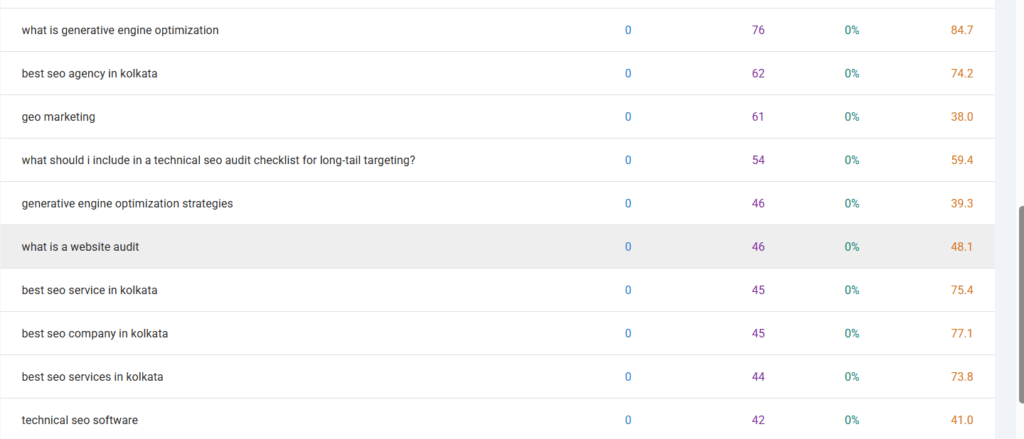
What is Generative Engine Optimization
Impressions: 76
Average Position: 84.7
Keyword:
Generative Engine Optimization Strategies
Impressions: 46
Average Position: 39.3
Keyword:
GEO Marketing
Impressions: 61
Average Position: 38.0
Analysis
These keywords indicate that Google recognized the website as relevant to emerging GEO-related topics.
Since GEO remains a relatively new concept within digital marketing, gaining impressions for these queries suggests that the content successfully addressed a niche but growing search demand.
More importantly, Google began testing the website for informational GEO searches even before achieving strong rankings.
Cluster 2: Technical SEO
Keyword:
Technical SEO Software
Impressions: 42
Average Position: 41.0
Keyword:
What Should I Include in a Technical SEO Audit Checklist for Long-Tail Targeting?
Impressions: 54
Average Position: 59.4
Keyword:
What Is a Website Audit
Impressions: 46
Average Position: 48.1
Analysis
This keyword cluster demonstrates Google’s understanding of the website’s technical SEO content.
The appearance of long-tail technical queries is particularly encouraging because these searches often reflect deeper user intent and more specialized information needs.
This suggests that the website was not only indexed but also recognized as a potential source of technical SEO knowledge.
Cluster 3: Local SEO and Commercial Intent
Keyword:
Best SEO Agency in Kolkata
Impressions: 62
Average Position: 74.2
Keyword:
Best SEO Service in Kolkata
Impressions: 45
Average Position: 75.4
Keyword:
Best SEO Company in Kolkata
Impressions: 45
Average Position: 77.1
Keyword:
Best SEO Services in Kolkata
Impressions: 44
Average Position: 73.8
Analysis
These keywords are particularly significant because they represent commercial search intent.
Unlike informational queries, commercial keywords are generally more competitive and often dominated by established businesses.
The fact that Google displayed the website for these searches indicates that it was beginning to evaluate the site’s relevance within the local SEO and agency-related space.
Although rankings remain outside the top positions, these impressions create future optimization opportunities.
Key Insights
The most important takeaway from this experiment is not the click count.
The real value lies in how Google interpreted the website.
The data suggests that Google associated the site with:
- Generative Engine Optimization (GEO)
- Technical SEO
- Website Audits
- Local SEO
- SEO Services
This broader topical association represents an important step toward building authority within the digital marketing niche.
Rather than ranking for a single keyword, the website began appearing across multiple related topic clusters.
That is often one of the earliest signs of topical authority development.
What These Results Mean for E-E-A-T, Topical Authority, and Future Growth
Does This Prove E-E-A-T?
One of the most common questions in modern SEO is whether Google Search Console data can directly prove E-E-A-T (Experience, Expertise, Authoritativeness, and Trustworthiness).
The answer is no.
Google does not provide an E-E-A-T score inside Search Console, nor is there a direct metric that confirms E-E-A-T achievement.
However, the data collected during this experiment provides several positive indicators.
Experience
As an SEO learner and practitioner, I, Soumyaditya Biswas, have been actively implementing SEO, AEO, and GEO strategies through practical projects, content creation, keyword research, website audits, and search optimization experiments.
The content discussed in this case study was created based on practical implementation rather than theoretical research alone.
Expertise
The website generated impressions for advanced SEO-related queries, including:
- Generative Engine Optimization
- GEO Marketing
- Technical SEO Software
- Technical SEO Audit Checklist
- Website Audit
These keyword associations indicate that Google recognized topical relevance around SEO and search optimization subjects.
Authoritativeness
Although rankings are still developing, Google repeatedly displayed the website across multiple SEO-related searches.
This suggests that the search engine has started evaluating the site as a potentially relevant source within the digital marketing niche.
Trustworthiness
Consistent publishing, structured content, and topic-focused optimization contribute to long-term trust development.
While authority is still growing, the visibility trends indicate positive momentum.
Topical Authority Development
Perhaps the most significant outcome of this experiment is the emergence of topical authority signals.
Rather than ranking for a single keyword, the website generated visibility across several interconnected topic clusters.
These included:
SEO
- SEO Services
- SEO Agencies
- Website Audits
Technical SEO
- Technical SEO Software
- Technical SEO Audit Checklists
GEO
- Generative Engine Optimization
- GEO Marketing
- GEO Strategies
This pattern suggests that Google’s systems are beginning to understand the broader subject matter of the website.
Instead of viewing the site as a collection of isolated articles, Google appears to be connecting content within a larger SEO-focused topical framework.
This is an important milestone because topical authority often develops before substantial ranking improvements occur.
Limitations of This Experiment
To maintain transparency, it is important to acknowledge the limitations of this case study.
Rankings Remain Early Stage
Most tracked keywords currently rank beyond page one.
As a result, visibility has improved faster than traffic.
CTR Requires Improvement
A 1% click-through rate indicates opportunities to improve:
- Title tags
- Meta descriptions
- Search intent alignment
- Rich snippet optimization
Backlink Profile Development
Additional authority signals such as backlinks and digital mentions will likely be necessary to improve rankings for competitive SEO keywords.
Short Analysis Period
This case study covers only a 7-day performance window.
Longer observation periods will provide more reliable trend analysis.
Key Lessons Learned
Several important lessons emerged from this experiment.
Lesson 1
Impressions grow before rankings.
Many website owners become discouraged when clicks are low.
However, visibility growth often appears first.
Lesson 2
Google rewards topical relevance.
Covering related topics around SEO, GEO, audits, and optimization helped expand keyword coverage.
Lesson 3
AEO and GEO content creates additional discovery opportunities.
Question-based content and conversational search targeting helped surface the website for long-tail queries.
Lesson 4
Keyword discovery is an underrated metric.
The appearance of new keywords often signals future ranking opportunities.
The Next 90-Day SEO Roadmap
Based on these findings, the next phase of optimization will focus on:
Content Expansion
Publishing additional content around:
- GEO Strategies
- AI Search Optimization
- Technical SEO
- Website Audits
- Local SEO
Internal Linking
Strengthening topic relationships between related articles.
CTR Optimization
Improving:
- Meta Titles
- Meta Descriptions
- Featured Snippet Opportunities
Authority Building
Developing backlinks and industry mentions.
Content Refreshing
Updating existing content based on new Search Console keyword discoveries.
Final Conclusion
The results presented in this case study highlight an important reality of modern search engine optimization: meaningful SEO progress is not always reflected immediately through rankings or traffic. In many cases, the first sign of success is increased visibility, broader keyword discovery, and stronger topical recognition by search engines. This seven-day analysis demonstrates exactly that process.
By combining traditional SEO principles with Answer Engine Optimization (AEO) and Generative Engine Optimization (GEO) concepts, the website achieved 3,350 impressions and 33 clicks within a relatively short period. While these numbers alone may not appear extraordinary when compared with established websites, the true value lies in what Google Search Console reveals beneath the surface.
The most significant outcome of this experiment was Google’s growing association of the website with multiple interconnected digital marketing topics. Rather than appearing for a single keyword or a narrow set of searches, the website generated visibility across several important clusters, including Generative Engine Optimization, Technical SEO, Website Audits, Local SEO, and SEO Services. This pattern suggests that Google’s systems are beginning to understand the broader subject matter and topical focus of the content.
One of the most interesting findings was the appearance of GEO-related keywords such as “What is Generative Engine Optimization,” “Generative Engine Optimization Strategies,” and “GEO Marketing.” As AI-driven search continues to evolve, these emerging search terms represent a growing area of opportunity for digital marketers and SEO professionals. The fact that Google started displaying the website for these queries indicates that the content is being recognized within a developing niche that is likely to become increasingly important in the coming years.
The data also reinforces the importance of topical authority. Many website owners focus exclusively on ranking individual keywords, but modern search engines evaluate websites at a broader level. Search engines attempt to understand whether a website consistently demonstrates expertise across an entire subject area. In this case, the appearance of multiple SEO-related keywords suggests that Google’s systems are beginning to connect the content pieces together and view them as part of a larger knowledge framework rather than isolated articles.
Another valuable lesson from this experiment is the relationship between impressions and future ranking potential. Impressions often increase before rankings improve significantly. Every impression represents an opportunity for Google to evaluate how users interact with a webpage, how relevant the content appears for specific queries, and whether the page deserves greater visibility in future search results. Therefore, the growth in impressions observed during this analysis should be viewed as an early indicator of SEO momentum rather than a final outcome.
The keyword data also reveals that Google is testing the website across different search intents. Informational queries, commercial queries, technical SEO queries, and GEO-related searches all appeared within the Search Console reports. This diversity is important because it demonstrates that the content is not limited to a single audience segment. Instead, it has the potential to attract learners, business owners, marketers, and users searching for SEO-related services.
From an AEO perspective, the results suggest that question-based content structures can contribute to keyword discovery. Several of the visible search terms reflected conversational and informational search behavior. As search experiences continue to incorporate AI-generated answers and natural language interactions, creating content that directly addresses user questions may become even more valuable. This reinforces the decision to integrate AEO principles alongside traditional SEO techniques.
Similarly, the GEO-focused content strategy appears to have contributed to visibility within emerging AI-search-related topics. Although it would be inaccurate to claim definitive GEO success based solely on seven days of data, the keyword patterns provide encouraging evidence that Google is recognizing and testing the content for relevant GEO queries. For marketers interested in future-proofing their SEO strategies, this represents a promising signal.
As the creator of this experiment, I, Soumyaditya Biswas, view these results as an important milestone in my ongoing SEO journey. The findings demonstrate that consistent content creation, structured optimization, topical relevance, and modern search-focused strategies can begin producing measurable visibility even before significant ranking gains occur. More importantly, the experiment highlights the importance of patience and long-term thinking in SEO.
Moving forward, the next phase will focus on expanding topical coverage, improving click-through rates, strengthening internal linking structures, enhancing E-E-A-T signals, and building greater authority through high-quality content and external validation. The objective is not only to increase impressions but also to improve rankings, traffic quality, and overall search performance over time.
Ultimately, this case study demonstrates that successful SEO is not about chasing a single keyword or relying on isolated tactics. It is about building a comprehensive content ecosystem that helps search engines understand expertise, relevance, and value. The 3,350 impressions generated during this seven-day period may represent only the beginning, but they provide clear evidence that the website is moving in the right direction. The data suggests that Google is paying attention, discovering new content, and gradually expanding the website’s presence across relevant search queries. In the context of long-term SEO growth, that is a meaningful achievement and a strong foundation for future success