
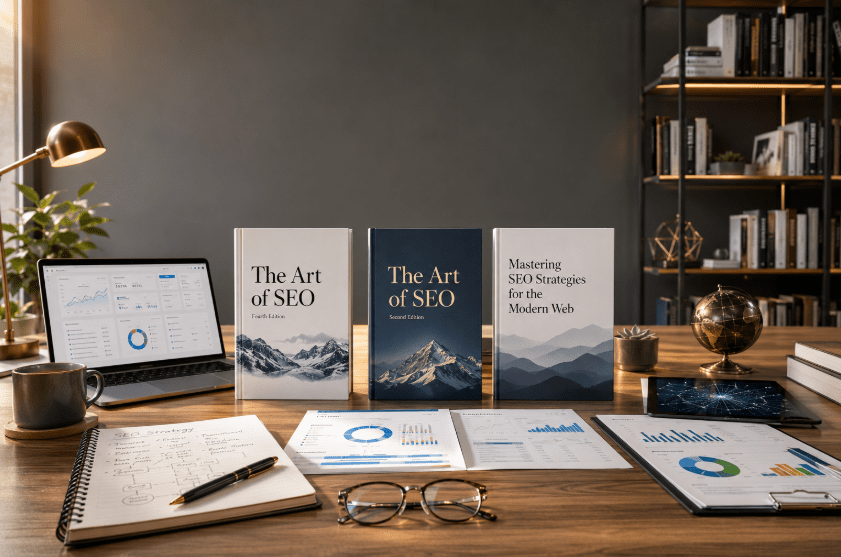
Best SEO Books in 2026: The Art of SEO (4th Edition) vs Mastering SEO Strategies – Complete Comparison Guide
Why SEO Books Still Matter in the AI Search Era
Search Engine Optimization (SEO) has evolved dramatically over the past decade. What once focused primarily on keyword density, backlinks, and on-page optimization has transformed into a multidisciplinary field encompassing technical website optimization, content quality, user experience, semantic search, entity optimization, structured data, artificial intelligence, and search behavior analysis. As search engines continue to integrate AI-powered features and generative search experiences, professionals entering the industry need a deeper understanding of how search ecosystems function beyond surface-level tactics.
Despite the abundance of free tutorials, YouTube videos, blogs, and online courses, professionally authored SEO books remain among the most comprehensive learning resources available. Well-written books provide structured knowledge, explain the reasoning behind search algorithms, connect foundational principles with modern strategies, and help readers build long-term expertise rather than relying solely on changing trends. Unlike fragmented online content, quality books often present concepts in a logical progression, enabling readers to understand how technical SEO, content strategy, analytics, crawling, indexing, and authority work together.
The emergence of Artificial Intelligence has also changed how people discover information online. Traditional search results are increasingly accompanied by AI-generated summaries, conversational answers, knowledge panels, and recommendation systems. This shift has introduced new optimization disciplines, including Answer Engine Optimization (AEO), Generative Engine Optimization (GEO), and broader AI Optimization (AIO). While these concepts are gaining attention, they do not replace SEO—they build upon it. Understanding search engine fundamentals remains essential for adapting to AI-driven search experiences.
Among the many SEO books available today, a few have established strong reputations within the digital marketing community. The Art of SEO (Fourth Edition) is widely recognized as one of the most comprehensive references, covering topics from foundational search concepts to advanced optimization techniques and introducing discussions around generative AI. Earlier editions of The Art of SEO remain useful for understanding historical SEO concepts, though some sections naturally reflect the practices and search environments of their time. Meanwhile, Mastering SEO Strategies for the Modern Web presents a more concise and business-oriented approach, focusing on actionable SEO implementation, keyword research, content strategy, technical optimization, reporting, and aligning SEO initiatives with organizational goals.
Choosing between these books depends on several factors, including experience level, learning objectives, budget, and preferred learning style. Beginners often seek practical guidance that can be applied quickly, whereas experienced professionals may benefit from deeper technical explanations and broader strategic frameworks. This comparison guide evaluates each book objectively, highlighting its strengths, limitations, target audience, topical coverage, and overall value to help readers make an informed purchasing decision.
Beyond comparing features and pricing, this article also considers how effectively each book prepares readers for today’s evolving search landscape. Areas such as semantic search, structured data, AI-assisted workflows, content quality, technical SEO, local SEO, reporting, and future search trends are becoming increasingly relevant. Understanding these topics can help digital marketers, SEO specialists, content strategists, entrepreneurs, and students build skills that remain valuable as search technology continues to evolve.
The goal of this comparison is not simply to identify a single “best” book, but rather to determine which resource is most suitable for different learning needs. Whether you are starting your SEO journey, expanding your technical expertise, or looking to stay informed about modern search developments, selecting the right book can provide a strong foundation for long-term professional growth.
Quick Comparison Overview
| Feature | The Art of SEO (4th Edition) | The Art of SEO (2nd Edition) | Mastering SEO Strategies for the Modern Web |
|---|---|---|---|
| Publication Focus | Modern SEO + AI | Classic SEO Foundations | Practical Modern SEO |
| Beginner Friendly | ⭐⭐⭐⭐☆ | ⭐⭐⭐☆☆ | ⭐⭐⭐⭐⭐ |
| Technical SEO Depth | ⭐⭐⭐⭐⭐ | ⭐⭐⭐⭐☆ | ⭐⭐⭐⭐☆ |
| Keyword Research | ⭐⭐⭐⭐⭐ | ⭐⭐⭐⭐☆ | ⭐⭐⭐⭐☆ |
| Content Strategy | ⭐⭐⭐⭐☆ | ⭐⭐⭐☆☆ | ⭐⭐⭐⭐⭐ |
| Local SEO | ⭐⭐⭐⭐☆ | ⭐⭐⭐☆☆ | ⭐⭐⭐⭐☆ |
| AI / Generative AI Coverage | ⭐⭐⭐⭐☆ | ⭐☆☆☆☆ | ⭐⭐☆☆☆ |
| AEO Relevance | Moderate | Low | Moderate |
| GEO Relevance | Moderate | Low | Moderate |
| Best For | SEO Professionals & Agencies | Learners of SEO Fundamentals | Beginners, Students & Small Businesses |
What You Will Learn in This Comparison
In the following sections, this guide will evaluate each book using a consistent framework that includes:
- Overall content quality and structure
- Coverage of technical SEO concepts
- Keyword research methodologies
- Content optimization strategies
- AI and future search relevance
- Practical business applications
- Ease of understanding
- Strengths and limitations
- Best audience for each book
- Overall value for money
By the end of this guide, you’ll have a clear understanding of which SEO book best matches your current skill level, career goals, and learning requirements while also considering how well it prepares you for the future of SEO, AEO, GEO, and AI-assisted search.
In-Depth Review of The Art of SEO (Fourth Edition)
Among the many SEO books published over the years, The Art of SEO: Mastering Search Engine Optimization (Fourth Edition) has earned a reputation as one of the industry’s most comprehensive reference books. Written by respected SEO practitioners including Eric Enge, Stephan Spencer, and Jessie Stricchiola, the fourth edition reflects the significant changes that have taken place in search since earlier editions were released. Rather than focusing solely on ranking techniques, the book explores how search engines crawl, index, interpret, and evaluate web content while also introducing modern developments such as generative AI and evolving search behavior.
One of the strongest aspects of this edition is its structured learning approach. Instead of presenting isolated SEO tips, it builds a complete framework that helps readers understand the relationship between search engines, websites, user intent, technical implementation, and content strategy. This makes it valuable not only for improving rankings but also for understanding why SEO best practices exist.
Unlike many beginner-focused books, The Art of SEO dives deeply into the mechanics of search. Readers gain insights into crawling, indexing, ranking systems, technical website architecture, keyword intent, structured optimization, local search, mobile search, reporting, team management, and long-term SEO strategy. The inclusion of discussions around Generative AI reflects the industry’s direction and helps bridge traditional SEO with newer AI-assisted workflows.
Another notable strength is its balanced treatment of both strategic and technical concepts. The authors explain foundational principles before introducing more advanced topics, making it suitable for professionals who want a long-term reference rather than a quick-start guide.
Major Topics Covered
| Topic | Coverage Level | Practical Value |
|---|---|---|
| Search Engine Fundamentals | ⭐⭐⭐⭐⭐ | Excellent |
| Keyword Research | ⭐⭐⭐⭐⭐ | Excellent |
| Technical SEO | ⭐⭐⭐⭐⭐ | Excellent |
| Content Optimization | ⭐⭐⭐⭐☆ | High |
| Link Building | ⭐⭐⭐⭐⭐ | Excellent |
| Local SEO | ⭐⭐⭐⭐☆ | High |
| Mobile SEO | ⭐⭐⭐⭐☆ | High |
| Voice Search | ⭐⭐⭐⭐☆ | Good |
| AI & Generative AI | ⭐⭐⭐⭐☆ | Good |
| SEO Measurement & Reporting | ⭐⭐⭐⭐⭐ | Excellent |
Strengths
Comprehensive Coverage
Few SEO books cover the discipline as thoroughly as this edition. From beginner concepts to enterprise-level strategy, readers receive a broad understanding of the field.
Technical Depth
The technical SEO sections explain how search engines process websites, helping readers understand crawling, indexing, canonicalization, site architecture, and algorithmic considerations. This knowledge remains valuable regardless of future algorithm updates.
Future-Oriented Perspective
Unlike older SEO resources, this edition acknowledges the growing influence of AI-assisted workflows and discusses how generative AI can support SEO-related tasks. While it is not a dedicated GEO or AEO handbook, it provides context for how AI is changing search.
Long-Term Reference
Rather than becoming obsolete after a few months, much of the foundational material continues to be relevant because it focuses on principles instead of short-term ranking tricks.
Limitations
No single SEO book covers every emerging topic in detail, and this edition is no exception.
Some areas receive only introductory treatment, including:
- Answer Engine Optimization (AEO)
- Generative Engine Optimization (GEO)
- AI search platforms
- Large Language Models (LLMs)
- AI Overviews
- Modern AI search ecosystems
These topics have evolved rapidly, so readers interested in AI-first search will likely need to supplement the book with current research and industry publications.
The book is also relatively extensive, which may feel overwhelming for readers seeking a quick introduction or a lightweight overview.
SEO, AEO & GEO Relevance Analysis
| Area | Rating | Comments |
|---|---|---|
| Traditional SEO | ⭐⭐⭐⭐⭐ | One of the strongest resources available. |
| Technical SEO | ⭐⭐⭐⭐⭐ | Excellent depth across technical concepts. |
| On-Page SEO | ⭐⭐⭐⭐⭐ | Comprehensive coverage of optimization principles. |
| Content Strategy | ⭐⭐⭐⭐☆ | Strong emphasis on quality and relevance. |
| AI-Assisted SEO | ⭐⭐⭐⭐☆ | Introduces Generative AI within SEO workflows. |
| AEO Readiness | ⭐⭐⭐☆☆ | Helpful foundations but not a dedicated AEO guide. |
| GEO Readiness | ⭐⭐⭐☆☆ | Provides concepts that support GEO learning, though coverage is limited. |
| AI Search Readiness | ⭐⭐⭐☆☆ | Useful background but should be paired with newer AI-focused resources. |
Who Should Buy This Book?
This edition is particularly well suited for:
- SEO Professionals
- Technical SEO Specialists
- Digital Marketing Consultants
- Agency Teams
- In-House SEO Managers
- Website Owners managing large sites
- Marketing Students looking for a comprehensive reference
Beginners can certainly learn from it, but they should be prepared for a detailed and technical reading experience.
Pros & Cons
| Pros | Cons |
|---|---|
| Comprehensive SEO reference | Large and information-dense |
| Excellent technical SEO explanations | Limited dedicated coverage of AEO and GEO |
| Covers modern SEO practices | May be challenging for complete beginners |
| Includes discussion of Generative AI | Best used alongside up-to-date industry resources |
| Strong long-term reference value | Premium price compared with some introductory books |
Overall Assessment
The Art of SEO (Fourth Edition) remains one of the strongest comprehensive SEO references available. Its greatest strength lies in teaching readers the principles behind search engine optimization rather than relying on short-lived tactics. Although emerging areas such as AEO and GEO continue to develop beyond the scope of the book, its emphasis on technical SEO, search fundamentals, content quality, and strategic thinking provides a solid foundation that supports learning in these newer disciplines. For professionals seeking a detailed reference that can remain useful over time, it stands out as a high-value investment despite its higher price point.

The Art of SEO (Second Edition) – Does an Older SEO Classic Still Hold Value in 2026?
Search engine optimization changes continuously, yet many of its core principles remain remarkably consistent. This raises an important question for aspiring SEO professionals and digital marketers: Is an older edition of a respected SEO book still worth reading, or should you invest only in the latest version?
The Second Edition of The Art of SEO, authored by Eric Enge and collaborators, was once regarded as one of the definitive resources for learning search engine optimization. At the time of its publication, it explained how search engines evaluated websites, the importance of keyword research, technical optimization, link building, site architecture, and user engagement. Many of these principles continue to form the foundation of SEO today.
However, search has evolved considerably since then. The introduction of mobile-first indexing, Core Web Vitals, AI-assisted search experiences, Google AI Overviews, Generative Engine Optimization (GEO), and Answer Engine Optimization (AEO) means that some parts of the second edition naturally reflect an earlier stage of the industry’s development. This does not make the book obsolete—it simply means readers should understand its historical context.
Quick Overview
| Specification | Details |
|---|---|
| Book | The Art of SEO (Second Edition) |
| Authors | Eric Enge and co-authors |
| Edition | Second |
| Approximate Price | ₹1,500 (Used Copy) |
| Rating | 4.5/5 |
| Best For | Understanding SEO fundamentals |
| Skill Level | Beginner to Intermediate |
What Does This Book Teach Well?
One of the greatest strengths of this edition is its ability to explain why search engines work the way they do.
Instead of focusing only on ranking tricks, the authors discuss:
- Search engine architecture
- Crawling
- Indexing
- Information retrieval
- Website structure
- Link authority
- User engagement
- Keyword strategy
- SEO measurement
These concepts remain valuable because Google’s underlying objective—providing relevant, high-quality search results—has not fundamentally changed.
Readers who understand these principles often adapt more effectively to future algorithm updates than those who rely solely on tactical checklists.
Areas That Have Changed Since Publication
Although the fundamentals remain useful, SEO has expanded significantly.
Modern professionals now need to understand topics such as:
- Google AI Overviews
- Generative AI
- Large Language Models (LLMs)
- Entity-based search
- Knowledge Graph optimisation
- AEO (Answer Engine Optimization)
- GEO (Generative Engine Optimization)
- AI-assisted content workflows
- Modern spam policies
- Core Web Vitals
- Helpful Content principles
These subjects are either absent or only indirectly related to the material in the second edition because they had not yet become major industry topics when it was published.
For that reason, readers should treat this book as a strong foundation rather than a complete guide to modern SEO.
Topic Coverage Evaluation
| SEO Area | Coverage | Current Relevance |
|---|---|---|
| Search Engine Fundamentals | ⭐⭐⭐⭐⭐ | Excellent |
| Keyword Research | ⭐⭐⭐⭐☆ | High |
| On-Page SEO | ⭐⭐⭐⭐☆ | High |
| Technical SEO | ⭐⭐⭐⭐☆ | High |
| Link Building | ⭐⭐⭐⭐⭐ | High |
| Site Architecture | ⭐⭐⭐⭐⭐ | Excellent |
| Local SEO | ⭐⭐⭐☆☆ | Moderate |
| Mobile SEO | ⭐⭐⭐☆☆ | Moderate |
| AI Search | ⭐☆☆☆☆ | Very Limited |
| AEO | ⭐☆☆☆☆ | Not Covered |
| GEO | ⭐☆☆☆☆ | Not Covered |
Strengths
Excellent Educational Foundation
The book explains SEO concepts clearly and logically, making it suitable for readers who want to understand how search engines evaluate websites rather than memorising isolated techniques.
Strong Technical Thinking
The discussions on crawling, indexing, website architecture, and technical optimisation continue to provide useful background knowledge for modern SEO professionals.
Timeless Principles
Although algorithms evolve, concepts such as relevance, authority, quality, usability, and search intent remain central to SEO. These timeless ideas continue to make the book worthwhile as a learning resource.
Limitations
Because this edition predates many recent developments, readers should be aware of its limitations.
It does not cover:
- Google AI Overviews
- Generative AI workflows
- Answer Engine Optimization
- Generative Engine Optimization
- AI visibility strategies
- Modern entity optimisation
- Recent algorithm developments
Professionals working in AI-powered search environments will therefore need additional resources alongside this book.
Who Should Buy This Book?
The second edition is most appropriate for:
- Students beginning to study SEO
- Readers interested in SEO history and foundations
- Professionals who can purchase it at a significantly reduced price
- Individuals building a strong theoretical understanding before moving to newer resources
However, if your budget allows, the Fourth Edition generally provides more up-to-date coverage and is likely to be the better primary purchase for most readers.
Pros & Cons
| Pros | Cons |
|---|---|
| Strong explanation of SEO fundamentals | Lacks AI-focused SEO topics |
| Excellent coverage of search engine theory | No dedicated AEO or GEO discussion |
| Valuable technical concepts | Published before many modern search developments |
| Useful historical perspective | Less suitable as a standalone resource in 2026 |
| More affordable when purchased used | Readers will need supplementary modern resources |
Overall Assessment
The Art of SEO (Second Edition) remains an important book for understanding the foundations of search engine optimisation. Its explanations of crawling, indexing, keyword research, link authority, and technical SEO continue to provide educational value, even though it predates many of today’s AI-driven search developments.
For readers seeking a historical perspective or a lower-cost introduction to SEO, it can still be worthwhile—particularly as a used purchase. However, for professionals who want a resource that reflects current industry trends, including generative AI and more recent SEO practices, the Fourth Edition is the more comprehensive and future-oriented choice.

Mastering SEO Strategies for the Modern Web – A Practical SEO Guide for Beginners and Business Professionals
Quick Overview
| Specification | Details |
|---|---|
| Book | Mastering SEO Strategies for the Modern Web |
| Authors | Orange AVA & Michael Van Den Reym |
| Approximate Price | ₹1,039 |
| Rating | Newly Published |
| Skill Level | Beginner to Intermediate |
| Primary Focus | Practical SEO Implementation & Business Growth |
What Does the Book Cover?
- Introduction to SEO
- Indexation
- Keyword Research
- SEO Copywriting
- Link Building
- Local SEO
- Business Strategy
- Content Strategy
- Technical SEO
- SEO Trends
- SEO Reporting
Topic Coverage Analysis
| SEO Topic | Coverage | Practical Value |
|---|---|---|
| SEO Fundamentals | ⭐⭐⭐⭐⭐ | Excellent |
| Indexation | ⭐⭐⭐⭐☆ | High |
| Keyword Research | ⭐⭐⭐⭐☆ | High |
| Copywriting | ⭐⭐⭐⭐⭐ | Excellent |
| Link Building | ⭐⭐⭐⭐☆ | High |
| Local SEO | ⭐⭐⭐⭐☆ | High |
| Technical SEO | ⭐⭐⭐⭐☆ | High |
| Content Strategy | ⭐⭐⭐⭐⭐ | Excellent |
| SEO Reporting | ⭐⭐⭐⭐☆ | High |
| AI & Generative AI | ⭐⭐☆☆☆ | Limited |
| AEO | ⭐⭐☆☆☆ | Limited |
| GEO | ⭐⭐☆☆☆ | Limited |
Why This Book Stands Out
One of the most appealing aspects of this book is its strong connection between SEO and business strategy.
Many beginner resources focus heavily on rankings without explaining how SEO contributes to:
- Brand visibility
- Lead generation
- Customer acquisition
- Website growth
- Business objectives
- Content planning
The dedicated chapters on Content Strategy and SEO Reporting are also valuable because successful SEO extends beyond technical optimization. Measuring results and creating sustainable content strategies are essential skills for long-term success.
AI, AEO and GEO Perspective
Modern search is evolving rapidly due to artificial intelligence.
Readers today are increasingly interested in:
- AI-assisted search
- Answer Engine Optimization (AEO)
- Generative Engine Optimization (GEO)
- Large Language Models (LLMs)
- AI Overviews
- Entity optimization
Based on the available description and table of contents, this book appears to focus primarily on traditional SEO best practices rather than offering extensive discussions of these emerging topics.
That should not necessarily be viewed as a weakness. Strong foundations in indexing, keyword research, technical SEO, and content strategy remain essential before exploring AI-driven search optimization.
Professionals wishing to specialize in AEO or GEO will likely need to supplement this book with more recent articles, research papers, official documentation, and practical experimentation.
Strengths
Beginner-Friendly Structure
The chapters follow a logical learning sequence that is approachable for readers who are new to SEO.
Business-Oriented Approach
The integration of SEO with business strategy distinguishes the book from many purely technical references.
Practical Focus
The coverage of keyword research, copywriting, reporting, and content strategy makes the material immediately applicable to real projects.
Affordable Pricing
Compared with several premium SEO reference books, the price point makes it accessible for students and professionals building their first SEO library.
Limitations
As a practical introduction, the book naturally provides less technical depth than comprehensive references like The Art of SEO (Fourth Edition).
Advanced professionals may find that topics such as:
- Large-scale technical SEO
- Enterprise SEO
- AI-assisted search
- Entity SEO
- AEO
- GEO
require additional resources beyond this book.
Pros & Cons
| Pros | Cons |
|---|---|
| Beginner-friendly learning path | Less technical depth than enterprise SEO references |
| Strong focus on practical implementation | Limited discussion of AI-driven search |
| Connects SEO with business strategy | AEO and GEO are not major focus areas |
| Covers reporting and content strategy | Advanced professionals may need supplementary resources |
| Affordable compared with premium SEO books | Newer title with a shorter track record |
Overall Assessment
Mastering SEO Strategies for the Modern Web is a practical and accessible resource for readers beginning their SEO journey or seeking to connect search optimization with business growth. Its emphasis on keyword research, content strategy, reporting, and implementation makes it particularly suitable for students, freelancers, entrepreneurs, and digital marketers who want actionable guidance rather than an encyclopedic reference.
While it does not explore AI-powered search, AEO, or GEO in depth, it provides a solid foundation upon which readers can later build more advanced knowledge. When combined with current industry resources and hands-on experience, it can serve as an effective starting point for developing modern SEO skills.

Complete Comparison, Buying Recommendations, FAQs & Final Verdict
For beginners, simplicity and practical implementation often matter more than technical depth. For experienced professionals, however, comprehensive coverage, strategic thinking, and technical SEO concepts become increasingly important. Likewise, business owners may prioritise content strategy and ROI, while technical SEO specialists require a deeper understanding of crawling, indexing, information retrieval, and search engine architecture.
In this final section, we’ll compare all three books across multiple criteria to help you determine which resource offers the greatest value for your specific needs.
Complete Comparison Table
| Feature | The Art of SEO (4th Edition) | The Art of SEO (2nd Edition) | Mastering SEO Strategies |
|---|---|---|---|
| Approx. Price | ₹2,300 | ₹1,500 (Used) | ₹1,039 |
| Publication Relevance | ⭐⭐⭐⭐⭐ | ⭐⭐⭐☆☆ | ⭐⭐⭐⭐☆ |
| Beginner Friendly | ⭐⭐⭐⭐☆ | ⭐⭐⭐☆☆ | ⭐⭐⭐⭐⭐ |
| Intermediate Level | ⭐⭐⭐⭐⭐ | ⭐⭐⭐⭐☆ | ⭐⭐⭐⭐☆ |
| Advanced SEO | ⭐⭐⭐⭐⭐ | ⭐⭐⭐⭐☆ | ⭐⭐⭐☆☆ |
| Technical SEO | ⭐⭐⭐⭐⭐ | ⭐⭐⭐⭐☆ | ⭐⭐⭐⭐☆ |
| Keyword Research | ⭐⭐⭐⭐⭐ | ⭐⭐⭐⭐☆ | ⭐⭐⭐⭐☆ |
| Content Strategy | ⭐⭐⭐⭐☆ | ⭐⭐⭐☆☆ | ⭐⭐⭐⭐⭐ |
| Local SEO | ⭐⭐⭐⭐☆ | ⭐⭐⭐☆☆ | ⭐⭐⭐⭐☆ |
| Link Building | ⭐⭐⭐⭐⭐ | ⭐⭐⭐⭐☆ | ⭐⭐⭐⭐☆ |
| SEO Reporting | ⭐⭐⭐⭐⭐ | ⭐⭐⭐☆☆ | ⭐⭐⭐⭐☆ |
| AI & Generative AI | ⭐⭐⭐⭐☆ | ⭐☆☆☆☆ | ⭐⭐☆☆☆ |
| AEO Readiness | ⭐⭐⭐☆☆ | ⭐☆☆☆☆ | ⭐⭐☆☆☆ |
| GEO Readiness | ⭐⭐⭐☆☆ | ⭐☆☆☆☆ | ⭐⭐☆☆☆ |
| Overall Value | ⭐⭐⭐⭐⭐ | ⭐⭐⭐☆☆ | ⭐⭐⭐⭐☆ |
Which Book Is Best for Different Readers?
| Reader Type | Recommended Book | Why? |
|---|---|---|
| Complete Beginner | Mastering SEO Strategies | Practical, structured, and easy to follow |
| College Student | Mastering SEO Strategies | Covers the SEO workflow without overwhelming technical detail |
| SEO Executive | The Art of SEO (4th Edition) | Comprehensive knowledge for day-to-day professional work |
| Technical SEO Specialist | The Art of SEO (4th Edition) | Strong focus on search engine mechanics and technical SEO |
| Digital Marketing Agency | The Art of SEO (4th Edition) | Useful as a long-term reference across client projects |
| Blogger | Mastering SEO Strategies | Strong emphasis on content and implementation |
| Freelancer | The Art of SEO (4th Edition) | Builds expertise across multiple SEO disciplines |
| Business Owner | Mastering SEO Strategies | Connects SEO with business growth and marketing strategy |
| SEO Researcher | The Art of SEO (4th Edition) | Extensive coverage and strategic depth |
| Budget-Conscious Learner | The Art of SEO (2nd Edition) (Used) | Good theoretical foundation at a lower cost |
Strengths & Weaknesses Summary
| Book | Biggest Strength | Main Limitation |
|---|---|---|
| The Art of SEO (4th Edition) | Comprehensive and future-oriented | Premium price and dense content |
| The Art of SEO (2nd Edition) | Excellent SEO fundamentals | Outdated on AI-driven search topics |
| Mastering SEO Strategies | Practical and business-focused | Less technical depth for advanced users |
My Recommendations
🥇 Best Overall SEO Book
The Art of SEO (Fourth Edition)
This is the strongest recommendation for professionals who want a deep understanding of SEO. It combines theory, technical concepts, strategic thinking, reporting, and updated discussions on generative AI into a single reference.
🥈 Best Book for Beginners
Mastering SEO Strategies for the Modern Web
If you’re starting your SEO journey, this book offers a practical roadmap that moves from fundamentals to implementation. Its business-oriented perspective also makes it useful for entrepreneurs and freelancers.
🥉 Best Budget Choice
The Art of SEO (Second Edition)
Although it predates many recent developments, it still provides valuable explanations of search fundamentals. It is most useful when purchased at a reasonable price and paired with current online resources.
Frequently Asked Questions
1. Which SEO book is best for beginners?
For readers new to SEO, Mastering SEO Strategies for the Modern Web offers the gentlest learning curve and a practical approach.
2. Which SEO book is best for professionals?
The Art of SEO (Fourth Edition) is the strongest choice for professionals seeking comprehensive coverage and long-term reference value.
3. Are older SEO books still useful?
Yes. While they may not cover AI-powered search or recent algorithm developments, many foundational SEO concepts remain relevant.
4. Do these books cover Google AI Overviews?
Not in depth. The Fourth Edition introduces generative AI concepts, but readers interested in AI Overviews should also follow current industry resources.
5. Which book discusses Technical SEO the most?
The Art of SEO (Fourth Edition) provides the deepest coverage of technical SEO topics among the three books.
6. Are these books suitable for digital marketing students?
Yes. Students can benefit from all three books, though beginners may find Mastering SEO Strategies easier to approach initially.
7. Can these books help with AEO and GEO?
They provide useful SEO foundations, but dedicated AEO and GEO concepts continue to evolve rapidly. Readers should supplement these books with recent articles, research papers, official search documentation, and hands-on experimentation.
8. Which book offers the best value for money?
If your priority is comprehensive learning, The Art of SEO (Fourth Edition) offers excellent long-term value. If budget is your primary concern, Mastering SEO Strategies provides a practical alternative at a lower price.
9. Should I buy more than one SEO book?
If you’re serious about building expertise, combining a comprehensive reference such as The Art of SEO (Fourth Edition) with a practical implementation guide like Mastering SEO Strategies can provide both theoretical understanding and actionable techniques.
10. Will these books still be relevant in the AI search era?
Yes. While search technologies continue to evolve, the fundamentals of crawling, indexing, relevance, search intent, content quality, and technical optimisation remain essential. These books provide that foundation, which can then be extended through learning about AI-driven search, AEO, and GEO.
Final Verdict
Search engine optimisation continues to evolve with artificial intelligence, conversational search, and generative experiences reshaping how users discover information. However, these developments do not eliminate the importance of SEO fundamentals—they make understanding them even more valuable.
Among the books compared in this guide, The Art of SEO (Fourth Edition) stands out as the most comprehensive resource for professionals who want to build deep expertise in modern SEO. Mastering SEO Strategies for the Modern Web is an excellent choice for readers who prefer a practical, business-oriented learning path, while The Art of SEO (Second Edition) remains a worthwhile historical reference for understanding core search principles.
Regardless of which book you choose, remember that reading alone will not make you an SEO expert. The greatest learning comes from applying these concepts to real websites, experimenting with technical SEO, analysing data through Google Search Console and Google Analytics, using Google Tag Manager, and staying informed about emerging areas such as AI Search, Answer Engine Optimization (AEO), and Generative Engine Optimization (GEO). A strong combination of foundational knowledge, practical implementation, and continuous learning will provide the best preparation for long-term success in search marketing.
Affiliate Disclosure
Pingback: Google Ads Cost in India (2026): Pricing, Budget & ROI Guide