
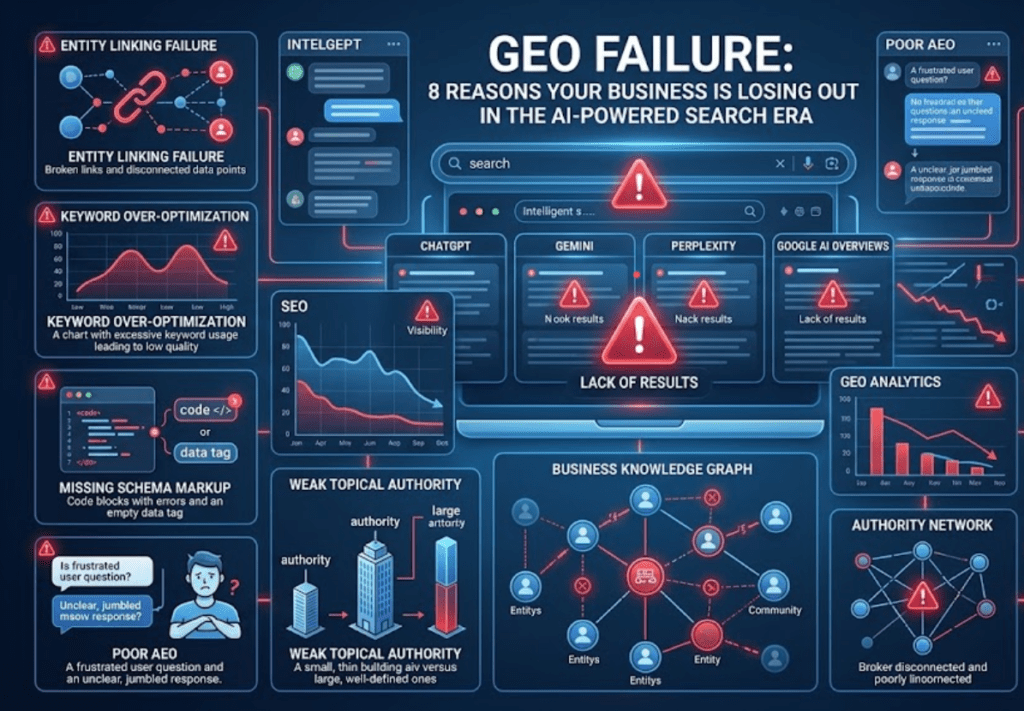
GEO Failure: 8 Reasons Your Business Is Losing Out in the AI-Powered Search Era
The digital landscape is undergoing its most significant shift since the invention of the search engine. Traditional SEO is rapidly evolving into Generative Engine Optimization (GEO). Businesses that continue relying on outdated search strategies risk becoming invisible to AI-powered discovery platforms such as ChatGPT, Gemini, Perplexity, and Google AI Overviews.
1. Neglecting Entity Linking
Modern AI search engines rely heavily on entities to understand content. An entity can be a brand, person, company, product, service, or concept. Without clear relationships between your business and relevant industry entities, AI systems struggle to understand your expertise.
Building Semantic Relationships
Entity linking helps AI models connect your brand with established topics and concepts. Strong semantic relationships increase trust and improve visibility across AI-generated answers.
- Associate your brand with industry-specific terminology.
- Use consistent naming conventions across platforms.
- Connect related topics through internal linking.
- Build topic clusters around core business themes.
2. Over-Optimizing Keywords
Keyword stuffing is no longer effective. AI systems focus on meaning, context, and user intent rather than simple keyword repetition.
Understanding the GEO Definition can help businesses move beyond outdated SEO practices and embrace semantic optimization.
Focus on User Intent
Instead of repeating the same keyword dozens of times, create content that comprehensively answers user questions and solves real problems.
3. Lack of Structured Data (Schema)
Structured data helps search engines and AI systems understand the meaning of your content. Without schema markup, your content becomes harder for machines to interpret accurately.
Businesses learning How Does GEO Work quickly discover the importance of machine-readable content structures.
Why Schema Matters
- Improves AI understanding.
- Supports rich search results.
- Strengthens knowledge graph associations.
- Enhances content discoverability.
4. Poor Answer Quality (AEO Failure)
AI systems prefer direct answers. If users need to read multiple paragraphs before finding the answer, your content becomes less useful for Answer Engine Optimization (AEO).
Create Direct Answers First
Answer the question immediately and then expand with supporting details, examples, and explanations.
- Use concise introductions.
- Include FAQ sections.
- Provide clear definitions.
- Structure answers logically.
5. Weak Topical Authority
Topical authority is becoming one of the strongest signals in GEO. Publishing isolated articles is no longer enough.
Understanding the relationship between GEO vs SEO reveals why topical depth is essential for long-term visibility.
Build Content Clusters
Create interconnected articles around a central topic and support them with internal links. This helps AI systems recognize your website as an authority source.
6. Ignoring Content Freshness
AI systems increasingly value fresh and updated information. Outdated content can reduce trustworthiness and citation opportunities.
Businesses that regularly update content often perform better when implementing strategies on How to Optimize Content for GEO.
Maintain Content Relevance
- Update examples regularly.
- Refresh statistics.
- Review outdated information.
- Expand content depth.
7. Inconsistent Brand Voice
AI systems compare information across multiple sources. Inconsistent messaging creates confusion and weakens trust signals.
Maintain Consistency Everywhere
Your website, social media profiles, business listings, and published content should communicate the same core message and expertise.
- Use consistent brand descriptions.
- Standardize service explanations.
- Align messaging across channels.
- Maintain factual accuracy.
8. Ignoring Internal Linking
Internal linking remains one of the most overlooked GEO strategies. Without proper internal links, AI systems may struggle to understand relationships between pages.
Businesses should regularly review important GEO Ranking Factors and connect related content through contextual internal links.
Create a Strong Content Network
- Link pillar pages to supporting content.
- Use descriptive anchor text.
- Avoid orphan pages.
- Strengthen topical clusters.
Related GEO Articles
About the Author
Soumyaditya Biswas is an SEO, AEO, GEO, and AI Search Optimization enthusiast focused on helping businesses improve visibility across traditional search engines and AI-powered discovery platforms.
Conclusion
GEO is rapidly becoming an essential component of modern digital marketing. Businesses that fail to adapt risk losing visibility in AI-powered search experiences. By focusing on entity optimization, structured data, topical authority, content freshness, and internal linking, organizations can significantly improve their chances of becoming trusted sources for AI-generated answers.
The future of search belongs to brands that help AI systems understand, trust, and confidently reference their content.
Pingback: What Is Technical SEO? Complete Guide for Beginners (2026)
Pingback: Technical SEO Checklist: 25 Essential Steps for Better Rankings
Pingback: Technical SEO Audit Checklist: 30 Essential SEO Checks for 2026
I have been searching for a reliable gaming spot and finally found my perfect match here. The mobile app works like a dream on my phone and the live dealer tables feel so alive. Customer service is always ready to help with a friendly smile. This is exactly what I needed for my downtime. vn79king12
Thank you for your feedback