
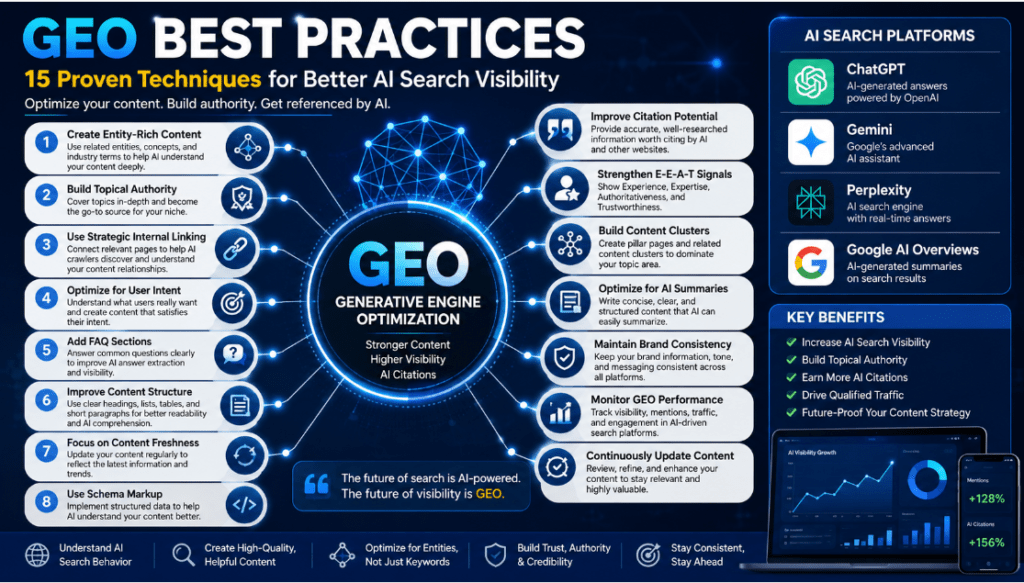
GEO Best Practices: 15 Proven Techniques for Better AI Search Visibility
Artificial intelligence is reshaping how users discover information online. Search is no longer limited to traditional search engine result pages. Platforms such as ChatGPT, Gemini, Perplexity, and Google AI Overviews increasingly provide direct answers, summaries, and recommendations to users.
As this shift accelerates, businesses must adapt their content strategies. Generative Engine Optimization (GEO) helps websites become more understandable, trustworthy, and useful for AI systems. The stronger your GEO implementation, the higher the probability of your content influencing AI-generated answers.
In this guide, we explore the most important GEO best practices that can improve AI visibility and strengthen your long-term search presence.
Table of Contents
- What Are GEO Best Practices?
- Why GEO Best Practices Matter
- Best Practice #1: Create Entity-Rich Content
- Best Practice #2: Build Topical Authority
- Best Practice #3: Use Strategic Internal Linking
- Best Practice #4: Optimize for User Intent
- Best Practice #5: Add FAQ Sections
What Are GEO Best Practices?
GEO best practices are techniques that help AI systems understand, evaluate, and reference your content more effectively. Unlike traditional SEO, which focuses primarily on rankings, GEO focuses on helping AI engines understand context, entities, expertise, and topical relationships.
If you are unfamiliar with the basics, start by understanding the GEO Definition before implementing advanced optimization strategies.
Why GEO Best Practices Matter
AI-powered search systems increasingly influence how users discover information. Rather than presenting ten blue links, modern AI systems synthesize information from multiple sources and generate direct responses.
Businesses that implement GEO best practices gain advantages including:
- Higher AI visibility
- Improved topical authority
- Better citation opportunities
- Enhanced user trust
- Future-ready search performance
Understanding How Does Generative Engine Optimization Work helps explain why these practices matter in modern search ecosystems.
Best Practice #1: Create Entity-Rich Content
Entities are one of the foundations of AI understanding. Search engines and AI systems use entities to connect concepts, organizations, people, and products.
How Entity Optimization Works
Instead of focusing only on keywords, include related concepts naturally throughout your content. When discussing GEO, relevant entities may include AI search, ChatGPT, Gemini, Perplexity, digital marketing, content optimization, and knowledge graphs.
- Use industry-specific terminology.
- Mention relevant tools and concepts.
- Build semantic relationships naturally.
- Avoid keyword stuffing.
Best Practice #2: Build Topical Authority
AI systems trust websites that consistently publish valuable content around a specific topic.
A strong topical authority strategy involves creating a cluster of interconnected articles covering every aspect of a subject.
For example, your GEO cluster already includes:
- What Is GEO
- GEO Definition
- How GEO Works
- GEO Ranking Factors
- How to Improve GEO
This content ecosystem signals expertise and trustworthiness.
Best Practice #3: Use Strategic Internal Linking
Internal links help AI systems understand how pages relate to each other.
For example, readers interested in GEO fundamentals may benefit from reading the comparison between GEO vs SEO to understand how AI search optimization differs from traditional SEO.
Benefits of Internal Linking
- Improved crawlability
- Stronger topical clusters
- Enhanced user experience
- Better authority distribution
Best Practice #4: Optimize for User Intent
AI systems prioritize content that satisfies user intent. Before creating content, ask what users truly want to know.
Different intents include:
- Informational
- Commercial
- Transactional
- Navigational
The better your content aligns with intent, the more useful it becomes for both users and AI systems.
Best Practice #5: Add FAQ Sections
Frequently Asked Questions help AI systems identify concise answers that can be surfaced in AI-generated responses.
Businesses implementing How to Optimize Content for GEO often discover that FAQ sections improve content clarity and answer extraction.
- Answer common questions directly.
- Use natural language.
- Keep answers concise.
- Support answers with detailed explanations where necessary.
Best Practice #6: Improve Content Structure
Content structure plays a major role in GEO. AI systems prefer information that is easy to scan, understand, and summarize. A poorly structured article may contain valuable insights but still fail to gain visibility because AI models struggle to identify the most important information.
Use Clear Heading Hierarchy
Organize content using a logical hierarchy:
- H1 for the main topic
- H2 for major sections
- H3 for supporting subsections
- Bullet points for readability
- Short paragraphs for easier comprehension
A clean structure improves both user experience and AI interpretation.
Best Practice #7: Focus on Content Freshness
Fresh content is a strong trust signal. AI systems prefer information that reflects current trends, technologies, and best practices.
One reason businesses experience poor AI visibility is that they fail to update existing content regularly. Reviewing and refreshing articles can significantly improve citation potential.
How to Keep Content Fresh
- Update outdated statistics
- Add new examples
- Refresh screenshots
- Expand thin sections
- Include emerging trends
Many of the mistakes discussed in GEO Failure: AI Search Mistakes can be avoided simply by maintaining content freshness and accuracy.
Best Practice #8: Use Schema Markup
Schema markup helps search engines and AI systems understand the meaning behind your content. It provides structured information about articles, FAQs, organizations, authors, products, and other entities.
Important Schema Types
- Article Schema
- FAQ Schema
- Organization Schema
- Breadcrumb Schema
- Author Schema
Structured data acts as a machine-readable layer that improves AI understanding and content discoverability.
Best Practice #9: Improve Citation Potential
One of the primary goals of GEO is increasing the likelihood that AI systems reference your content when generating answers.
How to Become More Citation-Worthy
- Use factual information
- Provide detailed explanations
- Support claims with evidence
- Answer questions directly
- Build topical authority
The stronger your expertise signals, the more likely AI systems will trust and reference your content.
Best Practice #10: Strengthen E-E-A-T Signals
Experience, Expertise, Authoritativeness, and Trustworthiness (E-E-A-T) remain important in both SEO and GEO.
AI systems increasingly evaluate credibility indicators when determining which information deserves visibility.
Ways to Improve E-E-A-T
- Publish expert-driven content
- Maintain author profiles
- Show real-world experience
- Provide accurate information
- Build a consistent publishing history
Many recommendations from How to Improve Generative Engine Optimization directly contribute to stronger E-E-A-T signals.
Best Practice #11: Build Content Clusters
Rather than publishing isolated articles, create interconnected content clusters that comprehensively cover a topic.
Benefits of Content Clusters
- Stronger topical authority
- Improved internal linking
- Better AI understanding
- Enhanced user navigation
Your growing GEO content hub is a practical example of a content cluster strategy in action.
Best Practice #12: Optimize for AI Summaries
AI-generated answers often summarize information from multiple sources. Content that is easy to summarize has a greater chance of influencing these responses.
How to Improve Summarization Potential
- Answer questions directly
- Use concise definitions
- Include key takeaways
- Use lists and tables where appropriate
- Structure content logically
Businesses studying GEO Ranking Factors quickly discover that readability and clarity significantly impact AI interpretation.
Similarly, implementing recommendations from How to Optimize Content for GEO can improve content quality and increase the likelihood of being included in AI-generated summaries.
Best Practice #13: Maintain Brand Consistency
AI systems evaluate information from multiple sources before generating answers. If your website, social media profiles, business listings, and published content present conflicting information, AI systems may struggle to trust your brand.
How to Maintain Brand Consistency
- Use the same business name across all platforms.
- Maintain consistent service descriptions.
- Keep contact information updated.
- Align messaging across channels.
- Build a recognizable brand identity.
Consistency strengthens trust signals and improves the likelihood of being referenced by AI-powered search systems.
Best Practice #14: Monitor GEO Performance
Generative Engine Optimization is not a one-time activity. Businesses must continuously monitor how their content performs across traditional and AI-driven search environments.
Important GEO Metrics
- Organic visibility
- Entity mentions
- Referral traffic
- User engagement
- Topical authority growth
- AI citation opportunities
Regular analysis helps identify strengths, weaknesses, and opportunities for improvement.
Best Practice #15: Continuously Update Content
Search behavior evolves constantly. AI models continue learning and adapting to new information.
Businesses that consistently improve content often outperform competitors who publish once and never update their resources.
Content Update Checklist
- Review articles every 3-6 months.
- Refresh outdated information.
- Add new industry developments.
- Expand FAQ sections.
- Improve internal linking.
Continuous improvement is one of the most overlooked GEO best practices.
Common GEO Mistakes to Avoid
Even well-intentioned businesses can make mistakes that reduce AI visibility.
Most Common GEO Mistakes
- Publishing thin content.
- Ignoring user intent.
- Weak internal linking.
- Poor content structure.
- Lack of topical authority.
- Inconsistent entity optimization.
- Outdated information.
- Missing schema markup.
Many of these issues are discussed in greater detail within GEO Failure: AI Search Mistakes.
Frequently Asked Questions (FAQ)
What are GEO best practices?
GEO best practices are optimization techniques that help AI systems understand, trust, and reference your content more effectively. They focus on topical authority, entity optimization, user intent, content quality, and AI visibility.
Why are GEO best practices important?
As AI-powered search becomes more popular, businesses need strategies that improve discoverability beyond traditional rankings. GEO helps increase visibility within AI-generated answers and recommendations.
How does GEO differ from traditional SEO?
SEO primarily focuses on rankings within search engines, while GEO focuses on helping AI systems understand and utilize content effectively. Understanding GEO vs SEO provides deeper insight into these differences.
Does internal linking help GEO?
Yes. Internal linking helps AI systems understand relationships between content pieces, strengthens topical authority, and improves user navigation.
What is the fastest way to improve AI visibility?
The fastest improvements often come from publishing high-quality content, building topic clusters, improving internal linking, and implementing strong entity optimization strategies.
How often should GEO content be updated?
Most GEO content should be reviewed and updated every three to six months to maintain freshness and relevance.
Related GEO Articles
About the Author
Soumyaditya Biswas is an SEO, AEO, GEO, and AI Search Optimization enthusiast focused on helping businesses improve visibility across traditional search engines and AI-powered discovery platforms. Through practical SEO strategies, content optimization, and AI search research, he helps organizations prepare for the future of search.
Conclusion
The future of search is increasingly influenced by artificial intelligence. Businesses that rely only on traditional SEO strategies may struggle to remain visible as AI-powered platforms become more important sources of information discovery.
Implementing these GEO best practices helps create content that is easier for AI systems to understand, trust, and reference. From entity optimization and topical authority to internal linking, content freshness, and structured data, every element contributes to stronger AI visibility.
Organizations that invest in Generative Engine Optimization today will be better positioned to attract users, strengthen authority, and improve discoverability across ChatGPT, Gemini, Perplexity, Google AI Overviews, and future AI-powered search systems.
GEO is not replacing SEO—it is expanding the way businesses approach digital visibility. The most successful brands will combine SEO, AEO, and GEO strategies to build a comprehensive search presence that performs across both traditional and AI-driven search experiences.
Pingback: What Is Technical SEO? Complete Guide for Beginners (2026)
Pingback: Technical SEO Checklist: 25 Essential Steps for Better Rankings
Pingback: Technical SEO Audit Checklist: 30 Essential SEO Checks for 2026
Pingback: What Is a Website Audit? Complete SEO Audit Guide for 2026