

Website Development Cost in India (2026): How Much Does a Business Website Cost?
Look, let’s break the illusion right here.
When three different people hand you three wildly different numbers for a “website”—one freelancer saying ₹20,000, an agency sitting at ₹85,000, and some specialized setup throwing ₹2,50,000 at your face—your brain doesn’t freeze because of the math. It freezes because nobody is telling you what’s actually burning under the hood.
Why does this happen?
Because two people can write the exact same word on a PDF proposal—“Website”—and mean two completely different species of engineering. One is giving you a pre-built template with six pages pasted together over a weekend. Look now here is the other is building a performance engine designed to handle real traffic, security headers, Core Web Vitals, and conversion funnels.
And here is most important point where actually the most founders shoot themselves in the foot: they treat a website quotation like buying a bag of cement. They think cement is cement, so whoever sells it cheapest wins.
Ask your own heart—when you go to a roadside stall and buy a ₹10 bowl of Maggi, do you sit there expecting the nutrition, kitchen standards, and dining experience of a full restaurant? Of course not. You know exactly what ₹10 bought you. Yet when it comes to web development, business owners drop ₹20,000 and expect an enterprise lead machine, then act shocked when the site crashes, loads like a snail on mobile, or brings in zero business.
That isn’t bad luck. That’s just the natural law of cause and effect (Karma-phala). You get what the architecture was designed to yield.
If you are typing “Website Development Cost in India” into Google, you aren’t looking for a sterile textbook price chart. You are sitting with operational anxiety, asking:
- How much capital do I actually need to keep aside without bleeding my cash flow?
- Why are these agency quotes bouncing around like wild stock prices?
- Is standard WordPress completely fine, or am I being tricked into paying for custom code I don’t need?
- Should I trust a solo freelancer who might disappear next month, or an agency that charges for overhead?
Let’s look at how the capital actually breaks down in the real Indian market—without the corporate fluff.
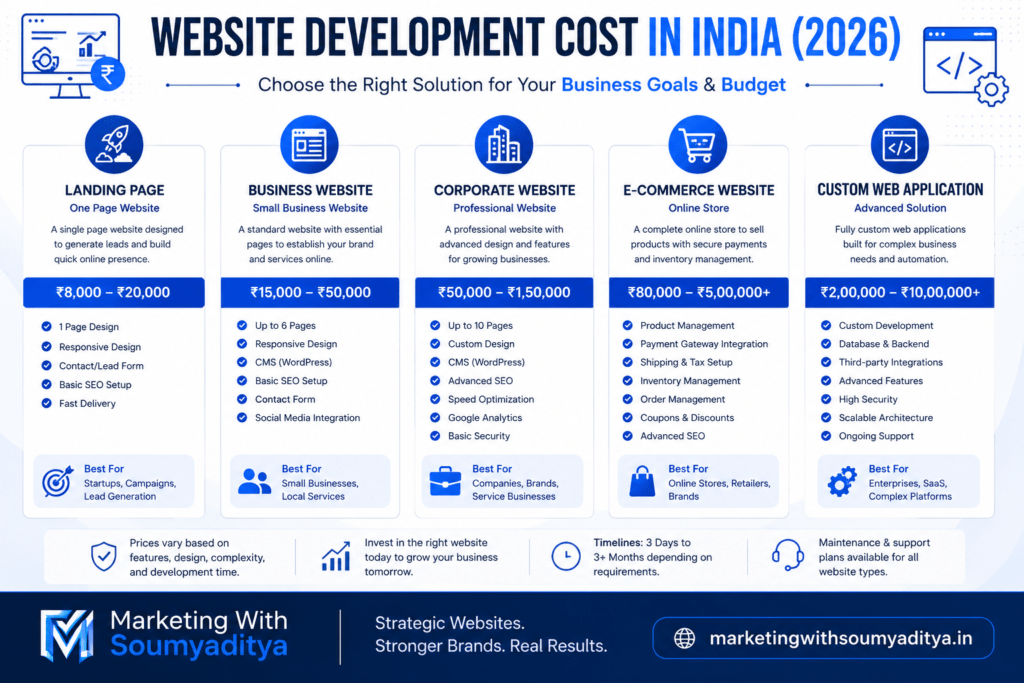
The Operational Breakdown: What the Money Actually Buys
The ₹15,000 to ₹30,000 Tier: The Operational Baseline
This is freelancer territory or micro-setup work. You’re getting a standard pre-built theme, basic page layout, a contact form, and standard mobile responsiveness. It gives you a digital address. That’s it.
If your only goal is so that when a local client googles your company name, you don’t look non-existent, fine. But don’t expect deep technical SEO, custom schema markup, conversion rate optimization, or speed tuning here. There is simply no room in that margin for real engineering time.
The ₹50,000 to ₹1,00,000 Tier: The Strategic Testing Ground
This is where growing Indian businesses usually land—not always because they lack capital, but because of human risk management. Traditional business owners have been burned before by scattered freelancers who delivered a broken layout and ghosted their calls.
So they enter here to test the setup: Are they transparent? Do they understand our buyer persona? Is the page speed actually fast on 4G networks?
Here, you aren’t just paying for layout. You are paying for UI/UX strategy, proper page architecture, security setups, speed optimization, and actual communication.
The ₹2,00,000+ Tier: The Performance & Scalability Engine
At this level, you aren’t buying pages. You are buying total risk reduction and enterprise scalability. Custom backend integrations, high-concurrency databases, tailored user journeys, advanced analytics tracking, and continuous post-launch support.
The client isn’t asking “how many pages will I get?” They are asking “how does this architecture protect our conversion rates and scale with our revenue?”
A cheap quote isn’t automatically a bargain, and an expensive quote isn’t automatically a guarantee of quality. The real question you need to ask isn’t “Which quotation is the lowest?”
Look my friends now the real question is: “Does this specific technical build match my current stage of business, and am I paying for real engineering value or just empty promises?”
Understand the technical cause, respect the financial effect, and make a decision that keeps your business sanity intact for the long haul.
How Much Does Website Development Cost in India?
Look, if someone tells you a business website in India costs anywhere between ₹15,000 and ₹5,00,000+, your brain naturally freezes. You sit there thinking: Are these agencies just throwing random numbers at the wall to see who falls for it?
But let’s pause for a second and look at what is actually burning under the hood.
A “website” isn’t a bag of cement with a fixed MRP stamped on the side. You just want a basic digital address so local clients know you exist? Fine, that’s ₹15,000 to ₹50,000. But the moment you start talking about real page architecture, technical SEO, conversion paths, and site speed on a patchy 4G connection in semi-urban India—now you’re standing in front of a ₹50,000 to ₹1,50,000 setup.
What if you want to sell products online? Plug in WooCommerce, Shopify, inventory sync, and payment gateways—boom, the build complexity spikes from ₹80,000 to easily ₹5,00,000+. Build a custom web app, SaaS platform, or something with heavy third-party API integrations? Crossing ₹2,00,000 is completely normal.
Why? Because you aren’t paying for “pages.” You are paying for the human engineering hours required to make those pages actually do work for your business instead of sitting dead on the web.
The Surface Delusion: Why Two Quotes Look Identical
And here is where every business owner gets trapped. Two proposals land on your desk. Both say: “5-Page Business Website with Contact Form.”
One freelancer quotes ₹18,000. An agency quotes ₹85,000. On paper, they look like identical twins.
But ask your own heart—when you buy a ₹10 packet of instant noodles at a roadside stall, do you sit there expecting the nutritional depth, kitchen standards, and service of a proper sit-down restaurant? Of course not. You know exactly what ₹10 bought you.
In web development, Karma-phala—the law of cause and effect—works with total precision:
- That ₹18,000 build usually means somebody bought a cheap ₹2,000 pre-made theme, swapped out the text, didn’t touch image compression, ignored mobile breakpoints, left security headers wide open, and handed you the keys.
- That ₹85,000 build usually means somebody actually sat down, researched your industry, structured the user journey, wrote clean code, optimized database queries, secured the backend against brute-force attacks, and made sure the page loads in under two seconds on a cheap smartphone.
You aren’t paying for the digital skin on top; you’re paying for the technical architecture underneath.
Direct Answers to the Operational Questions
So how do you actually allocate your hard-earned capital without bleeding cash flow? Let’s cut through the usual fluff and address what founders bounce around when making decisions.
“What is the real average cost I should plan for?” Look at where your business stands right now. You just need a clean baseline so clients don’t think you’re a fake entity? Keep ₹15,000 to ₹50,000 aside. You want a site that actively pulls in leads, ranks on search engines, and builds authority? Budget ₹50,000 to ₹1,50,000. Complex transactions or custom portal logic? Prepare for ₹80,000 and above.
“Why do agency prices bounce around like wild stock prices?” Because scope isn’t page count. A static text page takes two hours. A page with custom interactive calculators, dynamic schema markup, multi-layer filtering, and custom mobile layouts takes twenty hours of engineering time. A higher quote usually reflects deeper technical preparation, better security standards, and actual testing—not an agency trying to rob you.
“Should I hire a freelancer or go with an agency?” It comes down to pure human risk management. A skilled freelancer saves you money upfront if your project is simple and you have the technical knowledge to guide them. But ask yourself this simple question: If your site crashes on a Sunday night right in the middle of a paid ad campaign, who is answering your call to fix it?
Agencies cost more because you aren’t paying one person—you’re paying for a multidisciplinary system: designers, developers, technical SEOs, copywriters, and operational continuity so you don’t lose sleep.
“Is WordPress always the cheapest way out?” Not always. WordPress keeps entry costs low because of its massive ecosystem. But if you force WordPress to handle complex, non-standard business logic by stacking 40 different plugins together, your site will eventually turn into a bloated, slow mess that breaks every time a plugin updates. At that point, a clean custom stack or headless build is actually far cheaper over a three-year window.
“How do I avoid getting cheated or overpaying?” Stop looking only at the single final number on the last page of the PDF. Open the proposals side-by-side on your desk and audit the line items:
- Do you explicitly own the domain, hosting, and source code?
- Is basic security (SSL, firewall, automated backups) written down in the agreement?
- Are Core Web Vitals and mobile page speed performance guaranteed in writing?
- What does post-launch maintenance actually cover after the site goes live?
A slightly higher quotation with clear technical accountability will save you far more capital than a cheap build that forces you to throw everything in the trash and rebuild six months down the line.
Match your budget to where your business actually stands today, demand total transparency on what is being engineered under the hood, and make the choice that keeps your business sanity completely intact.
Website Development Cost in India by Website Type (2026)
Look, before someone tries to sell you a “website” or hands you a shiny PDF proposal, let’s stop and cut straight through the noise.
Why is one freelancer asking for ₹15,000 while an agency throws a ₹5,00,000 quotation right at your face? Are they just gambling with numbers? Is it pure greed? Or is there something else burning under the hood that nobody is telling you?
Ask your own heart—if a local clinic in Nadia, a B2B industrial factory, an online clothing brand, and a tech startup all walk into a room, can they use the exact same digital build?
Obviously not. So why do business owners keep asking the same lazy question: “How much does a website cost?”
When you ask a lazy question, you get trapped. It’s that simple.
You fall into one of two expensive traps. What traps? Either you over-engineer and burn precious capital on custom code you don’t even know how to use, or you buy a ₹10,000 cheap theme that looks fine for three days—until twenty people try submitting an inquiry at the same time on a patchy 4G connection, the server chokes, and leads vanish into thin air.
Is that bad luck? No. That’s pure cause and effect (Karma-phala). You get what the underlying architecture was engineered to yield.
Ground-Level Reality: Budget Tiers by Business Engine
Let’s look at how the capital actually breaks down across the Indian market. These aren’t textbook MRPs—this is raw market data based on what is actually being built under the hood:
Website Category | Realistic Budget Range (India) | What It’s Actually Built For |
Landing Page | ₹5,00,0 – ₹20,000 | Targeted performance ad campaigns, specific product drops, quick lead capture. |
Portfolio Website | ₹10,000 – ₹30,000 | Freelancers, consultants, architects, creative professionals building immediate visual trust. |
Small Business Website | ₹15,000 – ₹50,000 | Local clinics, retail shops, regional service providers needing a clean digital address and contact hub. |
Corporate Website | ₹50,000 – ₹1,50,000 | B2B firms, industrial suppliers, SMEs needing deep authority, structured service flows, and lead funnels. |
WordPress Business Build | ₹25,000 – ₹1,50,000 | Companies needing content flexibility, regular blog updates, custom dynamic fields, and scalable SEO architecture. |
E-commerce Platform | ₹80,000 – ₹5,00,000+ | D2C retail brands, online stores needing payment gateways, inventory sync, and conversion-optimized checkouts. |
Custom Web Application | ₹2,00,000 – ₹10,00,000+ | SaaS platforms, multi-vendor marketplaces, enterprise portals requiring custom backend workflows and high concurrency. |
The Surface Delusion: Why Two Quotes Look Identical
Wait, why does an e-commerce site cost ₹90,000 at one place and ₹3,50,000 somewhere else when both proposals literally read: “Online store with product catalog and payment gateway”?
Is Agency B just trying to rob you? Or are you staring at the digital skin on top while completely ignoring the 80% living underwater?
Ask yourself again—when you buy a ₹10 packet of instant noodles at a roadside stall, do you sit there expecting the nutritional depth, kitchen sanitation, and service of a proper sit-down restaurant?
Of course not. You know exactly what ₹10 bought you.
So why expect an enterprise performance engine out of pocket change?
- The ₹90,000 build usually means installing a stock template, slapping on standard payment plugins, ignoring image compression, leaving security open, and praying the database doesn’t crash during a holiday sale.
- The ₹3,50,000 build usually means someone sat down and engineered custom checkout workflows, real-time inventory/ERP sync, automated multi-carrier shipping calculations, database query optimization, brute-force security hardening, and sub-two-second load times on a budget smartphone.
You aren’t paying for the pixels on the screen. You are paying for the technical architecture underneath.
Stop chasing the lowest number at the bottom of the PDF just to save a few thousand rupees upfront. Open the proposals side-by-side on your desk, audit the technical line items line-by-line, and ask yourself what operational engine your business actually needs to survive.
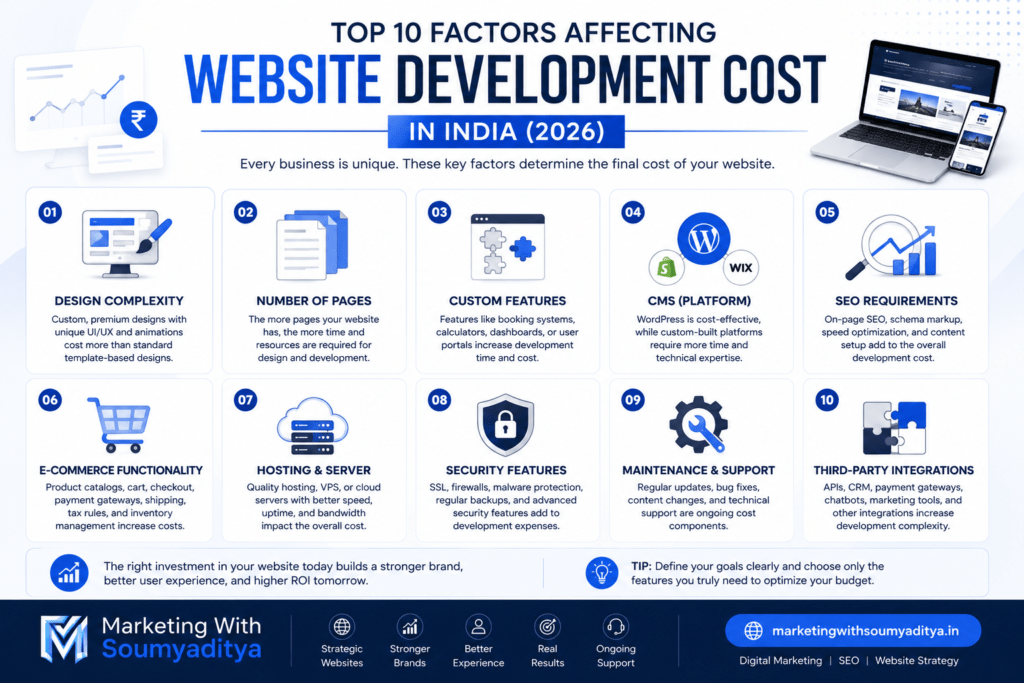
What Actually Determines Website Development Cost in India?
Look, when three proposals land on your table—one saying ₹25,000, another asking ₹90,000, and a third throwing ₹2,50,000 right at your face—what is your immediate reaction?
Confusion. Panic. You sit there thinking someone is trying to rob you blind, or that you just stumbled onto an unbelievable bargain in the cheap option.
But let’s pause. Look at what is actually burning under the hood.
Why do two people write the exact same word on a PDF—“Website”—and quote numbers that are light-years apart? Is it pure greed? Or is it because they are engineering two completely different species of machinery?
Ask your own heart: if you tell a contractor you want to “build a structure,” does a basic one-room security cabin cost the same as a three-story commercial setup with smart wiring, heavy security systems, and high-load foundations?
Obviously not. So why do business owners treat digital code like it’s a standardized brick with a fixed MRP?
Look at a local dental clinic in Nadia. What do they actually need? Clean doctor profiles, clinic timings, appointment details, and a contact button so a patient can find them on Google. It’s an operational baseline—a digital credibility card so patients know they aren’t dealing with a fake setup.
Now look across the table at an online furniture brand.
Suddenly, you aren’t just showing static text on a screen. You’re dealing with live inventory tracking, secure payment gateway handshakes, abandoned cart recovery, automated GST invoice generation, custom shipping weight calculators, and multi-layer product filters.
What happens if thirty people try to checkout at the exact same time on a patchy semi-urban 4G network?
If you built that store on a ₹25,000 pre-made theme held together by twelve free plugins, the server chokes, the checkout hangs, and your ad spend burns right down the drain.
Is that bad luck? No. That is just pure cause and effect (Karma-phala). You get what the underlying technical architecture was engineered to yield.
When an agency quotes ₹90,000 or ₹2,50,000, where is the capital actually going? You aren’t paying for the visual skin on the screen—you’re paying for the technical engineering living underwater where your eyes never look:
- Are they buying a ₹2,000 stock theme and swapping text, or writing clean, customized code?
- Is the platform WordPress, Shopify, or a custom stack—and can it handle your traffic without breaking on the next plugin update?
- Did anyone bother with image compression, mobile breakpoint testing, and Core Web Vitals, or does the page take six seconds to load?
- Are security headers and database protection configured against brute-force scripts?
- When something breaks on a Sunday night right in the middle of a live campaign, who is actually answering your phone call to fix it?
None of these things exist in isolation. They compound. A cheap quote isn’t automatically a bargain, just like a ₹2.5 Lakh quote isn’t automatically a guarantee of perfection.
Stop asking lazy questions like “Which agency is giving me the lowest price?”
Lazy questions lead to broken systems.
The real question you need to sit down and audit line-by-line is: “What technical engine does my business actually need at this exact stage of growth, and am I paying for genuine engineering time or just empty agency hype?”
Match your budget to where your business stands today, demand radical transparency on what’s being built under the hood, and make a decision that protects your capital and your business sanity for the long haul.
Why Does One Website Cost ₹20,000 While Another Costs ₹2,00,000?
Look, when you open your inbox and see two proposals sitting side by side—one freelancer confidently promising the world for ₹20,000, and an agency staring back at you with a ₹2,00,000 quotation—what is the first thought that hits your brain?
Panic? Suspicion?
You sit there thinking: Is the ₹2 Lakh agency just trying to finance their plush office on my budget? Or is the ₹20,000 guy running a charity?
Where does that extra ₹1,80,000 actually evaporate?
If you think the answer is simply “prettier design” or “better fonts,” let me kill that delusion right now. You aren’t paying for visual polish on a screen. You are looking at two entirely different species of business machinery.
Ask your own heart—when you buy a ₹10 cup of tea at a roadside stall, do you sit there demanding air-conditioned seating, brand-new ceramic mugs, and formal table service? Of course not. You know exactly what ₹10 bought you.
So why do business owners drop ₹20,000 on a digital skin and act shocked when it can’t perform like a full-scale corporate engine?
The Engineering Reality: ₹20,000 vs. ₹2,00,000
Let’s strip away the agency buzzwords and look at what is actually being engineered under the hood:
Feature / Dimension | ₹20,000 Website Build | ₹2,00,000 Enterprise Build |
Development Approach | Assembling a pre-made template; swapping text and images. | First-principles architecture, custom UI/UX mapping, and tailored code. |
Design Architecture | Off-the-shelf theme downloaded from a marketplace. | Unique brand system engineered for conversion psychology. |
Team Structure | Usually a single solo freelancer wearing five different hats. | Specialized specialists: UI/UX designer, backend developer, QA tester, SEO strategist. |
Features & Logic | Static informational pages and a basic contact form. | Custom backend workflows, API integrations, automated dashboards, custom logic. |
Performance Engineering | Standard plugin-based caching (if any). | Mobile-first asset compression, database query optimization, Core Web Vitals focus. |
Security Standards | Basic login protection and free SSL certificate. | Hardened server config, brute-force protection, sanitized input fields, security audits. |
Scalability Horizon | Holds up fine for static traffic; chokes under sudden load spikes. | Built on modular architecture ready for traffic scaling and database expansion. |
Post-Launch Support | Handover and goodbye; project-based or non-existent support. | Structured SLAs, active monitoring, bug fixing, and long-term maintenance. |
Does Every Business Need a ₹2 Lakh Build? Absolute Nonsense.
Now, does this table mean you should automatically run out and spend ₹2,00,000?
Not at all. Anyone who tells you that every business needs an enterprise-grade website is either ignorant or trying to sell you something you don’t need.
Look at a local bakery in your neighborhood. What do they actually need a website for?
They need clean photos of their cakes, clinic/shop timings, an address map, and a clear button that routes customers straight to WhatsApp or Zomato. That’s it. It’s a digital address card. If an agency tries to charge that bakery ₹2 Lakhs for custom microservices, automated user logins, and complex database queries, that isn’t strategy—that is pure capital destruction.
Now, turn around and look at a D2C clothing brand planning to ship thousands of orders across India.
What happens to them?
They need real-time inventory synchronization, instant payment gateway handshakes, automated GST invoice generation, custom weight-based shipping calculators, abandoned cart email triggers, and sub-two-second load times on a budget smartphone using a weak 4G connection.
What happens if that D2C brand tries to run their business on a ₹20,000 pre-made theme held together by sixteen free plugins?
The first time they run a festive ad campaign, fifty people click the link at the same time. The server chokes. The checkout hangs. Payments fail midway. The customer leaves, never to return. And your performance ad spend? Burned straight down the drain.
Is that bad luck? Is that a technical mystery?
No. That is pure cause and effect (Karma-phala). You get what the underlying technical architecture was built to yield. You cannot buy a ₹20k baseline skin and demand a ₹2L operational outcome.
Stop Asking Lazy Questions
When you compare two proposals on your desk, stop asking the lazy question: “Why is this agency charging more than that freelancer?”
Lazy questions guarantee you get trapped by whoever promises the lowest number at the bottom of a PDF.
Sit down and ask your own heart the real strategic questions:
- “What operational friction am I paying this team to solve?”
- “Does my business at its current stage actually need high-concurrency architecture, or do I just need a clean digital address?”
- “If this system breaks at 10 PM on a Sunday during a sale, who is taking responsibility for the fix?”
Sometimes the higher quotation includes technical security, speed optimization, and database architecture that saves you hundreds of thousands of rupees in lost sales down the road. Other times, the extra features are completely useless for where your business stands today.
Don’t spend money to feel premium. Don’t cut corners to feel cheap.
Audit the deliverables line-by-line, align the technical build with your real-world business objectives, and choose the engine that protects both your capital and your long-term sanity.
Website Development Packages Explained: Which One Is Right for Your Business?
By now, if you’ve been paying attention, one truth should be staring you right in the face: a business website is not a standardized product sitting on a grocery store shelf.
So why do so many business owners stare at agency package tables as if they are ordering off a fast-food combo menu?
They look at the numbers at the bottom, panic about the budget, and completely miss the operational engine hiding behind the invoice. You don’t pick a package based on how much money you feel like spending today. You pick it based on what you need the system to actually execute when a real customer lands on the page.
Let’s cut through the agency fluff and look at how these tiers break down in real-world Indian business conditions:
Package Tier | Realistic Budget Range (India) | What It’s Actually Built For |
Basic Baseline | ₹15,000 – ₹35,000 | Local businesses, solo consultants, and regional service providers needing a clean digital address and credibility hub. |
Standard Operational Build | ₹40,000 – ₹1,50,000 | Growing SMEs, corporate firms, service providers, and D2C brands needing dynamic content, lead flows, and structured SEO foundations. |
Premium / Custom Architecture | ₹2,00,000+ | SaaS platforms, enterprise portals, multi-vendor marketplaces, and complex web apps requiring custom backend logic and API handshakes. |
The Basic Baseline (₹15,000 – ₹35,000)
Let’s be brutally honest about what this tier actually is. If you run a local clinic in Nadia, a regional wholesale firm, or a solo consulting practice, your primary goal right now might just be keeping a digital heartbeat.
You need a clean layout, essential service pages, a working contact form, a WhatsApp routing button, and basic hosting setup so that when someone searches your brand name on Google, you don’t look like a ghost business.
It’s practical. It establishes basic credibility. But ask your own heart: if you spend ₹20,000 on a basic digital address card, can you sit there and demand high-concurrency performance, custom marketing funnels, or automated inventory tracking?
Of course not. That isn’t how the law of cause and effect (Karma-phala) works. You bought a digital brochure—treat it as a digital brochure and don’t expect an enterprise engine out of pocket change.
The Standard Operational Build (₹40,000 – ₹1,50,000)
This is where smart, growing Indian businesses usually settle when they realize a static page isn’t cutting it anymore. The moment your business relies on organic search traffic, regular content publishing, payment gateway handshakes, or structured lead capture, a basic template starts buckling under the pressure.
In this range, you aren’t just paying for visual layout—you are paying for actual content management systems (CMS), solid SEO architecture, mobile performance tuning, dynamic custom fields, and database structures that can expand as your business expands.
It’s the sweet spot for most small to mid-sized firms because it balances initial capital outlay with long-term operational sanity.
Premium or Custom Architecture (₹2,00,000+)
When a founder opens a quotation and sees a number starting at two lakhs or more, the knee-jerk emotional reaction is often: “Is this agency just trying to finance their luxury office on my bill?”
Wait. Look under the hood before you judge the proposal.
If you are building a SaaS platform, a high-volume marketplace, or a business that requires custom user dashboards, real-time ERP or CRM sync, automated subscription billing, or enterprise-level security protocols, you are no longer building a “website.”
You are engineering software.
The system has to be coded around your specific business logic, not squeezed into a pre-made theme downloaded off an asset store. You are paying for senior developer hours, rigorous testing cycles, security hardening, and backend stability so your system doesn’t choke during peak commercial operations.
Stop Asking Lazy Questions
When you sit down to evaluate agency proposals, kill the habit of asking the lazy question:
❌ “Which package gives me the lowest price tag?”
That question guarantees you buy the cheapest digital skin available and then burn three times the original budget trying to patch up broken plugins six months later.
Sit down and ask yourself the uncomfortable first-principles question:
👉 “Which build solves my current operational friction without forcing me to pay for bloat I won’t use for the next two years?”
Matching your business reality to the right technical build isn’t about being cheap or showing off. It’s about respecting your capital, owning the natural consequences of your choices, and keeping your business built on solid ground.
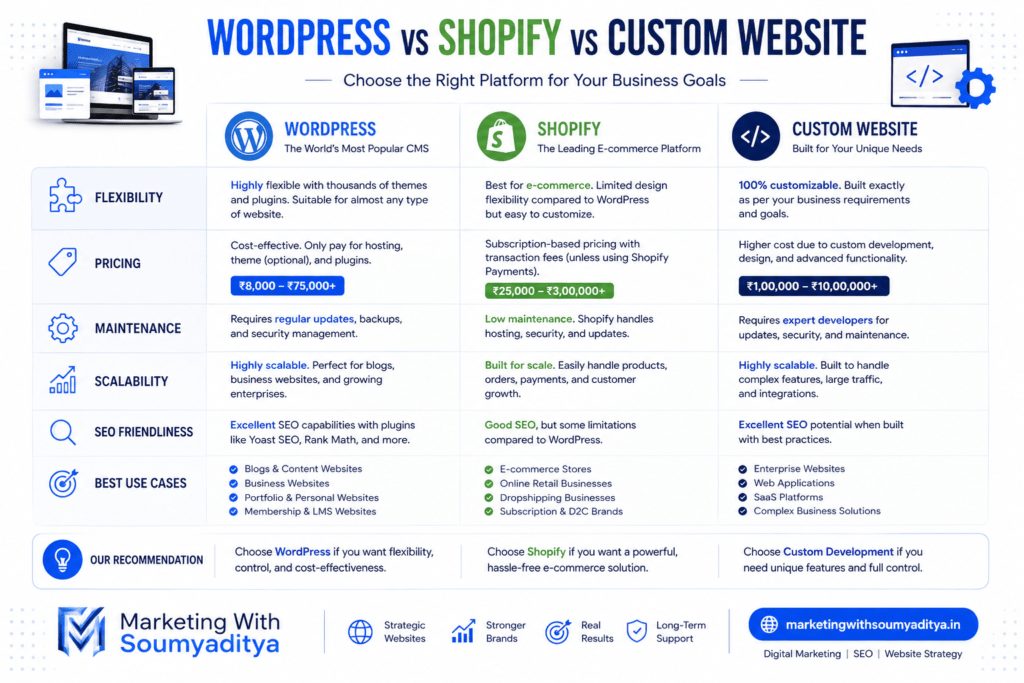
WordPress vs Shopify vs Custom Development vs Webflow: Which Platform Should You Choose?
Look, let’s kill a massive delusion floating around the Indian business market right now: the tech stack you choose is not a status symbol.
Did a freelancer tell you WordPress is obsolete and you must build on React? Did an agency promise that moving to Shopify will magically double your sales overnight? Or did someone throw the word “custom code” at you just to justify a six-figure invoice?
Ask your own heart—if you need to transport two tons of raw materials across West Bengal, do you buy a heavy-duty Mahindra truck, a family sedan, or a sports car because it looks shiny on Instagram?
Obviously not. You pick the vehicle that matches the payload.
So why do business owners pick website platforms based on hype, agency pitch decks, or what an influencer posted on LinkedIn?
Picking a platform purely because it’s popular—without looking at what your business engine actually needs day-to-day—is a direct route to capital destruction.
Ground Reality: Platforms vs. Real-World Budgets
Let’s strip away the technical jargon and look at what these platforms actually do, what they cost in the Indian market, and what you are getting under the hood:
Platform | Realistic Budget (India) | Key Advantage | What You Must Know Before Choosing |
WordPress | ₹25,000 – ₹1,50,000 | Unmatched flexibility, deep SEO control, total ownership of your content. | Needs active maintenance, caching, and security hardening—or it becomes slow and vulnerable. |
Shopify | ₹40,000 – ₹3,00,000+ | Blazing fast D2C checkout, inventory management, zero server headaches. | You are locked into their ecosystem; monthly app subscriptions stack up quickly. |
Webflow | ₹50,000 – ₹2,00,000 | Ultra-clean visual design, modern animation, pristine frontend output. | Limited backend logic; expensive hosting for high-traffic or dynamic setups. |
Custom Stack (React / Next.js / Laravel) | ₹2,50,000+ | Infinite scalability, total technical control, custom backend logic. | High upfront engineering cost, longer timelines, and total dependence on senior developers. |
What Are You Actually Buying? (The Real Operational Trade-offs)
Let’s break down these options, not by what their marketing pages claim, but by how they perform when money is actually on the line:
- When Does WordPress Make Sense?
If your business primary engine runs on generating inquiries, publishing long-form content, building deep technical SEO authority, or running a regional service firm, WordPress remains one of the most practical tools on the planet.
Why? Because you own the database. You aren’t paying a monthly software tax just to keep your pages alive, and your team can publish updates without calling a developer every single morning.
But here is the catch that agencies hide: if you install thirty free, unverified plugins, skip security configuration, and host it on a ₹100/month shared server, the site will choke, get infected with malware, and load like a snail on mobile networks.
Is that WordPress’s fault? No. That’s pure cause and effect (Karma-phala). You neglected the underlying architecture, so you inherited the outcome.
- When Does Shopify Become Mandatory?
If selling physical products online is the core heartbeat of your business, building on a non-ecommerce platform just to save a few thousand rupees upfront is an invitation to heartbreak.
Shopify handles payment gateway handshakes, checkout security, inventory sync, and order tracking straight out of the box. Yes, you pay a monthly fee, and yes, every custom feature requires an app subscription. But ask yourself: is it cheaper to pay a monthly SaaS fee, or to hire a full-time developer to manually fix broken checkout code at 11 PM during a festive sale?
For D2C brands, Shopify buys you operational sanity.
- Why Look at Webflow or Custom Engineering?
Webflow is built for brands where visual impact, sleek aesthetics, and high-end positioning dictate whether a client trusts you. It gives you agency-grade visual design without writing thousands of lines of manual HTML/CSS.
Custom development (React, Next.js, Laravel), on the other hand, isn’t even in the same category as the others.
When you build a custom web application, you aren’t building a website—you are engineering software.
If you are launching a SaaS startup, an enterprise client portal, a complex booking system, or a multi-vendor marketplace, template plugins will inevitably collapse under your operational requirements. You need custom database schemas, API handshakes, and high-concurrency server architecture.
Stop Asking “Which Platform Is Best?”
That is a lazy, surface-level question. And lazy questions lead directly to wasted budget.
If you build a ₹5 Lakh custom Next.js web application for a basic local clinic that just needs clinic hours and a contact number, you are burning capital for no reason.
Equally, if you try to run an enterprise-level SaaS platform or a high-volume marketplace on a ₹20,000 pre-made template held together by free plugins, the server will crash, users will abandon the platform, and your campaign spend goes straight down the drain.
Sit down and audit your business line-by-line:
👉 “Which platform solves my immediate operational friction today, matches my internal team’s execution capacity, and gives me room to scale over the next 24 months without a complete rebuild?”
Align your tech stack with your actual operational reality, demand total clarity on the long-term maintenance costs, and build your digital presence on solid, uncompromising ground.
Common Mistakes to Avoid When Hiring a Website Developer or Agency
Look, let me kill a massive delusion right at the start: picking the person who builds your website is not an administrative errand where you simply pick the lowest bidder on a PDF and call it a day.
You can have a solid business idea, a ready budget, and real market demand, but if you hand the keys of your digital asset to the wrong person, you are guaranteed to burn your cash flow and lose your operational sanity.
When a business owner opens three proposals and sees one freelancer offering ₹15,000, another quoting ₹60,000, and an agency asking ₹1,80,000, what is the immediate knee-jerk reaction?
They assume the ₹15,000 guy is offering a hidden bargain and the ₹1.8 Lakh team is just trying to rob them.
Ask your own heart—if you go to a local market in West Bengal to buy bricks for your building foundation, and someone offers you “bricks” at one-fifth of the market price, do you celebrate your luck? Or do you immediately stop and ask yourself: What on earth are these bricks made of? Are they going to crumble into dust the moment monsoon rain hits the wall?
So why do smart founders turn off their brains when it comes to digital engineering?
When a freelancer quotes ₹15,000 for a project that realistically takes eighty hours of skilled labor, where do you think the discount comes from? It comes directly from stripping out everything that actually makes a website work: no mobile breakpoint testing for weak 4G networks in semi-urban areas, no security hardening, no image compression, zero technical SEO structure, no schema markup, and zero post-launch accountability.
They hand you a cheap digital skin that looks okay for three days. Then the moment you launch a campaign, twenty people try to click your link at the same time, the server chokes, and leads vanish into thin air.
Is that bad luck? No. That is just pure cause and effect (Karma-phala). You cannot buy a ₹15,000 skin and demand an enterprise performance engine.
The Hidden Trapdoors: Where Founders Lose Money
Let’s cut through the usual fluff and look at the exact places where web development projects collapse in the real world:
- The Vague Scope of Work (SOW) Trap
If your contract says something as lazy as “Build a 5-page professional website similar to XYZ.com,” you haven’t hired a developer. You’ve signed up for an inevitable argument.
Vague expectations breed terrible results. What does “professional” mean? Does it include custom database queries? Does it include Core Web Vitals optimization under two seconds? Does it cover payment gateway handshakes?
If your proposal doesn’t detail page counts, exact technical stacks, dynamic fields, revision limits, security protocols, and post-launch maintenance, line-by-line, you are gambling with your capital.
- The Digital Hostage Situation (Asset Ownership)
Here is a horror story I see SME owners face every single month: a business owner hires a developer to set up their site. Two years pass, the business grows, and they decide to upgrade their infrastructure.
When they ask for access, they discover that the developer registered the domain under his own personal GoDaddy account, hosted the files on his personal server, and locked the Google Search Console keys behind his personal email.
Suddenly, you don’t own your business asset—you are a tenant in someone else’s personal account. And if that developer disappears, changes his phone number, or demands ₹50,000 to “release” your domain name, what do you do?
Demand total ownership from Day 1. Your domain, your hosting, your SSL, your GSC, your GA4, and your source code must be registered under your business credentials. Period.
- Pretty Screenshots vs. Operational Reality
Stop looking at a developer’s portfolio as if you are judging an art gallery. Prettiness on a desktop screen is cheap.
Ask the uncomfortable technical questions:
- Does this page load in under two seconds on a cheap smartphone using a weak mobile connection?
- Is the code clean, or is it held together by twenty-five free plugins that will break on the next update?
- Does this developer understand conversion flows, or did they just drop pretty pictures on a canvas?
- The Sunday Night Breakdown (Post-Launch Accountability)
What happens six weeks after launch when an automated server update breaks your contact forms, right in the middle of a paid ad campaign at 10 PM on a Sunday?
Did you clarify post-launch support in writing? Or did you foolishly assume “everything is included forever” inside a one-time payment?
Developers who offer zero post-launch maintenance agreements leave you completely stranded the moment something goes wrong. Communication, SLAs, and clear bug-fix windows matter far more than a developer’s pitch deck.
The Pre-Hiring Reality Audit
Before you transfer a single rupee of advance payment or sign an agency contract, place the proposal on your desk and run through this first-principles audit line-by-line:
- Is the Scope of Work (SOW) completely explicit? Do you have a line-by-line breakdown of every single page, dynamic integration, design revision, and technical deliverable?
- Do I understand what is omitted from the quote? Are hosting fees, domain renewals, premium plugin licenses, and copywriting clearly categorized, or hidden in the fine print?
- Will my business hold 100% ownership of all digital assets? Are domain, hosting, analytics, and codebase registered directly under your business email address?
- Have I audited live sites from their portfolio on a mobile phone? Did you test page speed and mobile responsiveness on a real mobile device, instead of just staring at static desktop screenshots?
- Are payment terms tied directly to verifiable milestones? Is your capital released step-by-step as real work is delivered, tested, and verified, rather than dumped upfront?
- Is post-launch support explicitly defined in writing? Do you know exactly how many days of bug-fixing support are included after the site goes live, and what the hourly rate is after that period ends?
- Have recurring software and server costs been mapped out? Do you know your exact annual maintenance expenditure before committing capital?
A successful website project isn’t built by hunting for the cheapest quotation at the bottom of a PDF. It is built on clear technical scope, total transparency, and a partner who treats your operational capital with respect.
Audit the proposals line-by-line, demand complete asset ownership, and make an investment decision that protects your business sanity for the long haul.
How to Choose the Right Website Development Package for Your Business
By now, if you’ve actually been paying attention, the grand illusion should be completely dead: a business website is not a digital ornament you throw onto the internet just to tell people you exist.
If your website doesn’t act as a functional, revenue-generating, or friction-reducing engine for your business, it is nothing more than expensive digital wallpaper.
Yet every single day, I watch business owners make multi-lakh decisions based on pure emotion, shiny agency pitch decks, or the frantic search for the absolute lowest quote on a PDF. Then six months later, when the site is laggy, broken, and generating zero inquiries, they want to blame “digital marketing” as a whole.
That isn’t bad luck. That is just the law of cause and effect (Karma-phala). If you plant a flawed seed, you cannot stand there and demand a healthy harvest.
Before you sign any quotation or transfer a single rupee of advance capital, sit down, strip away the agency hype, and force yourself to answer these five first-principles questions.
- What Is the Exact Operational Engine My Business Needs Right Now?
Stop giving generic answers like “I want a professional website.” What does “professional” even mean?
Ask your own heart—what specific job is this piece of software supposed to execute for your daily operations?
- Are you a local clinic in Nadia trying to get phone calls and WhatsApp booking inquiries?
- Are you a D2C brand where every millisecond of checkout lag costs you real cart abandonments?
- Are you a regional B2B manufacturer needing a structured product catalog to send to prospective distributors?
- Or are you a SaaS startup requiring secure custom user authentication and dynamic dashboards?
The moment you get crystal clear on the exact operational goal, the conversation about tech stacks and pricing stops being a guessing game.
- What Features Do I Need TODAY versus What Am I Buying Out of Vanity?
One of the fastest ways to burn your operational capital is paying an agency to build complex, over-engineered features that nobody in your business will actually touch for the next two years.
If you run a local law firm or a service consultancy, why are you paying for an automated user-login portal, a multi-vendor cart system, or custom dynamic filters on day one?
Focus entirely on the core payload:
- Clear, high-converting service messaging.
- Mobile page load times under two seconds on weak 4G networks.
- A clean, frictionless lead form or WhatsApp routing button.
Build what solves today’s friction first. Ensure the backend architecture is clean enough to expand tomorrow, but stop financing an agency’s experimental code for features you don’t even have the traffic to support.
- Am I Asking Cheap Questions or First-Principles Questions About My Budget?
When a business owner looks at three proposals and asks, “How cheaply can I get this done?”, they are practically begging to be scammed.
When you force a developer down to a bargain-basement quote, where do you think their profit margin comes from? It comes from cutting every corner that matters under the hood—skipping mobile responsiveness checks, installing bloated pirated plugins, ignoring security protocols, and dumping zero-effort boilerplate text.
Kill the cheap question. Ask the uncomfortable one:
👉 “What investment level builds a stable, secure digital asset that won’t force me to pay for a complete redesign in twelve months?”
Spending a little extra upfront to get clean code and solid architecture is cheap. Rebuilding a crashed, malware-infected site from scratch midway through a paid marketing campaign is catastrophically expensive.
- Is This Built as an Expandable System or a Dead-End Trap?
A good website should grow alongside your business revenue. Before approving any proposal, demand technical clarity on future expansion:
- If we add fifty new products or service locations next year, will the database choke?
- If we decide to integrate an automated CRM or payment gateway later, does the underlying framework allow API handshakes?
- The Ultimate Test: If this developer vanishes tomorrow or we decide to part ways, can another competent developer take over the codebase without tearing down the entire infrastructure?
If your developer is building on a proprietary, locked system where only they hold the keys, you aren’t building a business asset—you are buying a subscription to a hostaging agreement.
- Am I Hiring a Thinking Partner or an Order-Taker Who Spoons Out Fluff?
Technology changes. Frameworks come and go. But a good development partner is someone who respects your capital and speaks to you with radical transparency.
Look for a partner who:
- Doesn’t throw 100% guarantees or magical promises in your face.
- Explains technical bottlenecks in plain, human language without hiding behind buzzwords.
- Insists on a detailed, line-by-line Scope of Work (SOW) before taking your money.
- Provides milestone-based payment structures so capital is released only as real deliverables are verified.
Anyone can sell you a pretty skin. A true strategist helps you engineer a system that protects your business sanity for years.
The First-Principles Ground Reality Audit
Before you sign any contract, transfer an advance payment, or approve a proposal, put the document on your desk and run through this final audit. If you can’t check “YES” with complete clarity, do not release your capital:
Audit Point | First-Principles Reality Check | Status |
Operational Scope | Is every single page, dynamic feature, design revision limit, and technical deliverable written line-by-line in the contract? | ☐ |
Digital Asset Ownership | Are the domain, hosting, SSL certificate, GSC, GA4, and source code registered directly under your business email? | ☐ |
Mobile Breakpoint Performance | Has the proposed architecture been engineered to load in under two seconds on weak mobile 4G networks in India? | ☐ |
Technical SEO & Schema | Is foundational page structure, clean heading hierarchy, and machine-readable schema markup explicitly included? | ☐ |
Security & Maintenance | Do you know exactly what security protocols are being installed and what annual hosting/plugin renewal costs look like? | ☐ |
Milestone-Based Capital | Is your payment schedule tied directly to verifiable, testable project milestones rather than arbitrary calendar dates? | ☐ |
Post-Launch SLA | Is there a written, explicit agreement covering bug fixes and technical support window (e.g., 30-60 days) after launch? | ☐ |
Scalable Architecture | Can another independent developer take over the codebase and expand it without having to rebuild from scratch? | ☐ |
At the end of the day, you are free to pick whichever proposal you want. You can choose the cheapest quote on the table, or you can invest in a properly engineered system.
You are completely free to choose your path—but remember, you will never escape the natural outcome of that choice. Audit the work line-by-line, protect your operational capital, and build your digital presence on solid ground.
Why You Can Trust This Guide
When you look at agency proposals, the mental freeze happens because nobody is explaining the mechanics under the hood. Let’s cut straight through the usual fluff and address the exact questions founders bounce around when trying to make sense of website investments.
Ground-Level Reality: Straight Answers to Strategic Questions
“What is the real baseline cost between a basic business site and an e-commerce store?”
If your only goal is giving your business a clean digital address so local clients in Nadia or Kolkata know you exist, keep ₹15,000 to ₹50,000 aside. That gives you an operational baseline. But the moment you start talking about WooCommerce, Shopify, inventory synchronization, automated shipping calculations, and payment gateway handshakes, the build complexity spikes to ₹80,000 – ₹5,00,000+.
Why? Because you aren’t paying for “pages.” You are paying for human engineering hours to make sure your checkout doesn’t choke when thirty people try to buy at the exact same time on a weak 4G connection.
“Is WordPress really cheaper, or am I being tricked into paying for custom code?”
WordPress keeps entry costs manageable because the content management system and plugin ecosystem are mature. It’s practical for 80% of business websites. But if you try to force WordPress to handle complex, non-standard business logic by stacking forty different free plugins together, your site will eventually turn into a slow, bloated mess that breaks on every update.
Custom development (React, Next.js, Laravel) costs more upfront, but if you’re building a SaaS platform or an enterprise portal, custom architecture is the only thing that survives real traffic load.
“Should I hire a solo freelancer or go with an agency?”
It comes down to pure human risk management. A freelancer is fine if your scope is small and you have the technical knowledge to guide them line-by-line. But ask your own heart: if your site crashes at 10 PM on a Sunday night right in the middle of a paid ad campaign, who is answering your phone call to fix it?
Agencies cost more because you aren’t paying one person—you are paying for an operational system: designers, developers, SEO strategists, quality assurance testing, and post-launch continuity so you don’t lose sleep.
“What hidden ongoing costs should I prepare for?”
A website isn’t a physical signboard you print once, hang on a wall, and forget for five years. It’s a living software machine. You have annual domain renewals, hosting server fees, SSL certificates, premium plugin licenses, automated backup storage, and post-launch maintenance.
If you ignore maintenance, security headers stay open, database queries lag, and browsers eventually flag your site as unsafe to visitors.
“How long does a proper build actually take?”
A basic informational site takes 1 to 3 weeks. A structured corporate build takes 4 to 8 weeks. Custom enterprise applications take several months.
If a developer promises to deliver a fully custom, high-converting e-commerce portal in three days for ₹10,000, ask yourself what they are cutting under the hood. They are downloading a cheap stock theme, swapping text, ignoring mobile breakpoints, and handing you broken code.
“Who should actually own the domain and hosting?”
Your business. Always. 100%.
Never let a developer register your domain name or hosting account under their personal profile. That is how founders end up trapped in a digital hostage situation two years later when they want to upgrade their infrastructure. Developers should receive access keys to build the site—never ownership of your core digital assets.
“Can I just start small and upgrade the platform later?”
Yes—provided you build on a scalable foundation from Day 1. If you launch on a clean WordPress setup or modular Shopify architecture, adding new service pages, blogs, payment integrations, or product lines later is straightforward.
If you build on a cheap, locked-down proprietary platform built by a local developer using non-standard code, upgrading usually means throwing everything in the trash and starting from scratch.
“What is the single biggest mistake business owners make?”
Selecting a developer based entirely on the lowest quote at the bottom of a PDF without auditing the Scope of Work (SOW), asset ownership, mobile speed performance, or post-launch support.
The Final First-Principles Check
At the end of the day, there is no single universal price tag for web development because there is no single universal business.
A ₹20,000 build might be the exact right operational decision for a local service clinic that just needs clinic hours and a WhatsApp button. A ₹2,00,000+ investment might be completely mandatory for a growing D2C brand shipping orders across India.
Stop asking lazy questions like “Which agency gives me the lowest price?”
Lazy questions lead directly to broken systems, lost leads, and wasted capital.
You are completely free to choose whichever path you want—a cheap digital skin or a built-to-last operational engine. But remember: you will never escape the natural law of cause and effect (Karma-phala). Build on solid technical ground today, or don’t be surprised when the setup collapses tomorrow.
Pingback: Social Media Marketing Packages in India in 2026:The entire Guide