
What Is Technical SEO? The Complete Beginner's Guide for 2026
Technical SEO is the foundation of a successful website. No matter how good your content is or how many backlinks you build, your website may struggle to rank if search engines cannot properly crawl, understand, and index your pages. This is why Technical SEO plays a critical role in modern search engine optimization.
In simple terms, Technical SEO refers to the process of optimizing a website’s technical infrastructure so that search engines like Google can efficiently crawl, index, and rank its pages. It focuses on improving the backend elements of a website that directly impact search visibility, website performance, and user experience.
When users search for information online, search engines first need to discover your pages. They then analyze the content, understand its relevance, and decide whether it deserves to appear in search results. Technical SEO helps make this entire process smoother and more efficient.
A well-optimized website provides clear signals to search engines. It ensures that important pages are accessible, loading quickly, mobile-friendly, secure, and free from technical issues that could prevent rankings. This not only helps search engines but also improves the experience for visitors.
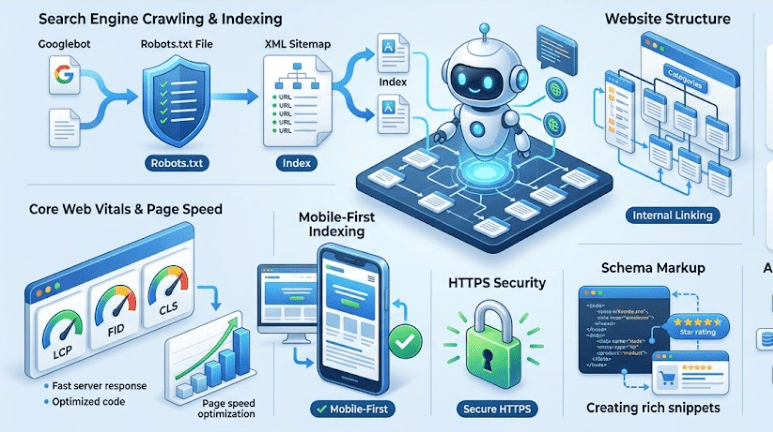
Technical SEO includes many important elements such as website crawling, indexing, XML sitemaps, robots.txt files, website architecture, page speed optimization, mobile usability, Core Web Vitals, structured data, canonical tags, HTTPS security, and internal linking. Together, these factors create a strong technical foundation that supports both content marketing and overall SEO performance.
As search engines continue to evolve, Technical SEO has become more important than ever. Google’s algorithms increasingly prioritize websites that deliver excellent user experiences while maintaining strong technical standards. Websites with technical issues often face challenges such as poor rankings, slow indexing, reduced organic traffic, and lower visibility in search results.
For businesses, bloggers, e-commerce stores, and digital marketers, understanding Technical SEO is essential for long-term success. Whether you are managing a small blog or a large enterprise website, technical optimization helps ensure that your content can be discovered and understood by search engines.
In this guide, you will learn what Technical SEO is, why it matters, how it works, and the key technical factors that can improve your website’s search performance in 2026 and beyond.
Why Is Technical SEO Important?
Technical SEO is important because it helps search engines efficiently discover, crawl, understand, and index your website. Without a strong technical foundation, even the best content may struggle to achieve high rankings in search results.
Many website owners focus heavily on content creation and link building but overlook technical issues that can prevent search engines from accessing their pages. If Google cannot properly crawl or index your website, your content may never appear for relevant searches, regardless of its quality.
Think of Technical SEO as the foundation of a house. Content represents the walls and interior design, while backlinks act as external recommendations. However, without a solid foundation, the entire structure becomes unstable. Similarly, Technical SEO provides the infrastructure that supports all other SEO efforts.
One of the biggest benefits of Technical SEO is improved crawlability. Search engines use bots, often called crawlers or spiders, to discover web pages. Technical optimization ensures these bots can navigate your website efficiently and find important pages without encountering errors.
Technical SEO also improves indexability. Indexing is the process of storing web pages in a search engine’s database. If a page is not indexed, it cannot rank in search results. Proper technical optimization helps search engines understand which pages should be indexed and which should not.
Another major advantage is better user experience. Modern search engines increasingly prioritize websites that offer fast loading speeds, mobile-friendly designs, secure connections, and smooth navigation. These factors not only improve rankings but also increase user satisfaction and engagement.
Technical SEO contributes to:
- Better crawling efficiency
- Improved indexing
- Faster website performance
- Enhanced user experience
- Higher search visibility
- Better Core Web Vitals scores
- Increased organic traffic
- Stronger search engine trust
As search algorithms become more sophisticated, Technical SEO continues to play a crucial role in determining website performance. Businesses that invest in technical optimization often gain a competitive advantage because their websites are easier for search engines to understand and rank.
In short, Technical SEO ensures that your content can be discovered, understood, and displayed to users when they search for relevant information online.
How Does Technical SEO Work?
Technical SEO works by optimizing the backend elements of a website that influence how search engines crawl, interpret, and rank web pages.
Whenever a new page is published, search engines follow a basic process:
- Crawl the page
- Understand the content
- Store the page in the index
- Evaluate ranking signals
- Display results to users
Technical SEO helps improve every stage of this process.
Step 1: Crawling
Search engine bots visit websites and discover pages through links, XML sitemaps, and other signals.
Technical SEO helps crawlers by:
- Creating XML sitemaps
- Improving website architecture
- Fixing broken links
- Managing robots.txt files
- Strengthening internal linking
When crawlability improves, search engines can discover more important pages efficiently.
Step 2: Indexing
After crawling a page, search engines decide whether it should be added to their index.
Technical SEO influences indexing through:
- Canonical tags
- Noindex directives
- Sitemap management
- Duplicate content control
- Structured data implementation
Proper indexing ensures that valuable pages become eligible to rank.
Step 3: Understanding Content
Modern search engines do more than match keywords. They attempt to understand topics, entities, relationships, and user intent.
Technical SEO supports this process through:
- Schema markup
- Structured data
- Clean URL structures
- Logical page hierarchy
- Internal linking systems
These elements help search engines interpret content more accurately.
Step 4: Performance Evaluation
Google evaluates technical factors that affect user experience, including:
- Page speed
- Mobile usability
- HTTPS security
- Core Web Vitals
- Server response times
Websites that perform well technically often provide better experiences for users and are more likely to achieve strong rankings.
Step 5: Ranking and Visibility
Once a page is crawled, indexed, and evaluated, it becomes eligible to appear in search results.
A technically optimized website gives search engines greater confidence in the site’s quality and usability. This can contribute to stronger rankings, better visibility, and improved organic traffic over time.
Technical SEO works behind the scenes, but its impact is visible across every aspect of search performance. It creates the framework that allows content, backlinks, and other SEO efforts to achieve their full potential.
Key Components of Technical SEO
Technical SEO consists of several critical components that work together to improve website performance, crawlability, and search visibility. Understanding these components is essential for building a technically optimized website that can perform well in search results.
One of the most important components is website crawlability. Search engines must be able to discover and access pages efficiently. XML sitemaps, robots.txt files, and a logical website structure help search engines navigate a website effectively.
Another essential component is indexability. Search engines need clear signals about which pages should be included in their index. Canonical tags, proper redirects, and duplicate content management play a crucial role in this process.
Website speed has also become a major ranking factor. Faster websites provide better user experiences and often achieve stronger rankings. Factors such as image optimization, caching, code minification, and server performance contribute to page speed improvements.
Mobile-friendliness is equally important. Since Google primarily uses mobile-first indexing, websites must perform well on smartphones and tablets. Responsive design and mobile usability testing help ensure a positive experience for mobile users.
Security is another key factor. HTTPS encryption protects user data and increases trustworthiness. Search engines prefer secure websites and often reward them with better visibility.
Finally, structured data and schema markup help search engines understand content more effectively. They provide context about pages, products, articles, FAQs, and other website elements, improving search appearance and AI understanding.
Together, these Technical SEO components create a strong foundation that supports both traditional SEO and AI-powered search visibility
Frequently Asked Questions (FAQ)
What is Technical SEO?
Technical SEO is the process of optimizing a website’s technical infrastructure to help search engines crawl, index, understand, and rank pages more effectively.
Why is Technical SEO important?
Technical SEO ensures that search engines can access and interpret website content correctly, improving visibility, rankings, and organic traffic.
What are the main components of Technical SEO?
The main components include crawlability, indexability, website speed, mobile optimization, HTTPS security, structured data, XML sitemaps, and internal linking.
Does Technical SEO improve rankings?
Yes. Technical SEO helps search engines understand and evaluate websites more efficiently, which can contribute to improved rankings and visibility.
What is the difference between Technical SEO and On-Page SEO?
Technical SEO focuses on website infrastructure and backend optimization, while On-Page SEO focuses on content, keywords, headings, and page-level optimization.
How does Technical SEO affect user experience?
Technical SEO improves page speed, mobile usability, navigation, and website performance, creating a better experience for visitors.
What is an XML Sitemap in Technical SEO?
An XML sitemap is a file that helps search engines discover and understand important pages on a website.
Why is page speed important for Technical SEO?
Faster websites improve user satisfaction, reduce bounce rates, and support stronger search engine performance.
What is Mobile-First Indexing?
Mobile-First Indexing means Google primarily uses the mobile version of a website for indexing and ranking purposes.
Can AI-powered search systems benefit from Technical SEO?
Yes. Technical SEO helps AI systems understand website structure, entities, relationships, and content context, improving visibility in AI-powered search environments.
Key Takeaways
- Technical SEO forms the foundation of successful SEO strategies.
- Crawlability and indexability are essential for search visibility.
- Website speed and mobile optimization significantly impact performance.
- Structured data helps search engines and AI systems understand content.
- HTTPS security improves trust and user confidence.
- Technical SEO supports both traditional search engines and AI-powered search platforms.
- A strong technical foundation enhances long-term organic growth.
Conclusion
Technical SEO is the foundation of every successful SEO strategy. While content, backlinks, and user engagement remain important, none of these efforts can reach their full potential if search engines cannot properly crawl, understand, and index your website.
A well-optimized technical foundation helps improve website performance, user experience, search visibility, and long-term organic growth. Elements such as website speed, mobile-friendliness, XML sitemaps, structured data, HTTPS security, internal linking, and proper indexing all contribute to stronger search engine performance.
As search technology continues to evolve, Technical SEO is becoming increasingly important not only for traditional search engines like Google but also for AI-powered search platforms and answer engines. Modern AI systems rely on clear website structures, entity relationships, and machine-readable information to understand and reference content accurately.
Whether you are a blogger, business owner, digital marketer, or SEO professional, investing in Technical SEO can help create a stronger online presence and improve your chances of achieving sustainable search visibility.
The key takeaway is simple: Technical SEO ensures that search engines and AI systems can access, understand, trust, and showcase your content to the right audience. By building a strong technical foundation today, you position your website for better rankings, improved user experience, and long-term success in both traditional and AI-powered search environments.
Pingback: Technical SEO Audit Checklist: 30 Essential SEO Checks for 2026
Pingback: What Is Answer Engine Optimization (AEO)? Complete Beginner's Guide
Pingback: Site Audit: Complete SEO and Website Audit Guide for 2026
Pingback: Search Engine Optimization Audit: Complete SEO Evaluation Guide1
Pingback: How AI Engines Crawl, Index, and Rank Websites:Top Technical SEO Guide 2026
Pingback: Why Most eCommerce Stores Don't Have a Traffic Problem—They Have a Data Problem