
What Is GEO in Digital Marketing? A Complete Guide to AI Search Optimization
Digital marketing continues to evolve as technology transforms the way users discover information online. For many years, Search Engine Optimization (SEO) dominated digital visibility strategies. Businesses focused on improving rankings, increasing organic traffic, and attracting users through traditional search engines.
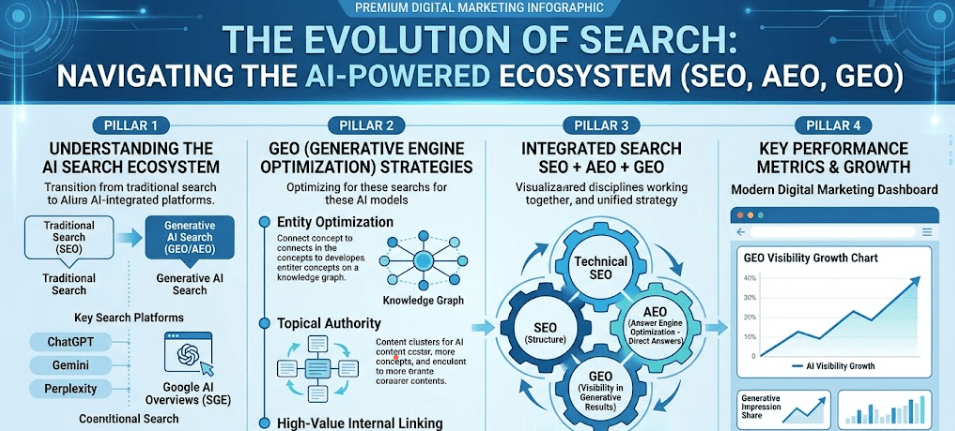
However, the emergence of artificial intelligence has created a new search environment. Platforms such as ChatGPT, Gemini, Perplexity, and Google AI Overviews now provide direct answers instead of simply displaying lists of websites.
This shift has introduced a new discipline known as Generative Engine Optimization (GEO).
Understanding GEO is becoming increasingly important for marketers, business owners, content creators, and SEO professionals who want to remain visible in AI-powered search ecosystems.
Table of Contents
- What Is GEO in Digital Marketing?
- Why GEO Matters for Digital Marketing
- How GEO Differs from Traditional SEO
- The Role of AI Search Platforms
- Benefits of GEO for Businesses
What Is GEO in Digital Marketing?
Generative Engine Optimization (GEO) is the practice of optimizing content so that AI-powered search systems can understand, trust, and utilize it when generating responses for users.
If you are new to the concept, understanding the GEO Definition provides a strong foundation before exploring its role in digital marketing.
Unlike traditional SEO, which focuses primarily on rankings within search engines, GEO focuses on increasing visibility within AI-generated answers.
The goal is simple:
- Help AI systems understand content.
- Increase AI citation opportunities.
- Improve brand visibility.
- Strengthen authority signals.
- Enhance discoverability in AI search.
As AI search adoption grows, GEO is becoming an important component of modern digital marketing strategies.
Why GEO Matters for Digital Marketing
Consumers are changing the way they search for information. Instead of browsing multiple search results, many users now ask AI assistants direct questions and expect immediate answers.
This creates both opportunities and challenges for marketers.
Businesses that understand How Does Generative Engine Optimization Work can position themselves to benefit from this shift.
The Rise of AI-Powered Search
AI systems analyze information from multiple sources and generate personalized responses. This changes the traditional customer journey.
Instead of:
- Search Query
- Search Results
- Website Click
- Conversion
Users increasingly follow this path:
- Question
- AI Response
- Recommended Source
- Conversion
Brands that appear within AI-generated responses gain significant visibility advantages.
How GEO Differs from Traditional SEO
Many marketers assume GEO is simply another version of SEO. While the two disciplines overlap, they have different objectives.
The comparison between GEO vs SEO highlights several important differences.
Traditional SEO Focuses On
- Keyword rankings
- Organic traffic
- Search engine result pages
- Technical optimization
- Backlink authority
GEO Focuses On
- AI visibility
- Entity optimization
- Topical authority
- Content understanding
- AI citation potential
Modern businesses should view GEO and SEO as complementary strategies rather than competing approaches.
The Role of AI Search Platforms
AI search platforms are becoming increasingly influential in digital marketing.
Businesses that implement recommendations from How to Optimize Content for GEO often improve their chances of appearing in AI-generated responses.
Key AI platforms include:
- ChatGPT
- Google AI Overviews
- Gemini
- Perplexity
- Future AI assistants
Each platform uses sophisticated algorithms to evaluate information quality, relevance, authority, and context.
Benefits of GEO for Businesses
Organizations that invest in GEO gain several advantages.
Many of the principles discussed in GEO Ranking Factors directly contribute to these benefits.
Improved AI Visibility
Content becomes more discoverable by AI systems.
Stronger Topical Authority
Comprehensive content clusters help establish expertise.
Better User Experience
Structured content improves readability and information retrieval.
Future-Proof Marketing Strategy
Businesses become better prepared for evolving search technologies.
Companies implementing recommendations from How to Improve Generative Engine Optimization often experience stronger long-term visibility.
Similarly, marketers can learn valuable lessons by avoiding issues discussed in GEO Failure: AI Search Mistakes.
Finally, adopting proven strategies from GEO Best Practices helps create a stronger foundation for sustainable AI search success.
How GEO Fits into a Modern Digital Marketing Strategy
Digital marketing is no longer limited to websites, search engines, social media, and paid advertising. The rise of artificial intelligence has created a new layer of visibility where businesses must optimize not only for users and search engines but also for AI systems.
GEO acts as the bridge between traditional digital marketing and AI-powered discovery. Businesses that embrace GEO are positioning themselves for the future of search.
Many of the concepts discussed in GEO Best Practices demonstrate how organizations can strengthen their AI visibility while supporting broader marketing objectives.
Key Areas Where GEO Supports Digital Marketing
- Content Marketing
- Search Engine Optimization
- Answer Engine Optimization (AEO)
- Brand Building
- Authority Development
- Lead Generation
- Customer Education
Instead of replacing existing digital marketing channels, GEO enhances them by making content easier for AI systems to discover, understand, and reference.
GEO and Content Marketing
Content remains the foundation of digital marketing. However, content created solely for keyword rankings may struggle to perform in AI-powered search environments.
Modern content should answer questions, establish authority, and provide clear contextual relationships between topics.
Content Characteristics That Support GEO
- Entity-rich content
- Comprehensive topic coverage
- Question-focused sections
- FAQ optimization
- Strong internal linking
- Structured formatting
Businesses that apply recommendations from How to Optimize Content for GEO often improve both AI visibility and user engagement.
How GEO and SEO Work Together
A common misconception is that GEO will replace SEO. In reality, the most successful businesses combine both strategies.
Traditional SEO helps users find your website. GEO helps AI systems understand and recommend your content.
The relationship explained in GEO vs SEO demonstrates why both disciplines are essential for future search success.
SEO Benefits
- Organic rankings
- Website traffic
- Search visibility
- Technical optimization
GEO Benefits
- AI visibility
- Citation opportunities
- Knowledge graph relevance
- Entity authority
Together, SEO and GEO create a stronger digital marketing ecosystem.
The Relationship Between GEO and AEO
Answer Engine Optimization (AEO) focuses on helping content appear in direct-answer environments. GEO expands this concept by helping AI systems understand and use information when generating comprehensive responses.
As AI assistants continue to evolve, the boundaries between GEO and AEO will become increasingly interconnected.
Why AEO Matters
- Featured snippets
- Voice search visibility
- Direct answer opportunities
- Improved user experience
Businesses that optimize for both GEO and AEO are often better positioned to capture emerging search opportunities.
Building Digital Authority Through GEO
Authority is becoming one of the most valuable assets in digital marketing.
AI systems prefer content from trusted sources that consistently demonstrate expertise.
Understanding GEO Ranking Factors can help businesses strengthen authority signals and improve AI citation potential.
Authority Building Techniques
- Create topic clusters.
- Publish consistently.
- Use factual information.
- Strengthen internal linking.
- Develop comprehensive resources.
These activities contribute to long-term digital visibility and trust.
The Future of Digital Marketing with GEO
The future of digital marketing will increasingly involve collaboration between humans, search engines, and artificial intelligence systems.
Businesses that ignore GEO risk losing visibility as user behavior shifts toward AI-powered discovery.
Organizations implementing strategies from How to Improve Generative Engine Optimization are preparing for this transition today.
At the same time, avoiding mistakes covered in GEO Failure: AI Search Mistakes helps ensure sustainable growth.
Digital marketers who understand GEO will have a competitive advantage as AI search continues to evolve.
Frequently Asked Questions
What is GEO in digital marketing?
GEO (Generative Engine Optimization) is the process of optimizing content so AI-powered search systems can understand, trust, and reference it when generating responses.
Is GEO replacing SEO?
No. GEO complements SEO. SEO helps users discover websites, while GEO helps AI systems understand and recommend content.
Why is GEO important for businesses?
GEO improves AI visibility, strengthens authority, increases citation opportunities, and helps businesses remain discoverable in AI-powered search environments.
How can I start implementing GEO?
Begin by creating high-quality content, building topical authority, improving internal linking, optimizing for entities, and following proven GEO best practices.
Related GEO Resources
About the Author
Soumyaditya Biswas is an SEO, AEO, GEO, and AI Search Optimization practitioner focused on helping businesses improve digital visibility across search engines and AI-powered platforms.
Connect on LinkedIn: Soumyaditya Biswas LinkedIn Profile
Advanced GEO & AEO Frequently Asked Questions
As AI-powered search continues to evolve, businesses and marketers are increasingly asking how GEO and AEO fit into their long-term digital marketing strategies. The following questions address some of the most common concerns surrounding AI visibility, citation potential, topical authority, and future search trends.
What is the difference between GEO and AEO?
Answer Engine Optimization (AEO) focuses on helping content appear as direct answers in search results, voice assistants, and answer engines. Generative Engine Optimization (GEO) goes a step further by helping AI systems understand, trust, and reference content when generating complete responses.
AEO focuses on answer extraction, while GEO focuses on AI understanding and citation opportunities.
Can GEO improve visibility in ChatGPT and Gemini?
Yes. While no business can directly control AI-generated responses, implementing GEO best practices can improve the likelihood that content is understood, trusted, and referenced by AI systems such as ChatGPT, Gemini, Perplexity, and Google AI Overviews.
Why are entities important in GEO?
Entities help AI systems understand relationships between topics, brands, organizations, products, and people. Strong entity optimization improves contextual understanding and supports AI visibility.
Does content length matter for GEO?
Content length alone is not a ranking factor. However, comprehensive content that fully answers user questions often performs better because it provides greater context and topical depth.
How many internal links should a GEO article contain?
There is no fixed number. Most high-quality GEO articles contain multiple contextual internal links that help users and AI systems navigate related content effectively.
What role does E-E-A-T play in GEO?
Experience, Expertise, Authoritativeness, and Trustworthiness help establish credibility. AI systems increasingly evaluate trust signals when determining which content deserves visibility.
Can small businesses benefit from GEO?
Absolutely. GEO is not limited to large brands. Small businesses can improve AI visibility by publishing helpful content, building authority, strengthening internal linking, and maintaining accurate business information.
What is the future of GEO?
The future of GEO will likely involve deeper integration between search engines, AI assistants, and personalized digital experiences. Businesses that begin implementing GEO strategies today will be better prepared for future developments.
AEO Quick Answers for AI Search Visibility
What is GEO?
Generative Engine Optimization (GEO) is the process of optimizing content so AI systems can understand, trust, and utilize it when generating responses.
Why is GEO important?
GEO helps improve visibility within AI-powered search environments, increasing the chances of being referenced in AI-generated answers.
What are the most important GEO factors?
- Content quality
- Entity optimization
- Topical authority
- Internal linking
- Content freshness
- Schema markup
- User intent alignment
- Trust signals
Can GEO replace SEO?
No. GEO complements SEO. Successful digital marketing strategies increasingly combine SEO, AEO, and GEO to maximize visibility.
Key Takeaways
- GEO is becoming an essential component of digital marketing.
- AI-powered search is changing how users discover information.
- Content quality and topical authority matter more than ever.
- Strong internal linking improves both SEO and GEO performance.
- Entity optimization helps AI systems understand content relationships.
- Businesses that adapt early gain a competitive advantage.
- GEO, SEO, and AEO work best when implemented together.
Final Thoughts on GEO in Digital Marketing
The digital marketing landscape is entering a new era driven by artificial intelligence. While traditional search engines remain important, AI-powered discovery platforms are changing how users interact with information online.
Generative Engine Optimization is emerging as a critical discipline for businesses that want to remain visible, relevant, and competitive. By helping AI systems understand and trust content, GEO enables organizations to participate in the future of search rather than simply reacting to it.
Throughout this guide, we explored how GEO fits within digital marketing, how it differs from traditional SEO, why topical authority matters, and how businesses can build stronger AI visibility. We also examined the growing relationship between GEO, AEO, content marketing, and authority development.
The organizations that succeed in the coming years will be those that create valuable content, establish expertise, optimize for entities, maintain strong internal linking structures, and consistently improve user experience.
AI search is not a temporary trend. It represents a long-term evolution in how information is discovered, processed, and delivered. Businesses that embrace GEO today position themselves to benefit from future advancements in AI-powered search systems.
Whether you are a business owner, digital marketer, content creator, SEO professional, or student, understanding GEO provides a valuable opportunity to stay ahead of the curve.
The future belongs to brands that are not only visible to users but also understandable to artificial intelligence.
By combining SEO, AEO, and GEO strategies, businesses can build a comprehensive digital presence that performs across traditional search engines, answer engines, and next-generation AI platforms.
As AI search continues to evolve, GEO will become one of the most important pillars of modern digital marketing. The sooner organizations begin implementing these strategies, the stronger their competitive position will be in the years ahead.
Pingback: What Is Technical SEO? Complete Guide for Beginners (2026)
Pingback: Technical SEO Audit Checklist: 30 Essential SEO Checks for 2026
Pingback: What Is Answer Engine Optimization (AEO)? Complete Beginner's Guide
Pingback: Technical SEO Tools: 15 Best Tools for SEO Audits and AI Optimization1
Pingback: Technical SEO vs On-Page SEO: Key Differences in the AI Search Era
Pingback: How Soumyaditya Biswas Built a Website Tracking Infrastructure
Pingback: The Biggest Digital Marketing Myth I Believed Before Learning Google Ads 1
Pingback: What My First 4,800 Google Search Impressions Taught Me About SEO
Pingback: What 7 Days of Google Search Console Data Revealed About My SEO Progress