
How to Optimize Content for GEO: 10 Practical Strategies for AI Search Visibility
Artificial intelligence is changing how people discover information online. Instead of relying only on traditional search engines, users are increasingly turning to AI-powered platforms such as ChatGPT, Gemini, Perplexity, and Google AI Overviews for direct answers.
As this shift continues, businesses and content creators need to think beyond traditional SEO. Ranking on Google remains important, but visibility within AI-generated responses is becoming equally valuable.
This is where Generative Engine Optimization (GEO) comes into play.
The goal of GEO is to help AI systems understand, trust, and reference your content when generating answers. In this guide, you will learn practical strategies that can improve your content’s visibility in AI-powered search environments.
Why GEO Content Optimization Matters
Traditional SEO focuses heavily on rankings and organic traffic. GEO focuses on helping AI systems understand and utilize content effectively.
When AI platforms generate responses, they often analyze information from multiple sources. Content that is structured, informative, and contextually relevant has a better chance of influencing those responses.
Businesses that optimize for GEO today may gain a competitive advantage as AI search adoption continues to grow.
Understand How AI Search Engines Read Content
Before optimizing content, it is important to understand how AI systems process information.
Context Matters More Than Keywords
Traditional SEO often emphasizes keyword targeting.
AI systems go further.
They attempt to understand:
- Meaning
- Context
- Relationships
- User intent
This means content should focus on explaining topics comprehensively rather than repeating keywords excessively
Entity Recognition Is Important
AI systems rely heavily on entities.
Examples include:
- ChatGPT
- SEO
- Digital Marketing
- Generative Engine Optimization
Using relevant entities naturally throughout content helps AI understand the topic more accurately.
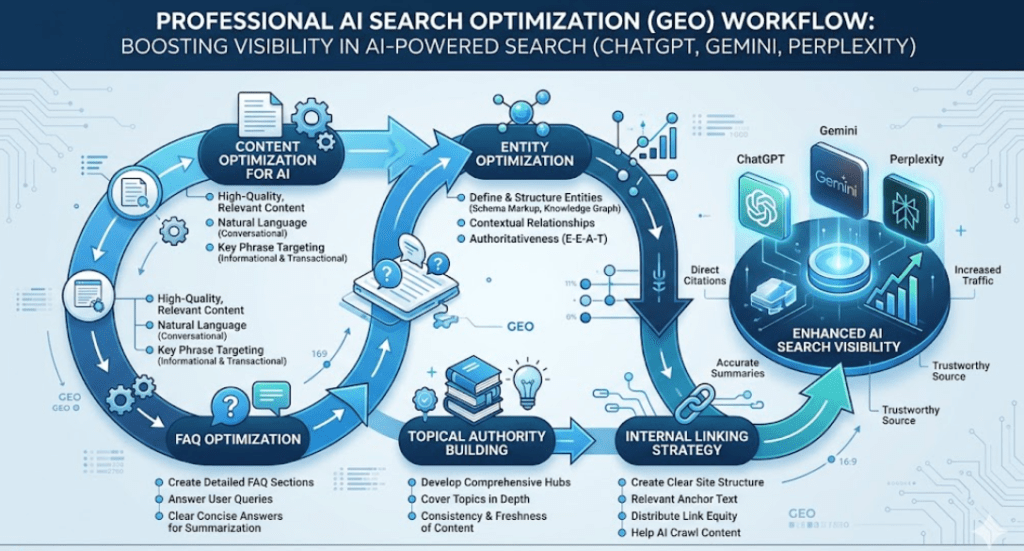
Strategy 1: Create Entity-Rich Content
Entities help AI systems connect concepts together.
For example, an article about GEO may naturally reference:
- SEO
- AI Search
- ChatGPT
- Gemini
- Perplexity
- Content Marketing
These entity relationships provide context and improve content understanding.
The key is to include entities naturally rather than forcing them into the content.
Strategy 2: Answer Questions Directly
AI-powered search often prioritizes content that provides clear answers.
Instead of making readers search through long paragraphs, answer important questions immediately.
Example:
Question:
What is GEO?
Answer:
Generative Engine Optimization is the process of optimizing content for AI-powered search systems.
Direct answers improve readability and increase AI citation potential.
Strategy 3: Build Topic Clusters
Publishing one article is rarely enough to establish authority.
Create related content around the same topic.
Example GEO Cluster:
- What Is GEO
- GEO Definition
- How GEO Works
- GEO vs SEO
- GEO Best Practices
- GEO Ranking Factors
Topic clusters strengthen authority signals and improve content discoverability.
Strategy 4: Use Strong Internal Linking
Internal links help search engines and AI systems understand relationships between pages.
For example, this article should naturally link to:
- What Is Generative Engine Optimization
- GEO Definition
- How GEO Works
- GEO vs SEO
Internal linking creates a stronger content ecosystem and improves user navigation.
Strategy 5: Add FAQ Sections
Many AI search queries are question-based.
Adding FAQ sections helps content address common user concerns.
Examples:
- What is GEO?
- Why is GEO important?
- How does GEO work?
- Is GEO replacing SEO?
FAQ sections support both AEO and GEO strategies.
Strategy 6: Improve Content Structure
Well-structured content is easier for AI systems to process.
Use:
- Clear H1 headings
- Logical H2 sections
- Supporting H3 subheadings
- Bullet points
- Lists
Good structure improves both user experience and content comprehension.
Strategy 7: Demonstrate Topical Authority
Topical authority is becoming increasingly important.
AI systems often trust websites that consistently publish high-quality content around a subject.
Instead of covering unrelated topics, focus on building depth within a niche.
For example, a website publishing dozens of GEO-related articles may become a stronger authority on the subject than a website with only one GEO article.
Strategy 8: Update Content Regularly
AI systems prefer accurate and relevant information.
Updating content helps maintain freshness.
Review articles periodically and:
- Add new information
- Improve examples
- Update statistics
- Expand explanations
Fresh content provides better value to both users and AI systems.
Strategy 9: Optimize for AI Citations
Although AI platforms work differently, content with strong authority and clear explanations has a better chance of being referenced.
To improve citation potential:
- Use factual information
- Provide detailed explanations
- Answer questions clearly
- Demonstrate expertise
Content that is easy to trust is easier to cite.
Strategy 10: Focus on User Intent
User intent remains one of the most important optimization factors.
Ask yourself:
- Why is the user searching?
- What problem are they trying to solve?
- What information do they need?
Content that satisfies intent is more valuable than content that simply targets keywords.
Common GEO Optimization Mistakes
Many businesses make mistakes when trying to optimize for AI search.
Keyword Stuffing
Repeating keywords excessively reduces readability.
Ignoring Content Quality
AI systems prioritize useful information.
Weak Internal Linking
Disconnected content creates weaker authority signals.
Publishing Thin Content
Short, low-value content often struggles to demonstrate expertise.
Focusing Only on SEO
The future of search requires both SEO and GEO strategies.
Frequently Asked Questions
What is GEO content optimization?
GEO content optimization is the process of improving content so AI systems can understand, trust, and utilize it when generating answers.
Does GEO replace SEO?
No. GEO complements SEO and works alongside traditional search optimization strategies.
Why are entities important for GEO?
Entities help AI systems understand relationships between concepts and improve contextual understanding.
How many internal links should a GEO article contain?
Most GEO articles should contain between 2 and 5 relevant internal links depending on the size of the content cluster.
Conclusion
Optimizing content for GEO requires a different mindset than traditional SEO alone. Instead of focusing solely on rankings, businesses must create content that AI systems can easily understand, trust, and reference.
By using entity-rich content, answering questions directly, building topic clusters, strengthening internal linking, and focusing on user intent, organizations can improve their visibility across AI-powered search platforms.
As AI search continues to evolve, businesses that invest in GEO today will be better positioned to build authority, increase discoverability, and remain competitive in the future of search.
Pingback: GEO Failure: 8 Common Mistakes Hurting Your AI Search Visibility
Pingback: GEO Best Practices
Pingback: What Is GEO in Digital Marketing? Complete Guide for 2026
Pingback: What Is Technical SEO? Complete Guide for Beginners (2026)
Pingback: Technical SEO Audit: Complete Guide to Finding and Fixing SEO Issues