
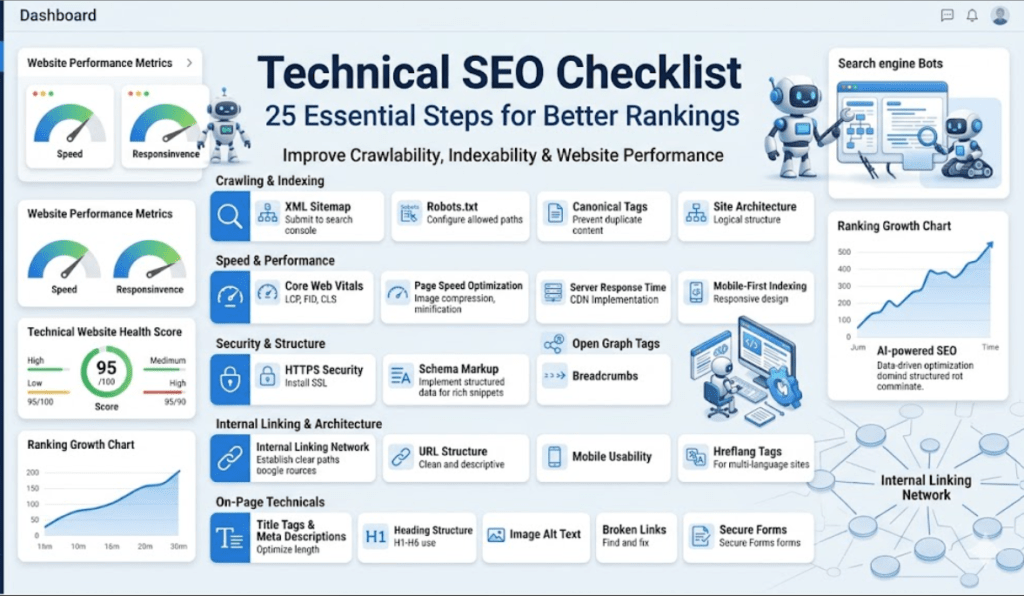
Technical SEO Checklist: 25 Essential Steps for Better Rankings
Technical SEO is one of the most important pillars of search engine optimization. While high-quality content and backlinks help websites rank, they cannot deliver their full potential if search engines struggle to crawl, understand, and index your website properly.
A Technical SEO Checklist provides a structured framework for identifying and fixing technical issues that may affect search visibility. It helps website owners, SEO professionals, bloggers, and businesses ensure that their websites meet the technical requirements expected by modern search engines such as Google.
As search algorithms become increasingly sophisticated and AI-powered search systems continue to evolve, technical optimization is no longer optional. Search engines now evaluate website performance, mobile usability, page experience, security, structured data, and crawlability as part of their ranking processes.
A properly optimized website offers several benefits:
- Better crawling and indexing
- Improved user experience
- Faster page loading times
- Higher search visibility
- Improved Core Web Vitals
- Better mobile performance
- Enhanced AI search understanding
- Stronger long-term SEO performance
Without a Technical SEO Checklist, important issues can go unnoticed. Broken links, crawl errors, duplicate content, poor site architecture, missing schema markup, and slow-loading pages can significantly reduce a website’s ability to perform well in search results.
Modern SEO also extends beyond traditional search engines. AI-powered platforms such as ChatGPT, Gemini, Perplexity, and Google AI Overviews increasingly rely on well-structured websites to understand content accurately. Technical SEO helps create the foundation that supports both traditional SEO and emerging AI search visibility.
Whether you are managing a personal blog, business website, eCommerce store, or enterprise platform, following a Technical SEO Checklist can help ensure that search engines and users can access your content efficiently.
In this guide, you will learn the most important Technical SEO Checklist items that can improve crawlability, indexability, performance, and overall search visibility in 2026 and beyond.
What Is a Technical SEO Checklist?
A Technical SEO Checklist is a structured list of technical optimization tasks that help improve a website’s ability to be crawled, indexed, understood, and ranked by search engines.
Think of it as a health checkup for your website.
Just as doctors use checklists to assess different aspects of a patient’s health, SEO professionals use Technical SEO Checklists to evaluate the technical health of a website.
The checklist helps identify issues that may prevent search engines from properly accessing or understanding website content.
A comprehensive Technical SEO Checklist typically covers:
Crawlability
Search engines must be able to discover and access website pages efficiently.
Checklist items include:
- XML Sitemap setup
- Robots.txt optimization
- Internal linking structure
- Crawl error monitoring
Indexability
Pages must be eligible for inclusion in search engine indexes.
Checklist items include:
- Index status checks
- Canonical tags
- Noindex directives
- Duplicate content management
Website Performance Checklist
Website performance is one of the most important sections of a Technical SEO Checklist. Search engines want to provide users with fast, reliable, and user-friendly websites. If a website loads slowly, visitors are more likely to leave before interacting with the content, which can negatively impact both user experience and search performance.
Google has repeatedly emphasized the importance of website speed and page experience. As a result, performance optimization has become a critical part of Technical SEO.
A fast website not only improves rankings but also helps increase engagement, reduce bounce rates, and improve conversions. Whether you run a blog, business website, or eCommerce store, performance optimization should be a priority.
Optimize Page Speed
Page speed measures how quickly a webpage loads and becomes usable for visitors.
Several factors influence page speed, including:
- Large image files
- Unoptimized code
- Excessive plugins
- Slow hosting servers
- Render-blocking resources
To improve page speed:
- Compress and optimize images
- Minify CSS, JavaScript, and HTML
- Use browser caching
- Implement a Content Delivery Network (CDN)
- Choose reliable hosting
Fast-loading websites create better experiences for users and make it easier for search engines to crawl content efficiently.
Improve Core Web Vitals
Core Web Vitals are a set of performance metrics that Google uses to evaluate user experience.
The three main Core Web Vitals are:
Largest Contentful Paint (LCP)
LCP measures how quickly the main content of a page loads.
A good LCP score should generally be under 2.5 seconds.
Interaction to Next Paint (INP)
INP measures how responsive a webpage is when users interact with it.
Lower INP scores indicate smoother user experiences.
Cumulative Layout Shift (CLS)
CLS measures visual stability.
Unexpected page movements during loading can create frustrating user experiences and negatively affect performance scores.
Improving Core Web Vitals often involves:
- Optimizing images
- Reducing server response times
- Eliminating unnecessary scripts
- Improving code efficiency
Why Website Performance Matters
Website performance affects both SEO and user satisfaction.
A technically optimized website provides:
- Faster loading times
- Better user experience
- Improved crawl efficiency
- Stronger Core Web Vitals scores
- Higher engagement rates
- Better search visibility
As search engines and AI-powered platforms continue prioritizing user experience, performance optimization remains one of the most valuable investments a website owner can make.
A strong Technical SEO Checklist should always include regular performance audits to ensure that the website remains fast, efficient, and capable of delivering a positive experience to both users and search engines.
Frequently Asked Questions (FAQ)
What is a Technical SEO Checklist?
A Technical SEO Checklist is a structured list of technical optimization tasks that help improve a website’s crawlability, indexability, performance, security, and overall search visibility.
Why is a Technical SEO Checklist important?
A Technical SEO Checklist helps identify and fix technical issues that may prevent search engines from properly crawling, understanding, and ranking website content.
How often should I perform a Technical SEO audit?
Most websites should perform a Technical SEO audit every three to six months. Larger websites and eCommerce platforms may require more frequent audits.
What are the most important Technical SEO factors?
The most important Technical SEO factors include:
- Crawlability
- Indexability
- Website Speed
- Core Web Vitals
- Mobile Friendliness
- HTTPS Security
- XML Sitemaps
- Robots.txt Optimization
- Structured Data
- Internal Linking
Does Technical SEO help improve rankings?
Yes. Technical SEO helps search engines access, understand, and evaluate website content more efficiently, which can contribute to stronger rankings and better visibility.
What is the difference between Technical SEO and On-Page SEO?
Technical SEO focuses on website infrastructure and backend optimization, while On-Page SEO focuses on content, keywords, headings, metadata, and page-level optimization.
How does page speed affect Technical SEO?
Page speed directly impacts user experience, Core Web Vitals, crawl efficiency, and search rankings. Faster websites generally perform better in search results.
Why is mobile optimization important for Technical SEO?
Google uses Mobile-First Indexing, meaning the mobile version of a website is primarily used for indexing and ranking purposes.
What is an XML Sitemap?
An XML Sitemap is a file that helps search engines discover, crawl, and understand important pages on a website more efficiently.
Can Technical SEO help with AI-powered search visibility?
Yes. Technical SEO helps AI systems understand website structure, content relationships, entities, and context, improving visibility across AI-powered search platforms and answer engines.
Conclusion
A Technical SEO Checklist is one of the most valuable tools for maintaining a healthy, search-friendly website. While content and backlinks remain important ranking factors, they cannot achieve their full potential without a strong technical foundation.
By focusing on crawlability, indexability, website performance, Core Web Vitals, mobile optimization, security, structured data, and internal linking, businesses can create websites that are easier for search engines to understand and users to navigate.
Technical SEO is no longer just about search engines. Modern AI-powered platforms such as ChatGPT, Gemini, Perplexity, and Google AI Overviews increasingly rely on well-structured, technically optimized websites to understand and surface information. This makes Technical SEO an essential part of both traditional SEO and future AI search visibility strategies.
Whether you are a blogger, business owner, digital marketer, or SEO professional, regularly following a Technical SEO Checklist can help identify issues before they impact performance and ensure your website remains competitive in an evolving search landscape.
The key takeaway is simple: Technical SEO creates the foundation that supports every other SEO effort. By implementing these essential Technical SEO Checklist steps, you can improve website health, enhance user experience, strengthen search visibility, and position your website for long-term success in both traditional and AI-powered search environments.
Pingback: Technical SEO Audit Checklist: 30 Essential SEO Checks for 2026
Pingback: What Is Answer Engine Optimization (AEO)? Complete Beginner's Guide
Pingback: Site Audit: Complete SEO and Website Audit Guide for 2026
Pingback: What Is an SEO Audit? Complete SEO Audit Guide for 2026
Pingback: Search Engine Optimization Audit: Complete SEO Evaluation Guide1
Pingback: Technical SEO Tools: 15 Best Tools for SEO Audits and AI Optimization1
Pingback: How Soumyaditya Biswas Built a website tracking infrastructure 1
Pingback: What My First 4,800 Google Search Impressions Taught Me About SEO