
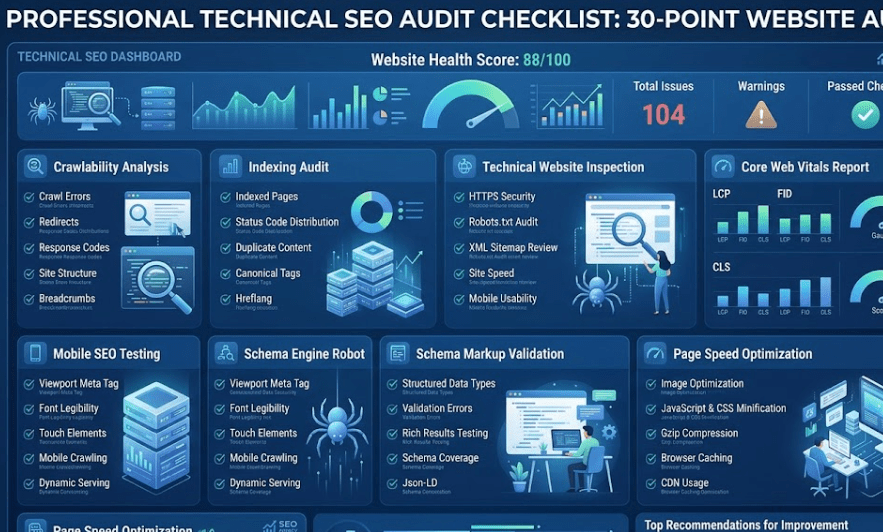
Technical SEO Audit Checklist: 30 Essential Checks for Better Rankings
What Is a Technical SEO Audit Checklist?
A Technical SEO Audit Checklist is a structured framework used to evaluate the technical health of a website. It helps identify issues that may prevent search engines from efficiently crawling, indexing, understanding, and ranking website content.
Think of a Technical SEO Audit Checklist as a roadmap for maintaining a search-engine-friendly website. Instead of randomly checking technical factors, SEO professionals follow a systematic process to ensure that every critical area of a website is properly optimized.
A comprehensive Technical SEO Audit Checklist typically covers:
- Crawlability
- Indexability
- XML Sitemaps
- Robots.txt Files
- Website Architecture
- Internal Linking
- Page Speed
- Core Web Vitals
- Mobile Friendliness
- HTTPS Security
- Structured Data
- Canonical Tags
- Redirect Management
Regular technical audits help website owners detect problems before they negatively impact rankings and user experience.
Why Every Website Needs a Technical SEO Audit Checklist
Search engines continuously evaluate websites to determine which pages deserve visibility in search results.
Even small technical issues can create significant SEO problems such as:
- Indexing failures
- Crawl errors
- Duplicate content
- Slow-loading pages
- Poor mobile usability
- Broken internal links
A Technical SEO Audit Checklist ensures these issues are identified and resolved systematically.
By following a consistent audit process, businesses can improve website health, strengthen search visibility, and create a better experience for both users and search engines.
Essential Technical SEO Audit Checklist Items
A successful Technical SEO Audit Checklist focuses on the most important technical factors that influence search performance.
Crawlability Checks
Ensure search engines can access your content efficiently.
Checklist items include:
- XML Sitemap submitted
- Robots.txt configured correctly
- Crawl errors fixed
- Internal links functioning properly
- Orphan pages identified
Indexability Checks
Verify that important pages can be indexed.
Checklist items include:
- Indexed page review
- Canonical tag validation
- Noindex tag review
- Duplicate content analysis
- Redirect optimization
Website Performance Checks
Search engines prioritize fast websites.
Checklist items include:
- Page speed testing
- Image optimization
- Caching implementation
- Core Web Vitals analysis
- Server response monitoring
Mobile SEO Checks
Mobile optimization is essential due to Mobile-First Indexing.
Checklist items include:
- Responsive design
- Mobile usability testing
- Mobile page speed review
- Touch-friendly navigation
- Mobile content consistency
Structured Data Checks
Structured data helps search engines and AI systems understand content.
Checklist items include:
- Article Schema
- FAQ Schema
- Organization Schema
- Breadcrumb Schema
- Schema validation
Following these audit checks helps create a technically optimized website capable of supporting strong SEO performance.
Frequently Asked Questions (FAQ)
What is a Technical SEO Audit Checklist?
A Technical SEO Audit Checklist is a structured list of technical checks used to evaluate and improve a website’s crawlability, indexability, performance, and search visibility.
Why is a Technical SEO Audit Checklist important?
It helps identify technical issues that may prevent search engines from properly accessing and ranking website content.
How often should I use a Technical SEO Audit Checklist?
Most websites should perform technical audits every three to six months, while larger websites may require more frequent reviews.
What are the most important Technical SEO Audit Checklist items?
The most important areas include crawlability, indexability, page speed, mobile optimization, Core Web Vitals, HTTPS security, and structured data.
Can a Technical SEO Audit Checklist improve rankings?
Yes. Fixing technical issues often improves crawl efficiency, user experience, and search visibility, which can contribute to stronger rankings.
What tools help with Technical SEO audits?
Popular tools include:
- Google Search Console
- Screaming Frog
- PageSpeed Insights
- Ahrefs
- Semrush
- Bing Webmaster Tools
Does Technical SEO matter for AI search?
Yes. Technical SEO helps AI-powered search systems better understand website content, structure, and entities.
Conclusion
A Technical SEO Audit Checklist is one of the most valuable resources for maintaining a healthy website. It provides a systematic approach to identifying technical issues that may affect search visibility, user experience, and overall website performance.
By regularly reviewing crawlability, indexability, page speed, mobile usability, structured data, and security factors, website owners can create stronger technical foundations that support both traditional SEO and emerging AI-powered search environments.
As search engines continue to evolve, websites with strong technical health will be better positioned to achieve sustainable rankings, improved visibility, and long-term organic growth.
Furthermore, a Technical SEO Audit Checklist should not be viewed as a one-time activity. Search engines continuously update their algorithms, websites evolve through content additions and design changes, and user expectations continue to rise. As a result, technical issues can emerge over time even on websites that were previously well optimized.
Regular technical audits help ensure that your website remains accessible, efficient, and aligned with modern search engine requirements. Small technical problems such as broken links, redirect chains, duplicate pages, missing metadata, crawl errors, or slow-loading resources can gradually accumulate and negatively impact overall website performance if left unresolved.
Another important consideration is the growing influence of artificial intelligence in search. Modern AI-powered platforms do not simply look for keywords; they attempt to understand entities, relationships, content structure, and contextual relevance. Websites that maintain strong technical foundations are often easier for both traditional search engines and AI systems to interpret accurately.
A comprehensive Technical SEO Audit Checklist helps businesses create a website environment where content can perform at its highest potential. Even the most valuable content may struggle to generate traffic if search engines cannot efficiently crawl and index it. Technical optimization ensures that content, backlinks, and other SEO efforts work together effectively rather than being limited by underlying technical issues.
Businesses that consistently perform technical audits often gain advantages such as:
- Improved organic visibility
- Faster indexing of new content
- Better user engagement
- Lower bounce rates
- Improved Core Web Vitals performance
- Stronger mobile usability
- Better crawl efficiency
- Enhanced AI search discoverability
In competitive industries, these advantages can create meaningful differences in search performance over time. Technical SEO is often the factor that separates websites that consistently grow from those that struggle to maintain visibility.
It is also important to remember that Technical SEO supports every stage of the user journey. Faster pages improve first impressions. Better site architecture helps users find information more easily. Secure connections build trust. Mobile optimization ensures accessibility across devices. Structured data improves content understanding. Together, these elements contribute to a stronger overall digital experience.
From an AEO (Answer Engine Optimization) perspective, technically optimized websites are more likely to provide clear, accessible, and machine-readable information that can be used in featured snippets, voice search responses, and direct-answer environments.
From a GEO (Generative Engine Optimization) perspective, strong technical foundations help AI systems understand content relationships, entity connections, and website authority more effectively. This increases the likelihood that content may be referenced, summarized, or utilized within AI-generated responses.
The future of search is becoming increasingly dependent on both technical excellence and content quality. Websites that invest in Technical SEO today are building a foundation for long-term success across traditional search engines, answer engines, and emerging AI-powered search platforms.
Ultimately, a Technical SEO Audit Checklist is not simply about fixing errors. It is about creating a technically strong, user-friendly, and search-optimized website that can adapt to future changes in technology, search behavior, and digital marketing. Organizations that prioritize technical health will be better equipped to compete, grow, and maintain visibility in an increasingly competitive online environment.
Pingback: What Is a Website Audit? Complete SEO Audit Guide for 2026
Pingback: Site Audit: Complete SEO and Website Audit Guide for 2026
Pingback: What Is an SEO Audit? Complete SEO Audit Guide for 2026
Pingback: Search Engine Optimization Audit: Complete SEO Evaluation Guide1
Pingback: SEO Audit Checklist: 25 Essential Steps for Better Rankings
Pingback: Technical SEO vs On-Page SEO: Key Differences in the AI Search Era1
Pingback: How Soumyaditya Biswas Built a website tracking infrastructure 1
Pingback: The Biggest Digital Marketing Myth I Believed Before Learning Google Ads 1