
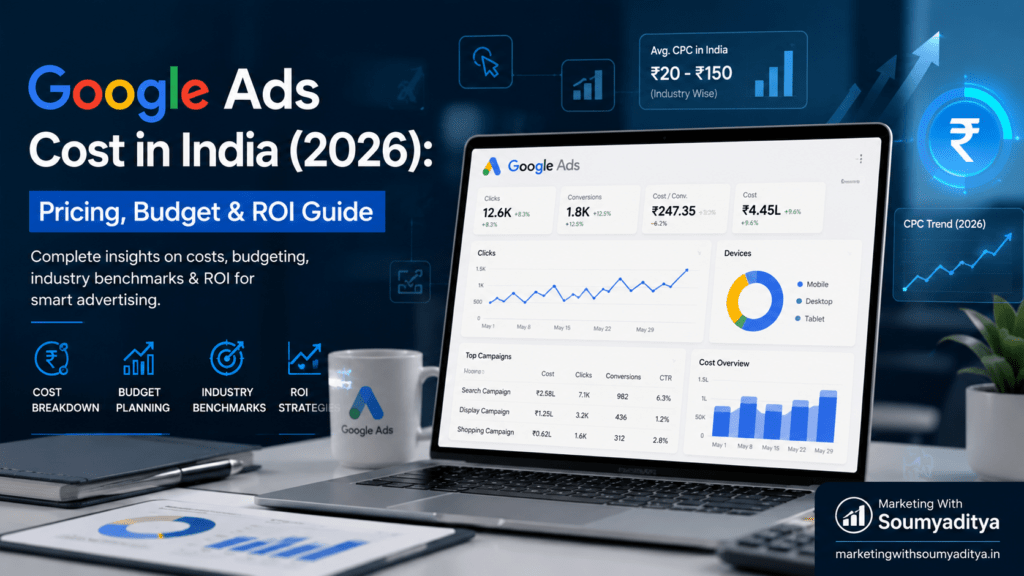
Google Ads Cost in India: Pricing, Budget and ROI Guide (2026)
Every business wants more customers. That’s obvious.
But if you’re searching for Google Ads Cost in India, I don’t think your biggest question is actually about the price.
Your biggest question is probably something much simpler.
“If I invest my hard-earned money into Google Ads, will it actually bring me customers, or will I end up wasting my budget?”
If you’re thinking like that, you’re not wrong.
In fact, I think you should be thinking like that.
After all, it’s your business. It’s your money. You have every right to question where it is going before spending even ₹1.
Today, you’ll find hundreds of articles, YouTube videos, agencies, freelancers, and so-called marketing experts talking about Google Ads. One person says you can start with ₹500 per day. Someone else says don’t even think about it unless you’re ready to spend ₹50,000 or even several lakh rupees every month.
As a business owner, what are you supposed to believe?
Honestly, I wouldn’t expect you to trust anyone immediately.
You don’t know me.
You don’t know whether the advice in this article is practical or just another piece of content written to attract traffic.
And that’s fair.
Instead of asking you to trust me, let me first show you something real.
One jewellery business invested ₹50,000 in Google Ads. That campaign generated approximately ₹4.78 lakh in revenue.
Now before you get excited, let me say something equally important.
This is not a promise.
I’m not saying every business that invests ₹50,000 will generate ₹4.78 lakh.
If anyone gives you that kind of guarantee, you should question it.
The reason I’m sharing this example is different.
I want you to understand that Google Ads is not about spending the biggest budget. It’s about spending the right budget with the right strategy.
The businesses that get good results are not always the ones spending the most money. In many cases, they’re simply the ones that understand their customers, target the right audience, and run campaigns with a clear plan.
That’s why asking,
“How much does Google Ads cost in India?”
is only half the question.
The other half is much more important.
“How much should my business invest, and what is a realistic expectation from that investment?”
That’s the question most business owners actually want answered.
And that’s exactly what we’re going to discuss in this guide.
We won’t start with complicated marketing terms.
We won’t assume you already know what CPC, CTR, Quality Score, or Ad Rank mean.
Because if you’re running a business, your primary job isn’t learning Google Ads.
Your job is growing your business.
Google Ads is simply one way of helping you do that.
So throughout this guide, we’ll look at Google Ads from a business owner’s perspective.
We’ll understand why businesses spend different amounts, what actually influences the budget, how to think about returns realistically, and how to judge whether your advertising investment is moving your business in the right direction.
By the end of this guide, you shouldn’t just know how much Google Ads costs in India in 2026.
You should understand why businesses spend what they spend, how to avoid unrealistic expectations, and how to make advertising decisions with confidence instead of confusion.
Because in the end, successful Google Ads campaigns aren’t built by spending the most money.
They’re built by understanding where every rupee goes… before you decide to invest it.
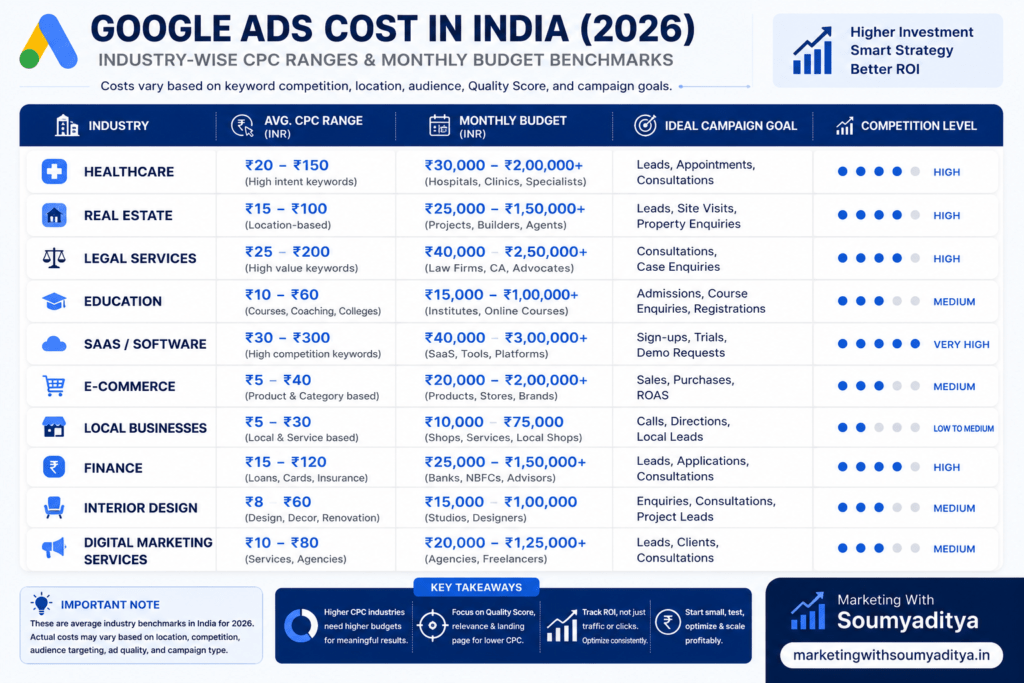
Quick Answer: How Much Does Google Ads Cost in India?
Let’s answer the core questions first because this is probably why you’re here.
Google Ads doesn’t have a fixed cost in India.
I know that may sound like an incomplete answer, but honestly, that’s the most accurate answer anyone can give.
Many businesses search for one fixed number. Some expect ₹500 per day. Others think they need ₹50,000 or even ₹1 lakh every month before Google Ads starts working. The reality is somewhere in between, and that’s exactly why so many people get confused.
Google Ads doesn’t follow a fixed pricing model.
Every business is different. Every campaign is different. Your industry, your target audience, your competitors, your keywords, your bidding strategy, your location, and even the quality of your ads all work together. Change one of these factors, and your advertising cost can also change.
That’s why two businesses selling similar products can still end up paying completely different amounts.
Now the next question naturally comes.
How much budget should I start with?
Look now for many small and medium-sized businesses, a monthly budget between ₹15,000 and ₹50,000 I think is usually a practical place to begin. Not because Google recommends this amount. There is no official Google budget.
It’s simply a range where many businesses can test campaigns properly, collect enough data, understand customer behaviour, and decide whether they should scale further.
But don’t make another common mistake.
A higher budget doesn’t automatically mean better results.
This is probably one of the biggest myths about Google Ads.
Imagine two businesses.
Look a business may spends ₹20,000 with proper keyword research, relevant advertisements, a well-designed landing page, and continuous optimization.
And in the sametime the business B spends ₹1,00,000 without understanding its audience, keywords, or campaign structure of any business.
Which business is more likely to generate profitable leads?
In many cases, Business A.
That’s why I personally don’t think the first question should be:
“How much does Google Ads cost?”
The better question is:
“How much should my business invest to generate profitable leads, enquiries, or sales?”
There is a difference between spending money and investing money. Many businesses focus on the first question and ignore the second one.
Throughout this guide, we’ll understand how Google Ads pricing actually works in India, what factors influence your advertising costs, how businesses across different industries usually plan their budgets, and most importantly, how to measure whether your investment is actually generating a positive ROI( Return On Investments) for your business
By the end of this guide, I don’t just want you to remember a budget number.
I want you to understand the system behind that number.
Because once you understand the system, budgeting becomes much easier. You stop making decisions based on assumptions or marketing myths and start making decisions based on your own business goals.
Quick Takeaway
There isn’t one “perfect” Google Ads budget for every business.
Look in my opinion the right budget is the one that aligns directly with your business objectives, reaches the right audience, and generates profitable returns consistently over time.
Now that we’ve answered the biggest question, let’s understand the most common questions businesses ask before launching their first Google Ads campaign.
Frequently Asked Questions About Google Ads Cost in India
Before understanding how Google Ads pricing actually works, let’s clear some of the questions almost every business owner has.
Whether you’re running a startup, a local business, or an established company, these are probably the same questions that came to your mind. They’re also among the most searched Google Ads questions in India.
Let’s answer them first. Look once these misconceptions are cleared totally,then the total understanding Google Ads pricing will become much more easier.
Then The Question Is Google Ads Free to Use?
The Answer Is No.
Google Ads is a paid advertising platform.
Many beginners think creating a Google Ads account means they’ll immediately start paying money. That’s not how it works.
You only pay when your campaign becomes active and starts participating in Google’s advertising auction. In most Search campaigns, you pay when someone clicks on your advertisement. Other campaign types may charge based on impressions, video views, or specific campaign objectives.
So, creating an account is free.
Running advertisements isn’t.
What Is the Minimum Budget Required for Google Ads in India?
This is probably one of the most common questions.
The simple answer is…
Google doesn’t officially say that every advertiser must spend a fixed amount every month.
Technically, you can start with a relatively small daily budget.
But here’s something many articles don’t explain properly.
Just because you can start with a very small budget doesn’t always mean you should.
If your campaign receives only a handful of clicks every week, you’ll collect very little data. Without enough data, optimization becomes difficult. And without optimization, it’s hard to know whether your campaign is actually improving.
Instead of asking,
“What’s the minimum budget?”
A better question is,
“What’s the minimum budget that allows my campaign to learn properly?”
There is a big difference between the two.
Can Small Businesses Afford Google Ads?
Yes.
In fact, there are so many small businesses exists that are directly get benefit from Google Ads more than larger companies because they don’t need to advertise to everyone.
They only need to reach the right people.
A local business can target a specific city.
A coaching centre can target nearby students.
A dentist can target people searching for dental treatment in their area.
Instead of spending money on broad advertising and hoping someone notices,Today actually The Google Ads allows all businesses to reach customers who are already searching for their products or services in the digital marketplace.
Look That Is the real advantage.
It is not just about having the biggest budget type things.
Actually It’s all about using all the available budget intelligently.
What Do you Think Why Do Two Businesses Pay Different Prices for Similar Keywords?
This confuses many advertisers.
They assume that if two businesses target the same keyword, Google will charge both of them the same amount.
It doesn’t work like that.
Google looks at much more than your bid.
It also evaluates:
Competition
Ad relevance
Landing page experience
Expected Click-Through Rate (CTR)
User intent
Device
Location
Quality Score
All of these work together.
That’s why two businesses targeting almost identical keywords can still pay completely different CPCs.
Google isn’t simply rewarding only with the highest bidder.
It’s trying to show the best advertisement that provides the best experience for the all users.
Is Google Ads Better Than Boosting Social Media Posts?
Honestly…
It depends on what you’re trying to achieve.
Suppose someone searches:
“Best CA near me.”
Or…
“Digital marketing agency in Kolkata.”
That person is already looking for a solution.
Google Ads allows you to appear exactly at that moment.
Social media works differently.
People aren’t necessarily searching for your product. They’re scrolling through content. Social media is generally stronger for creating awareness, introducing a new product, or building your brand before someone starts searching.
So I don’t think this should be treated as a competition.
Google Ads and social media advertising both actually solve different kind of marketing problems in a very different way.
Many successful businesses today use both together because they have understand each platform serves a different purpose in the customer journey.
Hopefully these answers have cleared the biggest misconceptions.
But this is only the starting point.
The bigger question still remains.
Why doesn’t Google Ads have one fixed price in the first place?
Once you understand Google’s advertising auction, almost everything about Google Ads pricing starts making sense.
So let’s understand how that system actually works.
Why Doesn't Google Ads Have a Fixed Price?
“How much does Google Ads cost?”
At first, that sounds like a reasonable question.
But personally, I don’t think there can ever be one universal answer.
Why?
Because every business is different.
A local shop doesn’t think like a startup.
A startup doesn’t think like an enterprise company.
A service business doesn’t spend like an eCommerce brand.
Even two companies in the same industry don’t think exactly the same. Their financial capacity is different, their growth goals are different, their risk appetite is different and even their marketing philosophy is different.
So if businesses themselves aren’t the same, why should Google force everyone to advertise using one fixed price?
I think this is where many people misunderstand Google Ads.
Google never designed its advertising platform around one fixed budget. Instead, it built a flexible system where businesses decide how aggressively—or conservatively—they want to invest.
Imagine if Google announced tomorrow,
“Every business must spend at least ₹50,000 every month to advertise.”
What would happen?
Thousands of startups wouldn’t even enter the platform.
Small businesses would immediately be excluded.
Local businesses would start looking for cheaper alternatives.
Instead of growing the ecosystem, Google would actually shrink it.
That’s why I don’t think flexible pricing exists only because Google wants to maximize advertising revenue.
Revenue is definitely part of the business.
But I think there’s a much bigger philosophy behind it.
Lower the entry barrier.
Allow every business to participate.
Let the market decide how much each advertiser wants to spend.
When more businesses enter the ecosystem, the ecosystem itself becomes stronger.
And once an ecosystem becomes strong enough, replacing it becomes incredibly difficult.
That’s one of Alphabet’s biggest strengths.
Every Search Creates a New Auction
Now let’s take this one step further.
If businesses are deciding their own budgets, how does Google decide who appears first?
This is where the auction comes in.
Imagine someone searches for:
“Best digital marketing agency in Bangalore.”
From our side, it feels simple.
We type the query.
Press Enter.
Google shows the results.
That’s all we see.
But behind the scenes, Google’s system is processing hundreds or even thousands of signals within milliseconds.
It identifies advertisers targeting that keyword.
Checks their bids.
Evaluates how relevant their advertisements are.
Looks at the landing page.
Predicts which advertisement is most likely to help the user.
Only after considering all of these factors does Google decide which ads should appear and in what order.
The interesting part is that this process starts every single time someone searches.
Not once a day.
Not once an hour.
Every search.
That’s why the same keyword doesn’t always cost the same amount.
Competition changes.
Budgets change.
Advertisers enter and leave auctions.
User behaviour changes.
The market itself keeps changing.
So Google Ads pricing changes with it.
Is It Just About Who Pays More?
Many beginners believe it is.
If someone bids more money, they assume they’ll automatically rank above everyone else.
If Google’s system worked like that, only businesses with the deepest pockets would dominate search results.
Small businesses would hardly get an opportunity to compete.
Fortunately, Google’s system is designed differently.
Let’s say two interior design companies are targeting the same keyword.
The first advertiser bids ₹180 per click.
The second advertiser bids ₹130 per click.
Looking only at those numbers, the first advertiser should win.
But Google doesn’t evaluate only the bid amount.
Suppose the first advertisement is generic.
The website loads slowly.
The landing page doesn’t answer the visitor’s question.
Now compare that with the second advertiser.
The advertisement closely matches the user’s intent.
The landing page is fast.
The content is relevant.
The overall experience is much better.
In many situations, Google may rank the second advertiser higher, even with the lower bid.
Because Google’s objective isn’t simply rewarding whoever spends the most money.
Its objective is to create the best possible experience for the person searching.
If users stop trusting the advertisements they see, Google’s entire search ecosystem becomes weaker.
That’s why campaign quality matters almost as much as budget.
What Does This Mean for Your Business?
Personally, I think this is encouraging, especially for startups and small businesses.
You don’t always need the biggest marketing budget.
You need a better strategy.
Relevant keywords.
Useful advertisements.
Landing pages that actually solve a user’s problem instead of only trying to generate a lead.
And continuous optimization.
Many businesses think the solution to poor performance is increasing the budget.
Sometimes that’s true.
But many times, improving the campaign itself delivers a much better return than simply spending more money.
Key Takeaway
Google Ads doesn’t have a fixed price because businesses aren’t fixed.
Markets aren’t fixed.
Competition isn’t fixed.
User behaviour isn’t fixed.
Everything keeps changing.
So the advertising system has to remain flexible as well.
Instead of asking,
“How much does Google Ads cost?”
I think a better question is,
“What is increasing my advertising cost, and which of those factors can I actually improve?”
Once you start thinking that way, Google Ads stops feeling like a platform where you’re buying clicks.
You begin to see it as a dynamic ecosystem where strategy, relevance, and user experience influence your costs just as much as your budget.
And that’s exactly what we’ll explore next, where we’ll break down each factor that affects Google Ads costs in India and identify which ones are within your control.
What Factors Affect Google Ads Cost in India?
Now that we’ve understood why Google Ads doesn’t have one fixed price, another question naturally comes up.
If there isn’t one fixed price, then what actually decides how much I pay?
Personally, I think this is where many businesses get confused.
Some believe it’s only about budget.
Others think whoever bids more automatically pays more.
Some even assume that every business in the same industry spends roughly the same amount.
Actually, none of these are completely true.
The reason is simple.
Google Ads doesn’t make decisions by looking at just one factor. Look I agree with you initially It looks at multiple factors together, and every one of them influences your final advertising cost at the end.
Think about it like this in a very deep way not just in abstract thinking.
Look think suppose anyone asks you, “How much will it cost to build a house?”
Can anyone answer with one number?
Probably not.
Because the answer depends on the location, materials, labour costs, size, design and many other things.
Google Ads works in almost the same way.
In the end of the day the final cost isn’t decided by one variable.
It’s actually is the result of several variables working together.
Let’s understand the most important ones.
- Your Industry Changes the Economics
Personally, I think businesses often compare themselves with completely different industries, and that’s where unrealistic expectations begin.
A local bakery doesn’t advertise the same way as a real estate company.
A dentist doesn’t think like an insurance company.
A software company doesn’t calculate marketing budgets the same way an eCommerce brand does.
Why?
Because the value of one customer is completely different.
If one new customer can generate several lakhs in revenue, businesses are naturally willing to spend much more to acquire that customer.
Once many advertisers start thinking like that, competition increases.
And when competition increases, advertising costs usually increase as well.
That’s why industries like:
- Legal Services
- Real Estate
- Insurance
- Healthcare
- Financial Services
- Higher Education
often experience much higher CPCs than many local service businesses.
So comparing your Google Ads budget with another industry doesn’t really make sense.
Every market has its own economics.
- Keyword Competition Matters More Than Keyword Volume
Here’s another misconception.
Many beginners think expensive keywords should always be avoided.
I don’t completely agree with that.
A keyword becomes expensive because multiple businesses believe that keyword has business value.
Look now I am giving you an example,
Imagine someone continuously in the internet searching “digital marketing” could simply be reading about the topic.
But someone searching “hire digital marketing agency in Kolkata” is much closer to becoming a customer.
Those two searches may look similar.
From Google’s perspective, they aren’t.
Businesses know that high-intent searches often convert better.
That’s why more advertisers compete for them.
More competition usually means higher CPC.
Look actually the reality is there are so many people think paying more is always bad but paying more isn’t always bad.
Now imagine if a higher-cost keyword consistently brings qualified customers to the business, it can easily become more profitable than dozens of cheap clicks that never convert.
Personally, I think businesses should stop chasing the lowest CPC.
They should start chasing the highest business value.
Those two things are very different.
- Your Location Also Changes the Cost
Where you advertise is just as important as what you advertise.
Think about Mumbai, Bengaluru, Delhi or Hyderabad.
Thousands of businesses compete for the same audience every day.
Now compare that with a smaller city.
Naturally, competition isn’t always the same.
A dentist advertising in South Mumbai may compete against dozens of clinics.
The same dentist targeting a smaller city may face much less competition.
The service hasn’t changed.
The business hasn’t changed.
Only the market has changed.
And because the market changes, advertising costs also change.
That’s why businesses targeting one city often have a completely different budget from businesses running campaigns across India.
- Your Campaign Goal Changes Everything
This is another factor people often overlook.
Before Google decides how to optimize your campaign, it first needs to know what you’re trying to achieve.
Are you looking for:
- Website traffic?
- Phone calls?
- Lead generation?
- Online sales?
- App downloads?
- Store visits?
- Brand awareness?
Each objective requires a different strategy.
Generating thousands of blog visitors is completely different from generating ten qualified insurance leads.
The campaign structure changes.
The bidding strategy changes.
The competition changes.
And naturally, the cost also changes.
So now just imagine a scenario where two businesses spending exactly the same amount can still achieve completely different outcomes because their objectives are different from the beginning.
Key Takeaway
Look Personally I think at the end of the day Ads cost can ever be explained using one single number.
Your industry influences it.
Your keywords influence it.
Your location influences it.
Your campaign objective influences it.
And these aren’t isolated factors.
They’re connected.
Change one of them, and the overall cost may change as well.
The good news is that while you can’t control market competition, you can control many of the decisions inside your own campaign.
And that’s where experienced advertisers create their competitive advantage.
In the next section, we’ll look at one of the most misunderstood metrics in Google Ads—Cost Per Click (CPC). We’ll understand what it actually means, why you don’t always pay your maximum bid, and how CPC fits into your overall advertising budget.
Understanding Cost Per Click (CPC): Why You Don't Always Pay Your Maximum Bid
Cost Per Click, or CPC.
Most articles explain it in one sentence.
“You pay at that specific moment whenever someone clicks on your advertisement.”
Technically, that is definitely 100% correct.
But personally, I am not agreeing with this, I don’t think that explanation helps anyone understand Google Ads.
Because the real question isn’t when you pay.
The real question is…
Why doesn’t Google simply charge everyone the amount they bid?
That’s where most beginners become confused.
Suppose you tell Google,
“I’m comfortable paying up to ₹100 for one click.”
Many people immediately assume something.
“Okay… so every click will cost me ₹100.”
But actually, that’s not the core message what you’re telling Google.
You’re telling Google something very different.
You’re saying,
“₹100 is the maximum I’m willing to pay if the competition requires it.”
Those two statements sound similar.
But they’re completely different.
Your Bid Is a Limit, Not a Promise
Personally, I think many businesses misunderstand the purpose of bidding.
Google isn’t asking,
“Question your own heart how much do you really want to spend in google ads?”
It’s asking,
“ Ask yourself one simple tiny question: What is the highest amount you are actually comfortable paying for just one click if that’s what it takes to stay competitive??”
Guess now we will take a very simple and easy example.
Now just imagine you are a owner of a dental clinic and your clinic is located in Kolkata.
You’re targeting the keyword:
“Best dentist near me.”
After looking at your business economics, you decide that one qualified visitor is worth spending ₹100.
So you set your maximum CPC at ₹100.
Now imagine the nearest competitor in that auction only requires ₹72 for you to remain ahead.
Ask yourself and go deep within your heart and ask the question and the you will find out would it make any sense for Google to automatically charge you ₹100?
Personally, I will never agree with this kind of things.
Look in actual reality here isn’t any reason to.
Google only needs to charge enough for you to maintain your position in that auction.
That’s why your actual CPC may be much lower than your maximum bid.
From my personal life experience I can tell all of you that I think this is one of the biggest misconceptions beginners have.
They treat the bid as the actual cost.
Reality is very different from the imagination in actual reality, it’s closer to a spending limit than a fixed price.
Why Doesn’t CPC Stay the Same?
Here’s another question I used to think about.
If I’m targeting the same keyword, why does my CPC change?
The answer is actually quite simple.
Because the market doesn’t stay the same.
And if the market keeps changing continuously , how can the price remain fixed, how this can be possible?
Think about it.
Monday morning isn’t the same as Sunday night.
Festival season isn’t the same as an ordinary month.
Ten advertisers participating in an auction isn’t the same as fifty advertisers participating.
Everything changes.
Competition changes.
User behaviour changes.
Demand changes.
Businesses increase or reduce budgets.
Some campaigns stop running.
Some new campaigns enter the auction.
Google simply reacts to those market changes.
Personally, I think CPC behaves more like a live market price than a printed price list.
That’s why looking at one CPC number without understanding the market behind it can sometimes be misleading.
Is a Lower CPC Always Better?
Honestly…
I don’t think so.
This is probably one of the biggest traps in Google Ads.
Many businesses celebrate when they reduce their CPC.
But they forget to ask one important question.
“Did the business actually perform better?”
Let’s imagine two campaigns.
The first campaign generates clicks for ₹20.
Sounds great.
But almost nobody becomes a customer.
The second campaign costs ₹150 per click.
At first glance, that looks expensive.
But what if those visitors consistently become customers worth ₹50,000?
Now which campaign is actually cheaper?
Personally, I think many businesses measure the wrong thing.
They measure the cost of getting a click.
Instead of measuring the value of getting a customer.
Those aren’t the same.
A cheap click that never converts can become one of the most expensive marketing decisions.
A costly click that consistently generates profitable customers can become one of the best investments your business makes.
That’s why experienced advertisers don’t try to buy the cheapest traffic.
They try to buy the most valuable traffic.
Look I am telling you that there’s a big difference between those two approaches.
CPC Is Only One Part of the Story
By now, one thing should be clear.
CPC isn’t a fixed number.
It changes because businesses change.
Competition changes.
Markets change.
Google responds to those changes through its auction system.
But another question still remains.
If two businesses bid almost the same amount, why does one often pay less while ranking higher?
The answer isn’t only the bid.
But in the actual reality my friends it is also the quality of the campaign itself.
And that’s exactly why the next concept—Quality Score and Ad Rank—is become so much vital for any google ads campaign creation process?
Once you understand those two ideas with your inner heart, you’ll begin to see that Google Ads isn’t simply rewarding businesses that spend more.
It’s rewarding businesses that create better experiences for the people using Google.
Pingback: Social Media Marketing Packages in India in 2026:The entire Guide