
SEO, AEO & GEO Case Study: Growing Organic Visibility for an International B2B Technology Services Website
Search engine optimization is often misunderstood as a collection of isolated tactics focused solely on rankings and keywords. In reality, successful SEO is a continuous process of understanding user intent, identifying content opportunities, improving website relevance, strengthening authority signals, and helping search engines better understand the value a website provides.
This case study documents my experience contributing to the SEO growth of an international B2B technology services website operating in a highly competitive digital landscape. Due to confidentiality requirements, I am unable to disclose the client name, domain, exact service portfolio, or proprietary business information. However, I can share the SEO process, research methodology, strategic thinking, execution principles, and performance outcomes that shaped this project.
As an SEO Executive, my involvement extended across multiple areas including search intent research, performance analysis, content opportunity identification, topical authority planning, optimization support, and continuous monitoring. Rather than focusing on a single SEO tactic, the objective was to build a stronger organic search foundation capable of supporting long-term visibility growth.
What makes this project particularly interesting is that it exists within a technology-focused environment where competition is constantly evolving. Businesses in technology sectors often compete not only against direct competitors but also against publishers, software companies, educational websites, industry blogs, and AI-driven information platforms. This creates a search environment where authority, expertise, and content quality become increasingly important.
As search engines continue incorporating AI-powered retrieval systems and answer-generation capabilities, websites must evolve beyond traditional SEO practices. This project therefore became an opportunity to apply principles related not only to Search Engine Optimization but also to Answer Engine Optimization (AEO) and Generative Engine Optimization (GEO).
Understanding the Initial Situation
Before identifying growth opportunities, I first focused on understanding the website’s current search visibility.
One of the biggest mistakes many SEO practitioners make is immediately jumping into optimization activities without establishing a clear baseline. Without understanding where a website currently stands, it becomes difficult to measure future progress accurately.
The first stage of my analysis involved examining available search performance data to identify visibility trends, ranking patterns, and potential opportunities.
Several observations emerged during this initial review.
The website was already appearing within Google search results for a variety of keywords. This indicated that search engines had indexed and recognized the website. However, visibility was not yet being fully maximized.
There appeared to be opportunities to strengthen keyword coverage, improve topical depth, expand content relevance, and support stronger ranking performance across important search categories.
Rather than treating this as a ranking problem alone, I approached it as a visibility expansion challenge.
The objective became:
- Increase organic visibility.
- Improve search relevance.
- Strengthen topical authority.
- Expand keyword coverage.
- Create a stronger foundation for future growth.
This broader perspective would ultimately influence every strategic decision made throughout the project.
Research Before Optimization
One principle I consistently follow is simple:
Research should always come before execution.
SEO decisions become significantly more effective when supported by actual data rather than assumptions.
To establish a strategic direction, I began analyzing several important factors.
Search Intent Analysis
Search intent represents the reason behind a user’s search query.
Understanding search intent is critical because users searching for information are often at different stages of their journey.
Some users may simply want to learn.
Others may be comparing solutions.
Some may be evaluating providers.
Others may be ready to make decisions.
Treating all keywords the same often results in ineffective content strategies.
Therefore, I focused on identifying:
- Informational intent
- Commercial investigation intent
- Navigational intent
- Transactional intent
This helped reveal how different users interacted with topics related to the website’s industry.
The analysis showed that search demand existed across multiple stages of the customer journey.
This insight suggested that future content should not focus solely on commercial pages but should also support educational and research-oriented content.
Competitive Search Environment Analysis
Another critical area involved evaluating the competitive search landscape.
Every SEO project exists within a competitive ecosystem.
Understanding who currently occupies search visibility provides valuable insights into what search engines consider authoritative.
During competitor analysis, I observed several recurring patterns.
Many competitors were producing:
- Extensive educational content
- Topic-focused resources
- Industry explanations
- Guides and knowledge articles
- Authority-building informational assets
This indicated that successful competitors were not relying solely on service pages.
Instead, they were creating content ecosystems designed to support broader topical authority.
This observation would later become a major influence on content planning decisions.
Evaluating Topical Authority Opportunities
One of the most important concepts in modern SEO is topical authority.
Search engines increasingly attempt to understand whether a website demonstrates genuine expertise across a subject area.
Instead of evaluating pages individually, search systems increasingly assess relationships between content assets.
As I reviewed the website, I identified opportunities to expand content coverage around related subjects that could strengthen overall topical relevance.
The goal was not simply to create more content.
The goal was to create more meaningful content relationships.
By developing supporting content around core topics, a website can help search engines understand its expertise more effectively.
This concept became one of the foundational pillars of the project strategy.
Search Console Performance Analysis
Search Console became one of the most valuable tools throughout the research process.
Rather than focusing exclusively on rankings, I examined:
- Impressions
- Clicks
- Click-through rates
- Average positions
- Emerging search queries
These metrics provided insights into how search engines currently interpreted the website.
Several encouraging signs appeared during the analysis.
The website was already generating visibility across a growing keyword footprint.
This indicated that Google was beginning to associate the website with relevant search topics.
More importantly, many keywords appeared to be approaching stronger ranking positions.
This suggested that the website had opportunities to improve performance through continued optimization and content development.
Why Visibility Matters More Than Traffic Initially
One of the most valuable lessons I’ve learned in SEO is that visibility often grows before traffic.
Many businesses focus exclusively on traffic metrics.
However, visibility metrics often reveal important growth signals much earlier.
When impressions increase consistently, it typically indicates that search engines are testing, evaluating, and exposing content to broader audiences.
This process often occurs before substantial click growth becomes visible.
As I reviewed the available data, I noticed signs that the website was gradually expanding its search presence.
This visibility growth would later become one of the strongest indicators that the SEO strategy was moving in the right direction.
The Role of AEO in Modern Search
While traditional SEO remains important, the search landscape continues evolving.
Users increasingly receive answers directly within search experiences.
Featured snippets, AI-generated responses, conversational search interfaces, and answer engines are becoming more common.
Because of this shift, websites must optimize not only for rankings but also for answer extraction.
This concept is known as Answer Engine Optimization (AEO).
During the planning stage, I considered how future content could support:
- Direct answers
- Clear explanations
- Structured information
- Question-focused content
- User-centered information architecture
These elements help improve visibility within answer-driven search experiences.
The Role of GEO in Future Search Visibility
Generative Engine Optimization (GEO) represents another important evolution within search.
AI-powered retrieval systems increasingly evaluate:
- Topic depth
- Expertise
- Contextual relevance
- Information quality
- Semantic relationships
This means websites must think beyond individual keywords.
Content must help establish authority across entire knowledge domains.
As I continued researching opportunities within this project, I recognized that many GEO principles naturally aligned with strong SEO practices.
By focusing on expertise, topical coverage, contextual depth, and user value, websites can position themselves more effectively for future AI-driven discovery systems.
Establishing the Strategic Foundation
By the end of the research phase, several conclusions had become clear.
The website already possessed a foundation capable of supporting organic growth.
Search engines were recognizing the website.
Visibility was increasing.
Keyword coverage was expanding.
Opportunities existed to strengthen topical authority.
Content ecosystems could be expanded.
Search intent coverage could be improved.
Content Strategy, Topical Authority Development, AEO Implementation, GEO Framework, and SEO Execution
After completing the initial research and performance assessment phase, the next step was translating insights into actionable SEO strategies. Research alone does not improve rankings. The true value of SEO emerges when data-driven observations are transformed into structured execution plans capable of improving search visibility over time.
One of the most important conclusions from the research phase was that the website already possessed a foundation capable of supporting growth. Search engines were recognizing the website, impressions were appearing, keywords were gaining visibility, and several opportunities existed to strengthen authority. The challenge was not creating visibility from zero. The challenge was accelerating and expanding existing visibility.
Because of this, my focus shifted toward strengthening topical authority, improving content relevance, enhancing search intent coverage, and building a stronger content ecosystem.
Building a Topic-Driven SEO Strategy
Many websites approach SEO by targeting individual keywords independently. While this approach can occasionally produce short-term wins, it often fails to establish long-term authority.
Instead of viewing content as isolated pages, I approached the project through a topic-driven framework.
The objective was to help search engines understand not only what individual pages discussed but also how the entire website related to broader subject areas.
This required identifying core themes, supporting topics, informational opportunities, and content relationships.
Rather than asking:
“What keyword should we target next?”
I focused on questions such as:
- What topics are missing?
- What information gaps exist?
- What questions are users asking?
- What supporting content can strengthen authority?
- How can content assets reinforce one another?
This shift from keyword thinking to topic thinking became one of the most important strategic decisions within the project.
Understanding the Customer Search Journey
One of the biggest opportunities in SEO often lies in understanding how users move through different stages of their search journey.
Many businesses focus only on users who are ready to buy.
However, search behavior is much broader than transactional intent alone.
Users often progress through multiple stages:
Awareness Stage
At this stage users are:
- Learning
- Exploring
- Understanding problems
- Seeking explanations
Consideration Stage
Users begin comparing:
- Solutions
- Service providers
- Technologies
- Approaches
Decision Stage
Users evaluate:
- Vendors
- Agencies
- Products
- Service offerings
Understanding these stages helped reveal opportunities for content development.
Instead of creating content only for bottom-of-funnel users, the strategy focused on supporting multiple stages of the search journey.
This allowed the website to engage users earlier while simultaneously strengthening topical authority.
Developing Topical Authority
Topical authority has become increasingly important within modern search ecosystems.
Search engines now evaluate:
- Depth of coverage
- Breadth of coverage
- Topic relationships
- Expertise signals
- Information completeness
To support topical authority growth, I evaluated how content could be expanded around existing themes.
The objective was not publishing content for the sake of publishing.
The objective was creating meaningful coverage that demonstrated expertise.
Several opportunities emerged:
- Industry-focused educational content
- Supporting informational resources
- Technology-related explanations
- Service-related knowledge assets
- Question-driven content opportunities
These opportunities helped establish a framework capable of supporting long-term authority growth.
Creating Content Relationships
One of the most overlooked aspects of SEO is content relationships.
Search engines increasingly attempt to understand how information connects across an entire website.
When content assets support one another, they create stronger semantic signals.
As part of the optimization process, I analyzed how existing content could connect more effectively.
This included evaluating:
- Topic overlap
- Supporting information
- Internal linking opportunities
- Knowledge expansion opportunities
Strong content relationships help search engines understand:
- Subject matter expertise
- Content hierarchy
- Topic relevance
- Information depth
These signals contribute significantly to long-term organic visibility.
Internal Linking Strategy
Internal linking became an important area of focus.
Many organizations underestimate the role internal linking plays in SEO performance.
Internal links help:
- Guide users
- Distribute authority
- Improve crawling
- Establish content relationships
As content opportunities were identified, I considered how pages could support one another through logical internal connections.
Rather than inserting links randomly, the goal was to create meaningful pathways that enhanced both user experience and search engine understanding.
A strong internal linking structure helps transform individual pages into a cohesive content ecosystem.
This became an important component of the broader authority-building strategy.
Search Intent Optimization
Search intent remained central throughout execution.
Even highly optimized content may struggle if it fails to satisfy user expectations.
Because of this, I continuously evaluated:
- What users wanted
- Why they searched
- What information they expected
- How content could better address those needs
Search intent optimization influences:
- Rankings
- Engagement
- Click-through rates
- User satisfaction
By aligning content more closely with actual search behavior, websites improve their ability to satisfy both users and search engines.
AEO Implementation Strategy
One of the most interesting aspects of this project involved incorporating Answer Engine Optimization principles.
Traditional SEO primarily focuses on rankings.
AEO focuses on becoming the answer.
This distinction becomes increasingly important as users interact with:
- Featured snippets
- AI Overviews
- Voice assistants
- Conversational search systems
- AI-generated search experiences
To support answer-focused visibility, I evaluated how content could become:
- More direct
- More structured
- More informative
- Easier to interpret
Content increasingly needs to answer questions clearly rather than simply mention keywords.
Because of this shift, I prioritized content characteristics that support answer retrieval.
These include:
- Clear explanations
- Logical structures
- Topic relevance
- Information completeness
- Question-focused organization
These improvements help increase the likelihood of content being surfaced within answer-oriented search environments.
GEO Strategy and AI Search Readiness
Generative Engine Optimization represents another important area of modern search.
AI-powered retrieval systems evaluate information differently than traditional search engines.
Instead of relying entirely on ranking positions, generative systems often assess:
- Context
- Expertise
- Topic coverage
- Information quality
- Content relationships
This creates new opportunities and new challenges.
Throughout the project, I considered how SEO activities could support both traditional search engines and AI-powered discovery systems.
Several GEO-aligned principles influenced optimization decisions.
Entity Development
Search engines increasingly understand entities rather than simple keywords.
Entities may include:
- Concepts
- Services
- Technologies
- Organizations
- Industry topics
Strengthening entity relevance helps improve contextual understanding.
Semantic Relevance
Rather than targeting isolated phrases, content should demonstrate natural topic relationships.
This helps search engines understand expertise more effectively.
Information Completeness
AI retrieval systems often prefer comprehensive information sources.
Creating deeper topic coverage increases the likelihood that content can contribute to future AI-generated answers.
Performance Monitoring and Continuous Improvement
SEO is never truly finished.
One of the most important components of the project involved continuous monitoring.
Search behavior changes.
Competitors evolve.
Algorithms improve.
New opportunities emerge.
Because of this, I regularly reviewed performance data to identify trends and opportunities.
Search Console remained particularly valuable during this process.
I monitored:
- Visibility growth
- Impression trends
- Ranking movements
- Query expansion
- Emerging opportunities
These insights helped determine where future optimization efforts should be directed.
Establishing a Sustainable Growth Model
Rather than focusing on short-term ranking gains, the project aimed to create a sustainable growth model.
The objective was to build:
- Stronger authority
- Better topic coverage
- Improved content ecosystems
- Enhanced search visibility
- Long-term discoverability
This approach aligns more closely with how modern search engines evaluate quality.
As search continues evolving toward AI-assisted discovery and answer-based experiences, websites that prioritize expertise, topical depth, and user value will likely achieve stronger long-term outcomes.
By the conclusion of this phase, the website had a clearer strategic direction, stronger content opportunities, improved topical authority planning, and a more structured SEO framework capable of supporting future growth.
Performance Analysis, SEO Outcomes, Key Learnings, Future Opportunities, FAQ, and Conclusion
One of the reasons I value performance monitoring so highly is because it removes assumptions from the decision-making process. Instead of guessing whether an optimization is working, performance data provides direct evidence of how search engines and users are responding to a website.
Understanding the Results
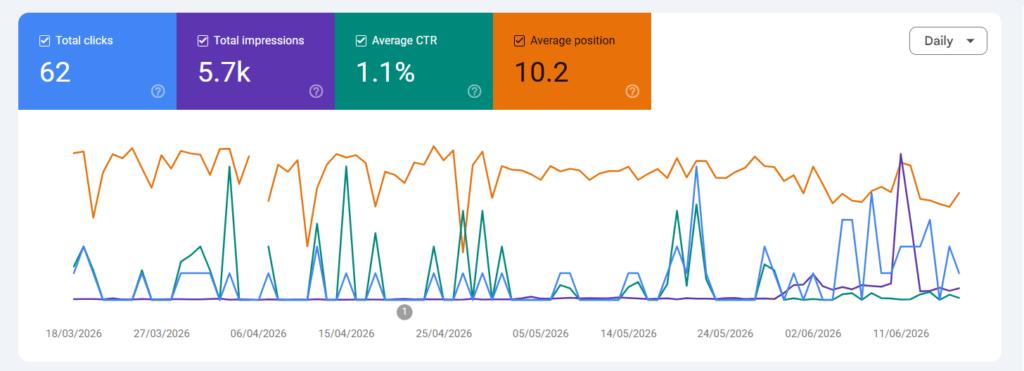
During the reporting period, the website achieved:
- 5.7K+ Organic Impressions
- 62 Organic Clicks
- 1.1% Click-Through Rate
- Average Position of 10.2
While these numbers may appear straightforward at first glance, their real significance becomes clearer when viewed through an SEO and search visibility perspective.
Before traffic increases significantly, search engines must first:
- Discover content
- Understand content
- Evaluate relevance
- Test rankings
- Expand visibility
The first major signal that this process is occurring is usually impression growth.
Why Impressions Matter
One of the strongest indicators of progress during this project was the growth in impressions.
Impressions represent the number of times a website appears within search results.
Whenever Google decides that a page may be relevant to a user’s search, an impression is recorded.
This means impressions reveal something very important:
Google’s willingness to show the website.
During the monitoring period, visibility expanded significantly, resulting in more than 5,700 impressions.
This indicates that Google increasingly associated the website with relevant topics and search queries.
For me, this was one of the most encouraging indicators because impressions often increase before traffic experiences major growth.
In many SEO campaigns, visibility acts as the foundation upon which future traffic growth is built.
Without impressions, clicks cannot occur.
Without visibility, rankings cannot improve.
Therefore, growing impressions represent an important milestone in any SEO project.
Understanding Average Position 10.2
Another important metric was the average ranking position of 10.2.
At first glance, this number might appear average.
However, within SEO, position 10.2 represents a particularly interesting stage of growth.
A position near 10 means that many keywords are hovering around:
- Bottom of Page One
- Top of Page Two
This creates substantial opportunity.
Moving a keyword from position 50 to position 30 may generate little visible impact.
Moving a keyword from position 10 to position 5 can dramatically increase traffic.
This is because click behavior changes significantly near the top of search results.
Users naturally gravitate toward higher-ranking results.
Therefore, a position of 10.2 suggests that the website is entering a stage where relatively small improvements can produce disproportionately large gains.
From a strategic perspective, this is often one of the most exciting stages of an SEO campaign.
The website has moved beyond the discovery phase and is approaching a stronger competitive position.
Evaluating Click Performance
The website generated 62 organic clicks during the reporting period.
While clicks are often the most visible metric, they should be interpreted alongside visibility data.
The relationship between impressions and clicks helps reveal whether search visibility is translating into actual engagement.
In this case, the click data demonstrated that users were beginning to interact with the website through search results.
As rankings continue improving and visibility expands further, there is significant potential for click growth.
The website has already established the foundation required for future increases.
The next stage involves improving positioning and increasing the percentage of impressions that convert into clicks.
Click-Through Rate Analysis
The click-through rate during the reporting period was 1.1%.
Although there remains room for improvement, CTR should always be evaluated within context.
Several factors influence CTR:
- Ranking position
- Search intent
- Competition
- SERP features
- User behavior
Because many keywords were positioned near the bottom of Page One or top of Page Two, a CTR of 1.1% is not unusual.
As rankings improve, CTR often improves naturally.
Future optimization opportunities may include:
- Improving page titles
- Enhancing meta descriptions
- Better matching user intent
- Strengthening search result appeal
These refinements can help increase engagement without necessarily increasing impressions.
What the Growth Trend Revealed
Beyond individual metrics, one of the most important observations came from the overall trend.
SEO success is not determined by isolated spikes.
It is determined by sustainable movement over time.
The performance data showed encouraging signs that visibility was gradually expanding.
This suggests that search engines were becoming increasingly confident in the website’s relevance.
Rather than relying on a single keyword or isolated ranking, the website appeared to be building broader search presence.
This type of growth is often more sustainable because it reflects expanding authority rather than dependence on a small number of rankings.
Key Lessons Learned
Every SEO project provides valuable lessons.
This project reinforced several principles that continue shaping my approach to organic search.
Lesson One: Visibility Comes Before Traffic
Many website owners focus exclusively on traffic.
However, traffic often arrives after visibility has already started growing.
The increase in impressions demonstrated that visibility was expanding before significant traffic growth occurred.
Understanding this relationship helps create more realistic expectations and better strategic decisions.
Lesson Two: Topical Authority Matters
Search engines increasingly reward expertise and depth.
The project reinforced the importance of building content ecosystems rather than isolated pages.
Strong topical authority supports both rankings and long-term discoverability.
Lesson Three: SEO Is a Continuous Process
There is rarely a single optimization that produces long-term success.
The strongest results usually emerge through consistent execution over time.
Research, monitoring, content development, authority building, and optimization must work together.
Lesson Four: Search Intent Drives Performance
Ranking for a keyword means little if the content fails to satisfy user expectations.
Understanding search intent remains one of the most important elements of modern SEO.
Lesson Five: AI Search Is Changing Optimization
The rise of AI-powered search experiences means websites must increasingly focus on expertise, information quality, and contextual relevance.
This project reinforced the growing connection between SEO, AEO, and GEO.
Future Growth Opportunities
Although the project produced encouraging results, several opportunities remain.
Future efforts may focus on:
Expanding Content Coverage
Additional content can help strengthen topical depth and authority.
Improving Internal Linking
More strategic internal relationships can strengthen content ecosystems.
Enhancing Entity Coverage
Broader entity development can improve contextual relevance.
Strengthening Authority Signals
Additional authority-building activities can support ranking growth.
Optimizing Existing Content
Content refreshes often produce strong returns because search engines already recognize those pages.
Improving CTR
Small adjustments to titles and descriptions can generate additional clicks without increasing impressions.
Frequently Asked Questions
What was the primary objective of this project?
The objective was to improve search visibility, strengthen topical authority, and establish a stronger foundation for long-term organic growth.
Why are impressions important?
Impressions reveal how often Google shows a website within search results. Growing impressions often indicate increasing relevance and visibility.
What does position 10.2 mean?
It means many keywords are approaching strong Page One visibility and have opportunities for further growth.
Why is topical authority important?
Topical authority helps search engines understand expertise and relevance across an entire subject area.
What role did AEO play?
AEO influenced content structure, information clarity, and answer-focused optimization.
What role did GEO play?
GEO influenced content depth, contextual relationships, expertise signals, and AI-search readiness.
Conclusion
This project demonstrated how a research-driven SEO strategy can contribute to meaningful improvements in search visibility.
Through search intent analysis, topical authority development, content strategy planning, performance monitoring, and continuous optimization, the website achieved growing visibility and stronger positioning within search results.
More importantly, the project highlighted the importance of adapting SEO strategies for a rapidly evolving search landscape. Traditional SEO remains valuable, but future success increasingly depends on how well websites support answer engines, AI retrieval systems, and generative search experiences.
For me, this project provided another valuable opportunity to strengthen my understanding of organic search, content ecosystems, topical authority, AEO, and GEO.
The lessons learned will continue influencing my future work as I explore new ways to help websites improve discoverability, build authority, and achieve sustainable organic growth.
About Soumyaditya Biswas
Soumyaditya Biswas is an SEO Executive specializing in Organic Search, Technical SEO, Content Strategy, Topical Authority Development, Answer Engine Optimization (AEO), and Generative Engine Optimization (GEO).
His work focuses on helping websites improve search visibility through research-driven strategies, performance analysis, content planning, and continuous optimization. Through practical SEO execution and ongoing experimentation, he aims to bridge traditional search optimization with the future of AI-powered discovery and search experiences.
Pingback: Organic Visibility Growth Case Study: 51.9K Impressions & 255 Clicks
Pingback: Organic Visibility Growth Case Study | International B2B SEO
Pingback: Healthcare SEO Case Study: 620% Click Growth & Visibility Improvement