
International B2B SEO Case Study: Improving Organic Visibility Through Strategic SEO Execution
Over the past few months, I have been actively involved in supporting the SEO growth of an international B2B website operating within a highly competitive luxury-focused industry. Due to client confidentiality and professional obligations, I am unable to disclose the company name, domain, or sensitive business information. However, I can share the overall SEO process, strategy, and measurable outcomes that resulted from the work completed during this period.
My role extended beyond routine SEO activities. I was involved in researching keyword opportunities, identifying content gaps, monitoring search performance, supporting content development, analyzing ranking movements, reviewing search intent patterns, and contributing to authority-building efforts. The objective was not simply to increase traffic but to create a stronger organic search foundation that could support long-term growth.
When I initially started reviewing the project, one of the first observations was that the website had significant potential to improve its visibility across search engines. While the business operated within a niche industry, there were numerous opportunities to expand keyword coverage, improve topical depth, and strengthen organic discoverability through a structured SEO approach.
Rather than focusing on isolated keywords, I concentrated on understanding how potential customers searched throughout different stages of their buying journey. This involved studying informational searches, commercial investigation queries, industry-related questions, and transactional opportunities. By analyzing these patterns, I was able to identify areas where additional content and optimization could support broader search visibility.
A major part of the process involved continuous monitoring through Google Search Console and performance analysis. Instead of making assumptions, I relied on actual search data to understand how Google was interpreting the website, which pages were receiving impressions, and where ranking opportunities existed. This allowed me to make decisions based on real search behavior rather than speculation.
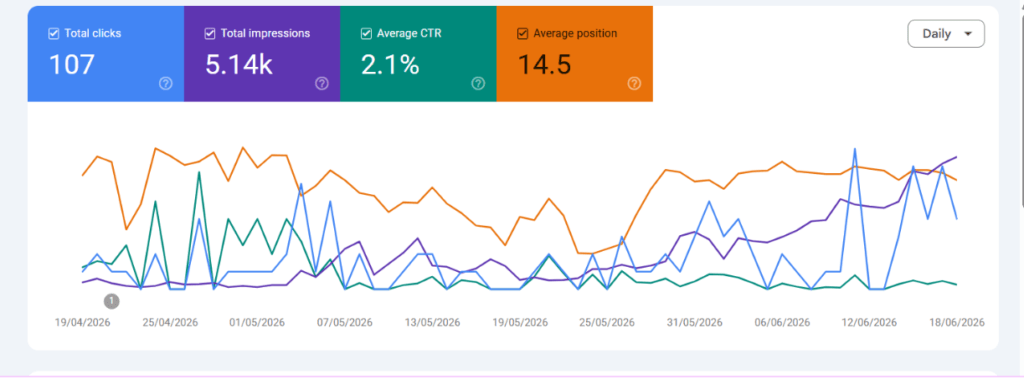
During the monitoring period, several encouraging trends began to emerge. Search impressions started showing a consistent upward trajectory, indicating that Google was gradually expanding the website’s visibility across a larger keyword footprint. This was particularly important because impressions often serve as an early indicator of growing search relevance before significant traffic increases occur.
The data also revealed that many keywords were moving closer to Page One and Page Two positions. This suggested that the website was beginning to establish stronger authority within its niche. While rankings alone are not the ultimate goal, they provided evidence that the optimization efforts were helping search engines better understand the site’s relevance for targeted topics.
Another important lesson from this project was the value of consistency. Organic growth rarely occurs because of a single optimization. Instead, it results from multiple activities working together over time. Research, content planning, search intent alignment, performance monitoring, and authority-building efforts all contributed to the overall outcome. Each improvement created additional opportunities for future growth.
As visibility increased, I continued evaluating which content themes generated the strongest search signals. This process helped identify future expansion opportunities and provided insights into how users interacted with industry-related topics. These findings would later influence content planning decisions and help strengthen topical coverage across the website.
The results achieved during this period demonstrated how a structured SEO approach can gradually improve organic visibility, even within a competitive B2B environment. While the project remains ongoing, the initial growth trends validated the strategy and provided a strong foundation for future optimization efforts.
In the next section, I will explain the research process, content strategy development, keyword opportunity analysis, and the specific SEO activities that contributed to the visibility improvements observed during the campaign.
Research, Optimization Strategy, and Performance Growth Analysis
Once the initial foundation was established, I shifted my focus toward understanding how search engines were interpreting the website and where the biggest opportunities for visibility growth existed. Rather than relying on assumptions, I used actual performance data to identify trends, opportunities, and areas that required further optimization.
One of the first things I analyzed was how search impressions were behaving over time. Search impressions are often one of the most overlooked metrics in SEO, but they provide a clear indication of how frequently Google is showing a website within search results. Even before significant traffic growth occurs, increasing impressions often signal that Google is gaining confidence in a site’s relevance across a broader range of search queries.
During the monitoring period, I observed a gradual increase in impressions, particularly during the latter half of the campaign. This indicated that the website was expanding its keyword footprint and beginning to appear more frequently for relevant searches. From an SEO perspective, this was an encouraging sign because visibility growth typically precedes traffic growth.
As impressions continued to increase, I analyzed whether ranking positions were improving alongside visibility. The data revealed that many keywords were moving into stronger positions within Google’s search results. Achieving an average position around the Page One and Page Two threshold demonstrated that the website was beginning to gain traction for competitive search terms.
This stage of SEO is often critical. Many websites spend months struggling to move beyond low-visibility rankings. However, once rankings start entering the second page and approaching the first page, relatively small improvements can produce significantly larger traffic gains. This insight helped guide the next phase of optimization efforts.
A major component of my work involved understanding search intent behind the keywords generating impressions. Search intent analysis is important because ranking alone does not guarantee traffic or conversions. Users perform searches with different objectives, and content must align with those objectives to perform effectively.
Through keyword and SERP analysis, I identified multiple intent categories that were driving visibility:
- Informational searches from users seeking industry knowledge.
- Comparative searches where users evaluated different options.
- Commercial investigation searches indicating buying interest.
- Transactional opportunities connected to purchase intent.
By understanding these intent categories, I could better support content development and optimization efforts. Instead of focusing on isolated keywords, I looked at broader topic relationships and content ecosystems.
This approach naturally led to a topical authority strategy.
Rather than creating standalone articles targeting unrelated keywords, I focused on how content pieces could support one another. Search engines increasingly evaluate websites based on topical depth and expertise rather than individual keyword optimization alone.
To strengthen topical authority, I helped identify content opportunities that could expand coverage around core themes while also addressing supporting questions users commonly ask during their research journey.
This process created stronger semantic relationships between pages and helped reinforce subject matter relevance across the website.
From an AEO (Answer Engine Optimization) perspective, I also considered how modern search engines and AI-powered search experiences process information.
Today’s search ecosystem extends beyond traditional rankings. Users increasingly interact with AI-generated answers, search summaries, featured snippets, and conversational search systems. Because of this shift, content needs to provide direct answers while also demonstrating expertise and contextual relevance.
Several optimization decisions were influenced by this reality.
Instead of focusing exclusively on keyword density or legacy SEO tactics, I emphasized:
- Clear information architecture.
- Search intent alignment.
- Entity relevance.
- Topic relationships.
- User-focused content structure.
These elements improve the likelihood of content being understood by both traditional search algorithms and emerging AI-driven retrieval systems.
From a GEO (Generative Engine Optimization) perspective, I paid close attention to how information was organized and connected across the website.
Generative search systems often prioritize content that demonstrates:
- Topical expertise.
- Information completeness.
- Contextual depth.
- Reliable information structures.
By contributing to content expansion and optimization efforts, I helped strengthen these signals and improve the website’s ability to establish authority within its subject area.
Another important aspect of the campaign involved ongoing performance monitoring.
SEO is not a one-time activity. Search behavior changes, rankings fluctuate, and new opportunities emerge continuously. Because of this, I regularly reviewed Search Console data to identify patterns that could influence future strategy decisions.
During these reviews, I noticed that visibility growth was becoming more consistent over time. Rather than relying on isolated ranking spikes, the website began demonstrating broader search presence across a growing number of queries.
This trend is often more valuable than short-term ranking fluctuations because it suggests sustainable growth rather than temporary performance gains.
The click-through rate data also provided useful insights.
While there remained opportunities for further improvement, the CTR indicated that users were engaging with search listings and that visibility was gradually translating into traffic. This suggested that ongoing title optimization, content refinement, and ranking improvements could unlock additional performance gains in future phases of the campaign.
One of the most important lessons I gained from this project was the relationship between visibility, authority, and patience.
Many people expect SEO results to appear immediately. In reality, sustainable SEO growth is usually the outcome of consistent execution over time. Search engines need signals of relevance, expertise, trustworthiness, and authority before significant ranking improvements occur.
Throughout the campaign, I observed how incremental improvements accumulated and contributed to broader visibility gains. Content enhancements, keyword targeting, performance monitoring, and authority-building activities worked together to create measurable progress.
As a result, the website achieved over five thousand search impressions and more than one hundred organic clicks during the reporting period while maintaining rankings that positioned many keywords within striking distance of Page One visibility.
Although there is still considerable room for growth, the results demonstrated that the strategy was moving in the right direction. The increasing impression trend, improving ranking positions, and growing search presence all indicated that the website was building momentum within organic search.
For me personally, this project provided valuable experience in applying SEO principles within a real-world environment. It reinforced the importance of combining research, execution, monitoring, and continuous optimization rather than relying on isolated tactics.
— Soumyaditya Biswas
SEO Executive | SEO Research & Organic Growth Enthusiast
SEO Execution, Authority Building, and Strategic Outcomes
One of the most important principles guiding my work throughout this project was that SEO success rarely comes from a single activity. Sustainable organic growth is usually the result of multiple initiatives working together. Content optimization, search intent alignment, performance monitoring, authority building, internal linking improvements, and ongoing refinement all contribute to the final outcome.
Because of this, I approached the project as an ecosystem rather than a collection of isolated tasks.
Content Expansion and Topical Authority Development
A major area of focus involved strengthening topical authority.
Search engines increasingly evaluate whether a website demonstrates comprehensive expertise within a subject area. Ranking for a single keyword is often less valuable than establishing broad authority across an entire topic cluster.
To support this objective, I participated in identifying content opportunities that could expand the website’s topical coverage while reinforcing relationships between existing pages.
Rather than creating content solely around individual keywords, I focused on understanding broader topic ecosystems.
This approach allowed the website to build stronger semantic relevance and improve its ability to rank for a wider range of related searches.
As additional content was introduced and existing content was strengthened, search engines gained more context regarding the website’s expertise and relevance.
This process contributed to the visibility improvements observed throughout the campaign period.
Search Intent Optimization
One lesson that became increasingly clear during this project was the importance of search intent alignment.
Many websites focus heavily on keywords while overlooking the actual needs behind those searches.
Throughout the campaign, I reviewed search behavior patterns and evaluated how different content assets aligned with user expectations.
This helped identify opportunities where content could better address informational, comparative, commercial, and transactional intent.
By improving alignment between content and user expectations, the website was better positioned to satisfy search demand and improve engagement signals.
Internal Content Relationships
Another area that received attention was strengthening relationships between content assets.
Internal linking is often underestimated despite playing a significant role in helping search engines understand content hierarchy and topical connections.
As new content opportunities were identified, I evaluated how pages could support one another through strategic internal linking.
This not only helps distribute authority throughout a website but also improves user navigation and content discovery.
Over time, stronger content relationships can contribute to improved crawling efficiency, deeper topical understanding, and stronger authority signals.
Performance Monitoring and Optimization
Continuous monitoring remained a core part of the project.
SEO campaigns generate valuable insights through performance data, and regular analysis often reveals opportunities that are not immediately obvious.
Using Search Console data, I reviewed trends related to:
- Search impressions
- Click activity
- Ranking movement
- Emerging keyword opportunities
- Visibility growth patterns
This process allowed me to identify which optimization efforts were producing measurable impact and where additional improvements could be prioritized.
One particularly encouraging observation was the consistency of visibility growth during the latter stages of the campaign.
Rather than relying on isolated ranking spikes, the website demonstrated broader search presence across a growing number of queries.
This type of growth is often a stronger indicator of long-term SEO health because it reflects expanding relevance rather than dependence on a small number of keywords.
Authority Building and Off-Page Support
While content and on-site optimization are essential components of SEO, authority signals also play an important role in competitive search environments.
Throughout the project, I contributed to authority-building efforts designed to strengthen the website’s overall trust profile.
The goal was not simply acquiring links but identifying opportunities that could support relevance, credibility, and discoverability.
Authority building is most effective when it complements strong content foundations.
As the website continued expanding its topical coverage, authority-building efforts helped reinforce those signals and support broader visibility objectives.
This combination of content depth and authority development created a stronger foundation for future ranking improvements.
Understanding the Performance Metrics
The results achieved during the reporting period provide several valuable insights.
The website generated:
- Over 5,000 search impressions
- More than 100 organic clicks
- A click-through rate exceeding 2%
- Average ranking positions approaching Page One visibility
While these numbers represent only one stage of an ongoing SEO journey, they demonstrate measurable progress.
The most significant metric, in my opinion, is not the click count.
It is the visibility trend.
The steady increase in impressions indicates that Google is recognizing the website across a broader keyword set.
This means the website is appearing in more searches, reaching more potential users, and establishing greater relevance within its topic space.
As visibility expands, opportunities for additional traffic naturally increase.
The average ranking position is also an important indicator.
Many keywords now appear within striking distance of Page One results.
From an SEO perspective, this creates significant potential because moving from Position 14 to Position 8 often produces larger traffic gains than moving from Position 80 to Position 40.
The website has reached a stage where targeted optimization efforts can generate disproportionately positive outcomes.
How This Project Supports Answer Engine Optimization (AEO)
Search behavior continues evolving beyond traditional search result pages.
Users increasingly expect direct answers rather than lengthy research processes.
Because of this shift, websites must provide clear, structured, and authoritative information that answer engines can easily understand.
Throughout this project, content planning and optimization efforts were influenced by AEO principles.
This included:
- Addressing user questions directly.
- Improving content clarity.
- Strengthening topical relationships.
- Expanding informational coverage.
- Organizing information logically.
These improvements help increase the likelihood that content can be surfaced within answer-oriented search experiences.
How This Project Supports Generative Engine Optimization (GEO)
Generative search experiences powered by AI systems are becoming increasingly important.
Unlike traditional search engines that rely primarily on ranking pages, generative systems often evaluate information quality, topic depth, contextual relationships, and expertise signals.
Many of the activities performed during this campaign naturally align with GEO best practices.
These include:
- Building topical authority.
- Expanding content ecosystems.
- Strengthening semantic relevance.
- Improving information completeness.
- Demonstrating subject matter expertise.
As AI-driven discovery continues expanding, websites that establish strong topic coverage and trustworthy information structures will likely benefit most.
Key Lessons Learned
Several important lessons emerged from this project.
First, visibility growth often occurs before traffic growth.
Second, topical authority is built through consistency rather than isolated content pieces.
Third, data-driven decision making produces stronger outcomes than assumptions.
Fourth, search intent should always guide optimization efforts.
Finally, modern SEO increasingly intersects with AEO and GEO, making information quality and expertise more important than ever.
Final Thoughts
This project provided valuable hands-on experience in applying SEO principles within a real-world environment while supporting measurable organic growth.
By combining research, optimization, monitoring, content strategy, and authority-building activities, I was able to contribute to improvements in search visibility and overall organic performance.
More importantly, this experience reinforced my belief that successful SEO is not about chasing algorithms. It is about understanding users, organizing information effectively, building authority gradually, and creating content ecosystems that remain valuable over time.
As I continue developing my expertise in SEO, Technical SEO, AEO, GEO, and organic growth strategy, the lessons from projects like this continue shaping my approach toward sustainable search performance.
About Soumyaditya Biswas
Soumyaditya Biswas is an SEO Executive with a strong interest in Organic Search, Technical SEO, Content Strategy, Topical Authority Development, Answer Engine Optimization (AEO), and Generative Engine Optimization (GEO).
His work focuses on understanding search behavior, identifying growth opportunities, improving content ecosystems, and supporting long-term organic visibility through research-driven SEO strategies. Through continuous experimentation, analysis, and execution, he aims to bridge traditional SEO principles with the evolving landscape of AI-powered search and discovery.
Future Opportunities, Strategic Roadmap, and Long-Term SEO Growth Potential
While the progress achieved during this campaign was encouraging, one of the most important aspects of SEO is understanding that growth is rarely linear. Every improvement creates new opportunities, and every stage of progress reveals additional areas for optimization.
After analyzing the performance data, visibility trends, ranking improvements, and search behavior patterns, I identified several opportunities that could contribute to continued growth in future phases of the campaign.
Expanding Existing Topic Coverage
One of the biggest opportunities involves deepening content coverage around subjects that are already generating impressions.
Search Console data frequently reveals keywords and search queries that are receiving visibility but may not yet have dedicated supporting content. These opportunities are valuable because Google is already associating the website with those topics.
By expanding coverage around these emerging themes, the website can strengthen relevance and increase its chances of achieving higher rankings.
Rather than continuously pursuing entirely new topics, strengthening existing topical authority often produces stronger results.
Strengthening Page One Opportunities
The average ranking position observed during the reporting period indicates that many keywords are approaching Page One visibility.
This creates a particularly attractive optimization opportunity.
Keywords ranking between positions 8 and 20 often require significantly less effort to improve than keywords ranking beyond position 50.
Future efforts can focus on:
- Content refreshes
- Search intent alignment
- Internal linking improvements
- Authority reinforcement
- Content depth enhancements
These optimizations can help move existing rankings closer to the top positions where click-through rates are substantially higher.
Increasing Topical Depth
As search engines continue evolving, topic completeness becomes increasingly important.
Future content development should focus on creating a deeper ecosystem around the website’s core subject matter.
Instead of publishing isolated articles, content should continue supporting broader knowledge networks that demonstrate expertise from multiple angles.
This approach not only supports traditional SEO but also aligns with modern AI-driven search experiences.
Authority Signal Expansion
Although authority-building efforts contributed to the campaign, there remains substantial opportunity to strengthen trust and credibility signals.
Future initiatives may include:
- Industry references
- Relevant citations
- Authority partnerships
- Thought leadership contributions
- Digital PR opportunities
As authority signals improve, search engines gain additional confidence in the website’s expertise and reliability.
Technical SEO Considerations
Technical SEO remains an ongoing process rather than a one-time implementation.
Future monitoring should continue evaluating:
- Crawl efficiency
- Indexation quality
- Page experience
- Core Web Vitals
- Structured data opportunities
- Internal architecture
These technical foundations support all future SEO activities and ensure that content can be effectively discovered and evaluated by search engines.
The Role of AI Search in Future Optimization
The search landscape continues changing rapidly.
Traditional ranking signals remain important, but AI-powered discovery systems are introducing additional considerations.
Future optimization strategies should increasingly focus on:
- Entity development
- Information completeness
- Expertise demonstration
- Contextual relevance
- Semantic relationships
Websites that successfully adapt to these changes are likely to remain competitive across both traditional search engines and emerging AI-driven platforms.
Personal Reflection
One of the most valuable aspects of this project was seeing how consistent effort produces measurable progress over time.
The growth observed during this campaign was not the result of a single tactic. Instead, it emerged through ongoing research, monitoring, content planning, optimization, and authority-building activities working together.
This reinforced the importance of patience and consistency in SEO.
Every improvement contributed to a larger system designed to strengthen visibility, relevance, and long-term performance.
The experience also strengthened my understanding of how SEO, AEO, and GEO increasingly overlap. Modern search optimization is no longer limited to rankings alone. It involves building content ecosystems capable of serving both traditional search engines and AI-powered information retrieval systems.
For me, this project served as another important step in developing practical SEO expertise and understanding how strategic execution translates into measurable search growth.
Frequently Asked Questions (FAQ)
What was the primary objective of this SEO project?
The primary objective was to improve organic search visibility, strengthen topical authority, increase keyword coverage, and create a stronger foundation for long-term search performance.
How long was the reporting period analyzed in this case study?
The performance analysis covered approximately two months of SEO activity and monitoring.
What metrics were used to evaluate progress?
The project focused on key SEO performance indicators including impressions, clicks, click-through rate (CTR), and average ranking position.
Why are impressions important in SEO?
Impressions indicate how frequently a website appears in search results. Growing impressions often suggest expanding keyword visibility and increasing search relevance.
What does an average position of 14.5 indicate?
An average position of 14.5 suggests that many keywords are ranking near the top of Page Two and approaching Page One visibility, creating opportunities for future traffic growth.
What role did content strategy play in the campaign?
Content strategy helped strengthen topical authority by expanding coverage around relevant subjects, supporting user intent, and creating stronger semantic relationships between content assets.
How does internal linking support SEO?
Internal linking helps search engines understand content relationships, distribute authority throughout a website, and improve content discoverability for users.
What is topical authority?
Topical authority refers to a website’s demonstrated expertise and depth of coverage within a specific subject area. Strong topical authority can improve search visibility across related topics.
What is Answer Engine Optimization (AEO)?
AEO focuses on structuring content so that search engines and answer engines can easily understand and surface direct answers to user questions.
What is Generative Engine Optimization (GEO)?
GEO focuses on optimizing content for AI-powered search systems that generate responses using information from multiple sources rather than simply ranking webpages.
Why is SEO a long-term strategy?
SEO requires ongoing research, optimization, content development, and authority building. Sustainable growth typically occurs through consistent effort over time rather than immediate changes.
What was the biggest lesson learned from this project?
One of the biggest lessons was that increasing visibility often occurs before substantial traffic growth. Consistent optimization and topical authority development create the foundation for future growth strategies.
Conclusion
This case study demonstrates how a structured, research-driven SEO approach can contribute to measurable improvements in search visibility over time. Through continuous monitoring, content planning, topical authority development, optimization activities, and authority-building efforts, the project achieved encouraging growth signals and established a stronger foundation for future organic performance.
Rather than focusing solely on rankings, the strategy emphasized understanding search intent, strengthening content ecosystems, improving discoverability, and supporting long-term search relevance. The resulting increase in impressions, growing keyword visibility, improving ranking positions, and broader search presence reflected the cumulative impact of these efforts.
The project also highlighted the growing relationship between traditional SEO, Answer Engine Optimization (AEO), and Generative Engine Optimization (GEO). As search technology continues evolving, websites that prioritize expertise, content depth, contextual relevance, and information quality will be best positioned for sustainable success.
For me, this experience reinforced the importance of combining research, strategic thinking, execution, and continuous optimization. It demonstrated that meaningful SEO growth is rarely achieved through isolated tactics but through consistent efforts that collectively improve visibility, authority, and user value.
As I continue expanding my expertise in SEO, Technical SEO, Content Strategy, AEO, and GEO, projects like this provide valuable real-world insights into how search ecosystems evolve and how data-driven decision-making can support long-term organic growth.
— Soumyaditya Biswas
SEO Executive | Organic Growth Enthusiast | Technical SEO Learner | AEO & GEO Researcher
Pingback: B2B Technology SEO Case Study: Improving Organic Visibility
Pingback: Organic Visibility Growth Case Study: 51.9K Impressions & 255 Clicks
Pingback: Organic Visibility Growth Case Study | International B2B SEO
Pingback: Healthcare SEO Case Study: 620% Click Growth & Visibility Improvement