
Organic Visibility Growth Case Study: From 336 to 4,731 Daily Impressions Through Strategic SEO Execution
This Organic Visibility Growth Case Study documents how a structured SEO approach contributed to significant search visibility improvements for an international B2B website operating in a competitive digital environment.
Due to confidentiality agreements and professional responsibilities, the company name, website domain, industry-specific identifiers, and proprietary business information have been intentionally omitted. However, the SEO process, strategic thinking, performance analysis, and measurable outcomes can be shared to demonstrate the impact of consistent optimization efforts.
As the SEO Executive involved in this project, I, Soumyaditya Biswas, was responsible for several critical SEO functions, including keyword research, competitor analysis, search intent mapping, backlink acquisition support, performance monitoring, Google Search Console analysis, visibility tracking, optimization recommendations, and ongoing SEO reporting.
The objective was not simply to increase rankings for a handful of keywords. Instead, the goal was to improve overall search visibility, strengthen topical relevance, expand keyword coverage, and create a stronger foundation for long-term organic growth.
In modern SEO, visibility often matters more than short-term traffic spikes. Before a website can generate substantial organic traffic, search engines must first recognize the relevance and authority of its content. This recognition typically appears through increased impressions, broader keyword coverage, and stronger search presence.
This case study focuses on that exact process.
Understanding the Initial Situation
When I initially began analyzing the website’s search performance, one of the first priorities was establishing a baseline.
Many SEO projects fail because execution begins before understanding the current situation. Without baseline metrics, measuring progress becomes difficult and often leads to inaccurate conclusions.
The initial review focused on several areas:
- Search visibility trends
- Keyword coverage
- Search Console performance
- Search intent opportunities
- Content expansion potential
- Authority-building opportunities
- Competitor positioning
The website already had a presence within Google Search. However, there were clear opportunities to improve how frequently it appeared for relevant search queries.
Rather than focusing only on rankings, I concentrated on understanding how Google was interpreting the website and where opportunities existed to expand search visibility.
One of the most important observations was that the website had untapped potential.
Search engines were already indexing the content and generating impressions, but there was room to increase discoverability through better optimization, improved topical relevance, and stronger authority signals.
This insight shaped the overall direction of the campaign.
Why Organic Visibility Was The Primary KPI
Many businesses focus almost exclusively on traffic numbers.
While traffic is important, visibility often serves as the leading indicator of future growth.
Every organic click begins with an impression.
Every ranking improvement begins with visibility.
Every traffic increase begins with search exposure.
Because of this, I prioritized visibility metrics as one of the core indicators of campaign performance.
“How many clicks are we getting today?”
I focused on questions such as:
- How many searches are we appearing for?
- Is keyword coverage increasing?
- Are impressions growing consistently?
- Is Google expanding our visibility footprint?
- Are we building stronger topical relevance?
These questions provided a more complete picture of organic growth.
My Responsibilities As SEO Executive
Throughout the project, my role extended beyond a single SEO function.
I contributed across multiple areas of the optimization process.
Keyword Research
Keyword research formed the foundation of the strategy.
Rather than targeting keywords based solely on search volume, I focused on identifying opportunities that aligned with search intent, business relevance, and topical authority development.
This included:
- Primary keyword opportunities
- Long-tail keyword opportunities
- Informational queries
- Commercial intent searches
- Supporting topic opportunities
The goal was to understand how users searched throughout different stages of their journey.
Search Intent Analysis
Search intent remains one of the most important factors in modern SEO.
Ranking for a keyword means little if the content fails to satisfy the user’s expectations.
I analyzed search behavior to understand:
- Informational intent
- Comparative intent
- Commercial investigation intent
- Transactional intent
This analysis helped identify opportunities where content could better align with user needs.
Competitor Research
Competitor analysis provided valuable insights into what search engines were already rewarding.
I reviewed:
- Content structures
- Topic coverage
- Keyword focus areas
- Authority-building approaches
- Search visibility patterns
This process helped reveal content gaps and opportunities for expansion.
Backlink Building Support
Authority signals remain an important component of SEO.
As part of the project, I contributed to backlink research and acquisition activities designed to strengthen the website’s overall trust profile.
The objective was not simply acquiring links.
Instead, the focus was on obtaining relevant signals capable of supporting long-term organic growth.
Performance Monitoring
A significant portion of my work involved monitoring performance data.
Google Search Console served as one of the primary sources of insight throughout the campaign.
I regularly analyzed:
- Impressions
- Clicks
- CTR
- Ranking positions
- Query trends
- Visibility patterns
These insights guided future optimization decisions and helped identify emerging opportunities.
Research Before Execution
One principle I consistently follow is simple:
Research should always precede execution.
SEO decisions become significantly more effective when supported by data rather than assumptions.
Before implementing recommendations, I spent time understanding:
- What users were searching for
- Which topics generated visibility
- Where competitors were outperforming
- What content opportunities existed
- Which areas required improvement
This research phase established the strategic foundation for all future optimization activities.
Rather than chasing isolated rankings, the objective became building a stronger content ecosystem capable of supporting long-term visibility growth.
That approach would later play an important role in the visibility gains observed during the reporting period.
Building The Foundation For Growth
By the end of the initial research and analysis phase, several conclusions had become clear.
The website possessed growth potential.
Search engines were already recognizing the content.
Keyword opportunities existed.
Visibility expansion opportunities existed.
Authority-building opportunities existed.
Most importantly, there was evidence that a structured SEO strategy could significantly increase the website’s search presence over time.
With the research phase complete, the next stage focused on transforming insights into execution.
SEO Execution Strategy, Keyword Expansion, Backlink Development, and Organic Visibility Growth
Transforming Research Into SEO Execution
After completing the initial research phase, the next step involved converting insights into actionable SEO activities. Research alone does not improve search visibility. Growth occurs when analysis is transformed into execution, monitoring, and continuous optimization.
Based on the findings from the initial assessment, several opportunities became clear:
- Improve keyword coverage
- Strengthen topical relevance
- Expand search visibility
- Support authority development
- Increase search engine discoverability
- Improve overall organic presence
Rather than focusing on one isolated SEO tactic, I approached the project through a combination of content research, keyword expansion, backlink support, search intent alignment, and ongoing performance monitoring.
This integrated approach would eventually contribute to the visibility improvements observed during the reporting period.
Developing a Keyword Research Framework
One of the first priorities was strengthening keyword coverage.
Many websites focus heavily on a small set of keywords while ignoring hundreds of related search opportunities.
As part of my responsibilities, I conducted extensive keyword research to identify opportunities that aligned with:
- User intent
- Business relevance
- Search demand
- Content opportunities
- Topical authority goals
The objective was not simply finding keywords with high search volume.
Instead, I focused on identifying search terms that could contribute to broader topic coverage and long-term visibility growth.
Understanding Search Intent
Every keyword reflects a user objective.
Some users search to learn.
Some search to compare.
Others search to evaluate solutions.
Some are ready to take action.
Because of this, I categorized opportunities based on intent.
Informational Intent
These users wanted answers, explanations, and educational content.
Commercial Intent
These users were evaluating solutions and comparing alternatives.
Transactional Intent
These users demonstrated stronger action-oriented behavior.
Understanding these differences helped create a more strategic approach to content planning and optimization.
Building Topical Relevance
One of the most important observations during competitor research was that successful websites were not relying solely on commercial pages.
Instead, they were building topical authority through broader content ecosystems.
Search engines increasingly reward websites that demonstrate expertise across an entire subject area.
Because of this, I focused on identifying ways to strengthen topical relevance.
The strategy included:
- Supporting content opportunities
- Topic expansion opportunities
- Related search coverage
- Question-based content opportunities
- Semantic keyword coverage
The goal was to help search engines better understand the website’s expertise and relevance.
Rather than creating isolated pages, the objective was to build stronger content relationships.
This approach supports both traditional SEO and emerging AI-driven search systems.
Supporting Content Optimization
As opportunities were identified, optimization efforts focused on improving content alignment with search intent.
This included reviewing:
- Content relevance
- Topic coverage
- Search intent matching
- Keyword placement
- Information completeness
One important lesson from modern SEO is that content quality matters more than keyword density.
Search engines have become increasingly sophisticated in understanding context, meaning, and user satisfaction.
Because of this, optimization efforts emphasized usefulness and relevance rather than keyword repetition.
Backlink Research and Authority Development
Backlinks remain an important ranking factor because they help search engines evaluate trust, credibility, and authority.
As part of the project, I participated in backlink research and acquisition support activities.
The objective was not to acquire links randomly.
Instead, the focus was on identifying opportunities that could contribute to:
- Authority growth
- Relevance
- Trust signals
- Organic visibility
Why Backlinks Matter
Search engines view backlinks as signals of credibility.
When relevant websites reference a resource, it can strengthen confidence in that content.
However, quality matters far more than quantity.
This is why backlink activities focused on relevance rather than volume.
The goal was to contribute to long-term authority development rather than short-term ranking manipulation.
Continuous Performance Monitoring
SEO is not a one-time activity.
One of my primary responsibilities throughout the campaign involved monitoring search performance and identifying trends.
Google Search Console became one of the most valuable tools during this process.
I regularly reviewed:
- Search impressions
- Organic clicks
- CTR trends
- Average positions
- Emerging search queries
- Visibility growth patterns
These metrics provided insight into how Google was interpreting the website.
More importantly, they revealed whether optimization efforts were contributing to increased visibility.
Identifying Early Signs of Growth
One of the most encouraging indicators appeared through impression growth.
Many people focus immediately on clicks.
However, impressions often reveal progress earlier than traffic.
Increasing impressions indicate that Google is expanding a website’s search presence and associating it with a broader range of search queries.
During the reporting period, visibility began showing encouraging signs of expansion.
As impressions increased, it became clear that the website was gaining stronger search exposure.
This was an important milestone because visibility growth typically creates the foundation for future traffic growth.
Organic Visibility Growth Analysis
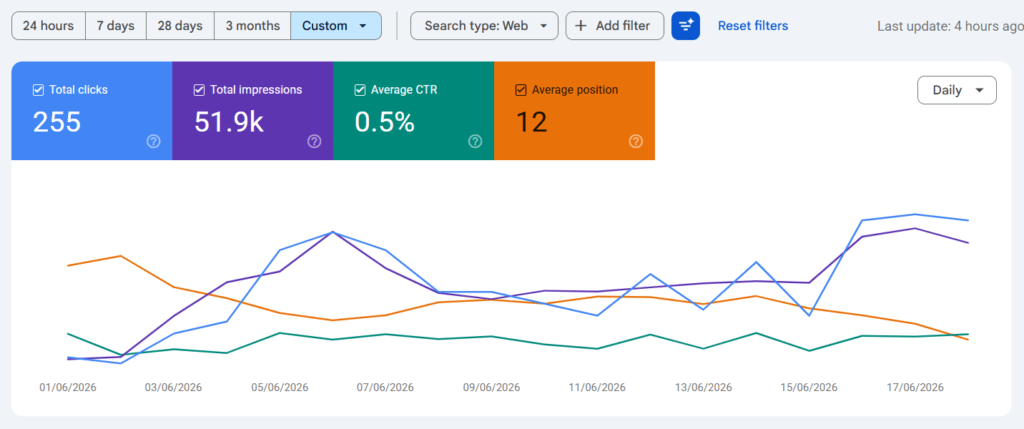
The reporting period covered approximately eighteen days of measurable performance data.
During this period, several important milestones were observed.
Starting Point
On 1 June 2026:
- 336 impressions
- 2 clicks
Peak Visibility Point
On 17 June 2026:
- 4,731 impressions
- 26 clicks
This represented substantial visibility expansion over a relatively short period.
What The Growth Indicates
The increase in impressions suggests that:
- Keyword coverage expanded
- Search visibility increased
- Google associated the website with more search queries
- Organic discoverability improved
From an SEO perspective, these are highly encouraging signals.
While impressions alone do not guarantee business outcomes, they demonstrate increasing search relevance and growing visibility.
Why Visibility Matters More Than Most People Realize
Many website owners judge SEO solely through traffic numbers.
While traffic remains important, visibility is often the leading indicator of future growth.
Every click begins with an impression.
Every ranking improvement begins with discoverability.
Every traffic increase begins with search exposure.
This is why visibility became one of the most important KPIs throughout the project.
By focusing on visibility expansion, the strategy aimed to create sustainable long-term growth rather than short-term fluctuations.
Search Visibility as a Long-Term Asset
One of the most valuable lessons from this project is that organic visibility compounds over time.
When search engines gain confidence in a website:
- More keywords become visible.
- More pages appear in search.
- More opportunities emerge.
- Greater authority develops.
These improvements rarely occur overnight.
They result from consistent execution across multiple areas of SEO.
Keyword research, content planning, backlink support, search intent analysis, and ongoing monitoring all contribute to the broader growth process.
Preparing for the Next Stage
By the conclusion of this phase, the website demonstrated clear signs of increasing visibility and expanding search presence.
Keyword coverage was improving.
Search impressions were growing.
Organic clicks were increasing.
Authority signals were strengthening.
Most importantly, the data suggested that the SEO strategy was moving in the right direction.
Performance Results, Growth Analysis, Key Learnings, Future Opportunities, and Final Takeaways
Measuring the Impact of Organic Visibility Growth
After completing the research, keyword analysis, backlink support activities, search intent evaluation, performance monitoring, and optimization efforts, the next step was analyzing the results.
SEO is ultimately measured by outcomes rather than activities.
Research matters.
Optimization matters.
Backlinks matter.
Content planning matters.
However, the true value of SEO becomes visible when search engines begin expanding a website’s visibility and users start discovering the website through organic search.
This is where performance analysis becomes important.
Rather than relying on assumptions, I used actual Search Console performance data to evaluate the effectiveness of the SEO activities performed throughout the reporting period.
The results revealed several encouraging trends that demonstrated growing search visibility and stronger organic discoverability.
Organic Visibility Growth Results
The reporting period analyzed in this case study covered 1 June 2026 through 18 June 2026.
During this period, the website achieved:
Search Performance Summary
- 51.9K Organic Impressions
- 255 Organic Clicks
- 0.5% Click Through Rate
- Average Position: 12
These numbers provide valuable insight into how search engines interacted with the website during the campaign period.
While many SEO case studies focus exclusively on traffic, I believe visibility tells a much more complete story.
Visibility is often the first indicator that search engines are gaining confidence in a website.
As visibility expands, rankings improve, keyword coverage grows, and traffic opportunities increase.
This relationship became very clear throughout this campaign.
Understanding the Starting Point
The campaign began with relatively modest daily visibility.
1 June 2026
- Impressions: 336
- Clicks: 2
- Position: 7.6
At this stage, the website had search visibility but was not yet maximizing its potential.
Search exposure existed, but there was significant room for expansion.
This is often where many SEO projects begin.
The website is indexed.
Some rankings exist.
Some impressions occur.
However, broader visibility growth opportunities remain available.
My focus was on identifying and supporting those opportunities.
The Visibility Expansion Phase
One of the most significant developments occurred during the first week of June.
Visibility began increasing rapidly.
3 June 2026
- 1,791 impressions
4 June 2026
- 2,920 impressions
5 June 2026
- 3,283 impressions
6 June 2026
- 4,619 impressions
Within only a few days, search visibility expanded dramatically.
This increase suggested that Google was associating the website with a broader range of search queries and increasing its presence within search results.
From an SEO perspective, this was one of the strongest indicators that the optimization strategy was beginning to gain traction.
The website was no longer competing for a small collection of search terms.
Instead, it was expanding its overall keyword footprint.
The Strongest Growth Period
When evaluating the reporting period, one section stands out as the strongest growth phase.
Growth Period
3 June 2026 → 17 June 2026
During this period:
Impressions
1,791 → 4,731
Clicks
6 → 26
This represented substantial growth in both visibility and engagement.
The increase in impressions indicated expanding search exposure.
The increase in clicks demonstrated that users were beginning to interact with that visibility.
This combination is particularly important because visibility alone is not enough.
Growth becomes meaningful when visibility starts generating engagement.
Peak Performance Day
One of the most important milestones occurred on:
17 June 2026
Performance reached:
- 4,731 impressions
- 26 clicks
This represented the highest visibility day observed during the reporting period.
From an SEO perspective, this peak demonstrates several important outcomes.
It suggests:
- Increased keyword coverage
- Improved search discoverability
- Expanded search engine trust
- Greater organic reach
Most importantly, it provided evidence that the website was moving in the right direction.
What The Impression Growth Means
Many people underestimate impressions.
However, impressions are one of the most valuable indicators available within SEO.
Every impression represents an opportunity.
Every impression indicates that Google has chosen to display a page within search results.
When impressions increase consistently, it often means:
- More keywords are ranking.
- More pages are appearing in search.
- More topical relevance is being recognized.
- More authority signals are being acknowledged.
The growth from 336 daily impressions to 4,731 daily impressions represents a substantial increase in search exposure.
This type of growth does not happen accidentally.
It is typically the result of multiple SEO activities working together over time.
Organic Click Growth Analysis
While impressions were the primary KPI for this project, click growth also provided encouraging signals.
The reporting period began with:
1 June
2 clicks
The peak reached:
17 June
26 clicks
This represents a significant increase in organic engagement.
As search visibility expanded, more users discovered the website through Google Search.
This relationship between impressions and clicks reinforces an important SEO principle:
Visibility growth creates traffic opportunities.
Without impressions, clicks cannot occur.
Without search exposure, users cannot discover content.
The increasing click trend suggested that growing visibility was beginning to translate into meaningful engagement.
Understanding Average Position
The average position during the reporting period remained close to:
Position 12
Some readers may view this as a weakness.
I view it differently.
Position 12 indicates that many keywords are competing near Page One visibility.
This creates substantial future opportunity.
The difference between Position 12 and Position 6 can often produce dramatic increases in clicks without requiring additional impressions.
In other words, the visibility foundation already exists.
Future optimization efforts can focus on moving rankings closer to the top positions where click-through rates are naturally higher.
Key Lessons Learned
Every SEO project provides valuable insights.
Several important lessons emerged throughout this campaign.
Visibility Comes Before Traffic
One of the strongest lessons was that visibility often increases before traffic.
Many businesses focus exclusively on clicks.
However, impression growth often provides earlier evidence of progress.
The visibility expansion observed throughout this campaign demonstrates this principle clearly.
Consistency Matters
SEO rewards consistent execution.
Research, monitoring, optimization, backlink activities, and content improvements collectively contribute to long-term growth.
No single activity creates sustainable results on its own.
Search Intent Remains Critical
Keywords alone are not enough.
Understanding why users search and what information they expect remains one of the most important components of SEO success.
Authority Development Takes Time
Building trust with search engines requires consistency.
Authority grows gradually through content quality, relevance, backlinks, and user-focused optimization.
Future Opportunities
Although the results achieved were encouraging, several opportunities remain available for future growth.
CTR Optimization
The current CTR provides opportunities for improvement.
Future efforts may focus on:
- Title optimization
- Meta description improvements
- Search snippet enhancement
Content Expansion
Additional content can strengthen topical authority and increase keyword coverage.
Internal Linking
Stronger content relationships can improve discoverability and authority distribution.
Authority Building
Continued backlink acquisition and authority-building activities can support future ranking improvements.
Final Thoughts
This Organic Visibility Growth Case Study demonstrates how structured SEO execution can contribute to meaningful improvements in search exposure and discoverability.
Through keyword research, search intent analysis, backlink support, competitor research, performance monitoring, and ongoing optimization, the website achieved significant visibility growth during the reporting period.
The increase from 336 daily impressions to a peak of 4,731 daily impressions highlights the value of consistent SEO execution and long-term strategic thinking.
Most importantly, this project reinforced a principle that continues shaping my approach to SEO:
Sustainable organic growth is not created through shortcuts.
It is built through research, execution, monitoring, optimization, and continuous improvement.
As search engines continue evolving, websites that prioritize relevance, authority, user value, and search intent alignment will remain best positioned for long-term success.
Frequently Asked Questions (FAQ)
What is an Organic Visibility Growth Case Study?
An Organic Visibility Growth Case Study is a detailed SEO analysis that demonstrates how search visibility, impressions, keyword coverage, and organic traffic opportunities improved over a defined reporting period through strategic SEO activities.
Why is organic visibility important in SEO?
Organic visibility determines how frequently a website appears in search engine results. Without visibility, users cannot discover content, products, or services through search engines. Visibility often serves as the foundation for future traffic growth.
How do impressions help measure SEO performance?
Impressions show how many times a website appears in search results. Growing impressions generally indicate that search engines are recognizing more content, ranking more keywords, and expanding the website’s search presence.
Can impressions increase before traffic increases?
Yes. In many SEO campaigns, impression growth occurs before significant click growth. Search engines often test and expand visibility before users begin interacting with search listings at higher volumes.
What was the primary objective of this project?
The primary objective was to improve search visibility, increase keyword coverage, strengthen discoverability, and establish a stronger foundation for long-term organic growth.
What SEO responsibilities were handled during this project?
The project involved multiple SEO responsibilities including keyword research, competitor analysis, search intent analysis, backlink support, performance monitoring, Google Search Console analysis, visibility tracking, optimization planning, and ongoing SEO reporting.
How important is keyword research for organic growth?
Keyword research is one of the most important SEO activities because it helps identify search opportunities, understand user intent, discover content gaps, and support stronger search visibility.
What role does search intent play in SEO?
Search intent helps determine why users perform specific searches. Content that aligns closely with user intent generally performs better because it satisfies search expectations more effectively.
Why are backlinks still important for SEO?
Backlinks continue to act as authority and trust signals. Relevant backlinks help search engines evaluate credibility and can contribute to stronger organic visibility over time.
What is topical authority?
Topical authority refers to a website’s ability to demonstrate expertise across an entire subject area rather than focusing on isolated keywords. Strong topical authority often improves long-term search visibility.
What was the strongest growth period in this case study?
The strongest visibility growth period occurred between 3 June 2026 and 17 June 2026, during which daily impressions increased from 1,791 to 4,731 while daily clicks increased from 6 to 26.
What was the highest-performing day during the reporting period?
The highest-performing day was 17 June 2026, when the website achieved 4,731 impressions and 26 organic clicks.
Why wasn’t CTR the primary focus of this case study?
The primary objective was organic visibility growth. While CTR remains important, impression growth and search visibility expansion were the most significant indicators of progress during this reporting period.
How can CTR be improved in future optimization efforts?
CTR improvements may come from better title optimization, stronger meta descriptions, improved search intent alignment, richer search snippets, and stronger positioning within search results.
What lessons were learned from this SEO project?
The project reinforced several key lessons:
- Visibility often grows before traffic.
- Consistent SEO execution produces stronger long-term results.
- Search intent remains critical for ranking success.
- Authority-building contributes to organic growth.
- Data-driven decision-making leads to better optimization outcomes.
What future opportunities exist for continued growth?
Future growth opportunities include:
- Content expansion
- Internal linking improvements
- Additional authority-building activities
- CTR optimization
- Topic cluster development
- Technical SEO enhancements
- Expanded keyword targeting
Who conducted the SEO activities described in this case study?
The SEO activities, research, monitoring, reporting, and optimization support described throughout this case study were handled by Soumyaditya Biswas, SEO Executive, as part of the broader organic growth initiative.
Pingback: Organic Visibility Growth Case Study | International B2B SEO
Pingback: Healthcare SEO Case Study: 620% Click Growth & Visibility Improvement
Pingback: Digital Marketing for Gastroenterology Clinics | Growth
Having a bookie that never sleeps is a game changer for busy schedules. I can place pre match or in play wagers whenever inspiration strikes and the settlement process is always accurate. The mobile optimized design fits my daily routine perfectly. Start playing at betbook247login