
Organic Visibility Growth Case Study: Improving Search Performance for an International B2B Commercial Website
In today’s competitive digital landscape, organic search visibility is no longer driven by a single ranking factor. Sustainable growth requires a combination of search intent analysis, keyword intelligence, content architecture, topical authority development, backlink acquisition, and continuous performance monitoring.
This Organic Visibility Growth Case Study documents a real-world SEO project where search visibility improved significantly during the optimization period. Due to confidentiality obligations and ongoing business agreements, the client identity, website domain, geographic location, and industry-specific details have been intentionally withheld. However, the SEO methodology, responsibilities, and measurable outcomes remain fully authentic.
As an SEO Executive, Soumyaditya Biswas participated in multiple stages of the optimization process, including keyword research, search intent mapping, content planning, entity analysis, backlink support, performance monitoring, and visibility tracking. The objective was not merely to improve rankings for a handful of keywords but to create a structured framework capable of supporting long-term organic growth.
Project Overview
Project Type
- International B2B Commercial Website (Identity Confidential)
- Established Commercial Organization
- Competitive Search Environment
- Ongoing SEO Growth Initiative
My Role
During the reporting period, my responsibilities included:
- Advanced keyword research
- Search intent analysis
- Keyword clustering
- Topic mapping
- Content strategy support
- Backlink acquisition support
- Search Console monitoring
- SEO performance reporting
- Visibility trend analysis
- GEO and AEO-friendly content structuring
- Entity research and optimization support
Initial Challenges Identified
Before the optimization activities began, several opportunities for improvement were identified.
Visibility Challenges
The website was receiving limited search exposure across important keyword segments.
Key observations included:
- Inconsistent keyword coverage
- Limited topical depth
- Underutilized content opportunities
- Fragmented search intent targeting
- Limited authority signals across selected topic areas
- Visibility fluctuations across commercial search queries
Search Performance Challenges
Analysis of available performance data revealed that search visibility growth had not yet reached its full potential.
Several indicators suggested opportunities for expansion:
- Additional keyword clusters could be targeted
- Existing content could be aligned more effectively with search intent
- Supporting entities required stronger integration
- Internal topical relationships could be improved
- Additional authority-building activities could support visibility growth
Research Framework Development
Rather than approaching SEO through isolated keywords, the project adopted a broader search intelligence framework.
The objective was to understand:
- What users were searching for
- Why users were searching
- Which content opportunities existed
- Which entities were influencing search visibility
- Which topics could contribute to long-term authority development
Keyword Clustering Strategy
A structured keyword clustering process was implemented to identify relationships between:
- Primary commercial keywords
- Informational search queries
- Supporting semantic keywords
- Related entities
- Long-tail opportunities
- User intent variations
This process helped create a clearer content roadmap while reducing keyword cannibalization risks.
Search Intent Mapping
Search intent became a critical component of the strategy.
Keywords were categorized according to:
Informational Intent
Users seeking education, guidance, and explanations.
Commercial Intent
Users comparing products, services, and available options.
Transactional Intent
Users demonstrating purchase-oriented behavior.
Navigational Intent
Users searching for specific destinations or brands.
By understanding intent patterns, content recommendations could be aligned more closely with user expectations and search engine requirements.
Building a Search Intelligence Framework
One of the most important discoveries during the project was that organic visibility growth was closely connected to search intelligence rather than isolated keyword targeting.
Instead of focusing solely on rankings, the optimization process considered:
- Search demand patterns
- Topic relationships
- Entity relevance
- User intent signals
- Content depth opportunities
- Authority-building requirements
This allowed the project to move beyond traditional keyword targeting and toward a more comprehensive visibility strategy.
Why This Case Study Matters
Many SEO projects focus exclusively on rankings or traffic.
However, organic growth often begins with visibility expansion.
When search engines begin displaying a website across a broader range of relevant searches, impressions increase, keyword coverage expands, and opportunities for future click growth become significantly stronger.
For this reason, visibility growth became one of the most important performance indicators throughout the project.
The following sections will examine the SEO execution process, optimization activities, visibility growth patterns, and measurable performance improvements observed during the reporting period while maintaining complete client confidentiality.
How the Organic Visibility Growth Case Study Strategy Was Executed
After establishing the search intelligence framework, the next phase focused on implementing a structured SEO strategy designed to improve search visibility, keyword coverage, and topical authority.
For this Organic Visibility Growth Case Study, the goal was not simply to rank individual keywords. The objective was to create a scalable SEO ecosystem capable of supporting long-term organic growth through research, content planning, entity optimization, and authority development.
Keyword Research and Search Opportunity Discovery
The first stage involved extensive keyword research across multiple search intent categories.
Rather than targeting isolated keywords, a broader keyword ecosystem was developed.
Research focused on:
- Primary commercial keywords
- Supporting informational keywords
- Long-tail keyword opportunities
- Question-based searches
- Topic cluster opportunities
- Related entities
- Semantic search variations
- Emerging search patterns
This process helped identify opportunities that competitors were either underutilizing or not fully covering.
Multi-Level Keyword Clustering Framework
A keyword clustering framework was then developed to organize search opportunities into logical topic groups.
The objective was to create stronger topical relevance across the website.
The clustering process included:
Primary Cluster Keywords
High-priority commercial search terms directly related to business objectives.
Secondary Cluster Keywords
Supporting search terms designed to strengthen topical depth.
Long-Tail Keyword Opportunities
Specific user queries with clearer intent and lower competition levels.
Question-Based Queries
Searches commonly appearing within:
- Featured Snippets
- People Also Ask Sections
- AI Overviews
- Conversational Search Results
This clustering approach allowed content recommendations to support multiple search opportunities simultaneously.
Search Intent Optimization Strategy
One of the most important findings throughout this Organic Visibility Growth Case Study was the relationship between search intent alignment and visibility expansion.
Many websites create content around keywords.
However, successful SEO often depends on understanding why users perform specific searches.
To address this, content recommendations were aligned around:
Informational Intent
Content designed to educate and answer user questions.
Commercial Investigation Intent
Content supporting comparison and evaluation behavior.
Transactional Intent
Content supporting action-oriented searches.
Navigational Intent
Content supporting branded and destination-focused searches.
This framework helped improve content relevance and search coverage.
Entity-Based SEO and Topical Authority Development
Search engines increasingly rely on entities and contextual relationships to understand content.
As part of the optimization process, entity research was conducted to identify:
- Core entities
- Supporting entities
- Related concepts
- Topical relationships
- Semantic associations
This research supported stronger content architecture and improved topical consistency.
Entity Optimization Objectives
The primary objectives included:
- Strengthening contextual relevance
- Improving semantic coverage
- Supporting topical authority
- Enhancing search engine understanding
- Increasing AI retrieval potential
This approach aligned with both traditional SEO principles and emerging GEO and AEO practices.
Content Strategy Development
Following keyword clustering and entity analysis, content planning activities were initiated.
The content strategy focused on creating stronger relationships between:
- Pillar topics
- Supporting topics
- Cluster content
- FAQ opportunities
- AI retrieval opportunities
- Search intent categories
Content Assets Supported During the Project
Content-related activities included:
- Blog topic planning
- Topic cluster recommendations
- Search intent optimization
- FAQ development
- Supporting content mapping
- Content gap identification
- Semantic keyword integration
- Internal linking recommendations
The objective was to strengthen the overall topical footprint of the website.
Authority Development Activities
Content alone rarely drives sustainable visibility growth.
Authority development remained an important component of the project.
Several supporting activities were executed throughout the reporting period.
Backlink Support Activities
Authority-building initiatives included:
- Backlink opportunity research
- Website prospect identification
- Link relevance evaluation
- Outreach support
- Web 2.0 content activities
- Citation-related opportunities
- Supporting authority signals
The focus remained on relevance and contextual alignment rather than volume alone.
Off-Page SEO Contributions
Additional off-page activities contributed to broader visibility efforts.
These included:
- Brand mention opportunities
- Content promotion support
- LinkedIn content activities
- Supporting visibility campaigns
- Digital authority-building initiatives
GEO and AEO-Oriented Optimization
As search behavior continues evolving, additional emphasis was placed on improving content accessibility for AI-driven search experiences.
Optimization considerations included:
Answer Engine Optimization (AEO)
- FAQ opportunities
- Direct answer structures
- Question-based content
- Featured snippet potential
Generative Engine Optimization (GEO)
- Entity coverage
- Contextual relevance
- Structured content hierarchy
- Topic relationships
- Retrieval-friendly formatting
These activities helped strengthen content discoverability beyond traditional search environments.
Performance Monitoring and Visibility Tracking
Throughout the optimization period, ongoing monitoring remained essential.
Regular performance reviews focused on:
- Search impressions
- Organic clicks
- Visibility trends
- Average position movement
- Search behavior changes
- Query expansion opportunities
The next section of this Organic Visibility Growth Case Study examines the measurable performance outcomes, visibility expansion patterns, ranking improvements, percentage growth metrics, and key SEO insights observed during the reporting period.
Organic Visibility Growth Case Study Results: Measuring Search Visibility Expansion and SEO Performance Improvements
The most important part of any Organic Visibility Growth Case Study is not the strategy itself but the measurable outcomes generated during the implementation period.
While SEO improvements rarely occur overnight, the combination of keyword clustering, search intent optimization, content planning, authority development, entity research, GEO-friendly structuring, and ongoing monitoring gradually produced measurable visibility gains across the project.
Due to confidentiality requirements, all business-identifying information remains undisclosed. However, the performance metrics and growth patterns discussed below accurately reflect the reporting period.
Establishing the Baseline
Before major optimization activities were fully implemented, the website’s average daily performance was relatively limited.
Initial Performance Indicators
Average Daily Clicks:
- 2.89 Clicks Per Day
Average Daily Impressions:
- 328 Impressions Per Day
Average Search Position:
- Approximately Position 25+
At this stage, the website was receiving visibility but had not yet achieved consistent first-page performance across many search opportunities.
Most visibility remained concentrated within lower-ranking search positions where click potential is naturally restricted.
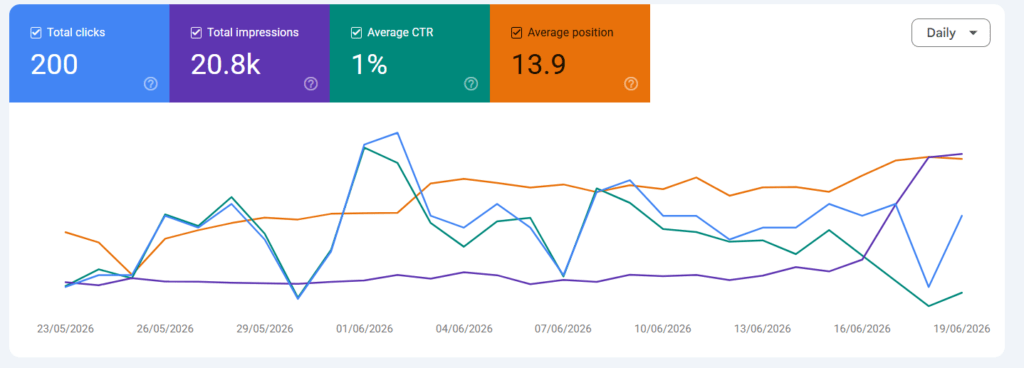
Organic Visibility Growth Case Study: Click Growth Analysis
One of the most noticeable improvements occurred in average daily clicks.
Before Optimization
- 2.89 Average Daily Clicks
During Reporting Period
- 7.14 Average Daily Clicks
Performance Improvement
Increase:
- +4.25 Daily Clicks
Percentage Growth:
- +147%
This improvement indicates that search visibility gains were not limited to impressions alone.
Users were increasingly interacting with search results and selecting the website across a broader range of relevant searches.
Organic Visibility Growth Case Study: Impression Growth Analysis
Search visibility expansion became even more evident through impression growth.
Before Optimization
- 328 Average Daily Impressions
During Reporting Period
- 743 Average Daily Impressions
Performance Improvement
Increase:
- +415 Daily Impressions
Percentage Growth:
- +126.5%
This level of growth suggests that search engines began displaying the website for a significantly larger set of relevant search queries.
In practical terms, the website gained additional opportunities to appear before potential visitors.
Ranking Improvement Analysis
Position improvements often provide some of the clearest indicators of successful SEO implementation.
Throughout the reporting period, average ranking positions improved substantially.
Starting Position
- Position 25.2
Ending Position
- Position 6.6
Ranking Improvement
Position Improvement:
- 25.2 → 6.6
Overall Ranking Improvement:
- Approximately 73.8%
Moving from the mid-twenties into the top-ten range represents a significant visibility milestone.
This transition often creates a compounding effect because higher rankings generally result in:
- Greater impression volume
- Increased click opportunities
- Improved search visibility
- Stronger authority signals
Visibility Expansion Curve
One of the most interesting observations throughout this Organic Visibility Growth Case Study was the visibility growth curve itself.
Rather than experiencing a temporary spike followed by decline, the project demonstrated several distinct stages of growth.
Phase 1: Foundation Development
The initial phase focused on:
- Keyword research
- Search intent mapping
- Content planning
- Topic clustering
- Entity identification
Visibility remained relatively stable while foundational SEO activities were being implemented.
Phase 2: Search Recognition
Search engines gradually began recognizing additional content relationships.
Indicators included:
- Higher click activity
- Increased visibility opportunities
- More stable rankings
This phase suggested that search engines were beginning to understand the website’s expanding topical coverage.
Phase 3: Ranking Improvement
As optimization efforts matured, rankings began improving across a wider range of search opportunities.
Several keyword groups moved closer to first-page visibility.
This created stronger visibility potential moving forward.
Phase 4: Visibility Expansion
The final stage produced the most substantial gains.
Search impressions accelerated significantly.
Search coverage expanded.
Additional queries began generating visibility.
Ranking performance strengthened further.
This phase reflected broader search exposure rather than isolated keyword success.
Key SEO Contributions During the Reporting Period
During my involvement as an SEO Executive, responsibilities included support across several optimization areas.
Search Intelligence Activities
- Keyword research
- Search intent analysis
- Query mapping
- Opportunity discovery
Content Strategy Activities
- Topic clustering
- Content recommendations
- FAQ opportunities
- Supporting topic identification
Authority Development Activities
- Backlink research
- Off-page SEO support
- Visibility enhancement initiatives
- Digital authority-building efforts
Performance Monitoring Activities
- Search Console analysis
- Impression tracking
- Click monitoring
- Position trend analysis
- Visibility reporting
Major Takeaways From This Organic Visibility Growth Case Study
Several important lessons emerged throughout the project.
Search Intent Matters More Than Individual Keywords
The strongest visibility gains occurred when content aligned with user intent rather than isolated keyword targets.
Topical Relationships Improve Search Understanding
Entity research and topic clustering helped strengthen contextual relevance.
Authority Development Supports Visibility Expansion
Backlink-related activities contributed additional trust and discovery signals.
SEO Growth Is Often Compounding
Many of the most significant visibility gains appeared after foundational work had already been completed.
This reinforces the importance of consistency throughout SEO campaigns.
Outcome Summary
During the optimization period:
- Average Daily Clicks increased by approximately 147%.
- Average Daily Impressions increased by approximately 126.5%.
- Average Position improved from 25.2 to 6.6.
- Search visibility expanded across a significantly larger query set.
- The website entered a stronger organic growth trajectory.
Strategic Lessons and Key Findings From This Organic Visibility Growth Case Study
Every SEO campaign provides valuable insights beyond rankings and traffic metrics. One of the most important outcomes of this Organic Visibility Growth Case Study was understanding how multiple optimization activities work together to create sustainable search visibility growth.
The results observed during the reporting period were not generated through a single tactic. Instead, they emerged through a combination of research, planning, execution, monitoring, and continuous refinement.
Key Finding #1: Keyword Clustering Creates Stronger Search Visibility
One of the most influential activities throughout the project was keyword clustering.
Rather than targeting isolated keywords independently, related search terms were organized into logical topic groups.
This provided several advantages:
- Improved topical relevance
- Better content organization
- Reduced keyword cannibalization risks
- Increased semantic coverage
- Enhanced search engine understanding
As keyword clusters matured, visibility improvements became increasingly noticeable across multiple search opportunities.
Why This Matters
Search engines increasingly evaluate topics rather than individual keywords.
This finding reinforced the importance of building content ecosystems instead of focusing exclusively on single-keyword rankings.
Key Finding #2: Search Intent Alignment Influences Performance
Another major observation involved search intent alignment.
Throughout the project, keyword opportunities were categorized according to user intent.
These included:
Informational Searches
Users seeking knowledge and educational content.
Commercial Searches
Users comparing available options.
Transactional Searches
Users preparing to take action.
Navigational Searches
Users searching for specific destinations or organizations.
By aligning content recommendations with search intent, visibility improvements became more consistent.
This demonstrated that understanding why users search is often as important as understanding what they search for.
Key Finding #3: Visibility Growth Often Appears Before Traffic Growth
Many website owners focus exclusively on traffic.
However, this project highlighted an important reality:
Search visibility often improves before substantial traffic gains occur.
The reporting period demonstrated:
- Increased impressions
- Expanded query coverage
- Improved ranking positions
- Greater search exposure
These indicators suggested that search engines were gradually expanding the website’s visibility footprint.
As visibility grows, traffic opportunities naturally increase.
This reinforces the importance of monitoring impressions alongside clicks.
Key Finding #4: Authority Signals Remain Important
Authority-building activities continued to play an important supporting role throughout the campaign.
These activities included:
- Backlink opportunities
- Supporting mentions
- Content promotion
- Visibility support initiatives
- Off-page SEO contributions
While backlinks alone do not guarantee rankings, they continue to contribute trust and discovery signals that support broader SEO objectives.
Authority Development Observation
The strongest improvements occurred when authority-building activities worked alongside:
- Content optimization
- Keyword research
- Search intent alignment
- Topical expansion
This demonstrated the importance of maintaining a balanced SEO strategy.
Key Finding #5: Entity-Based Optimization Supports Search Understanding
Entity research became an increasingly valuable component of the project.
Search engines attempt to understand relationships between:
- Topics
- Concepts
- Brands
- Products
- Services
- Supporting entities
Through entity mapping and contextual optimization, content became easier for search engines to interpret.
Benefits Observed
- Improved contextual relevance
- Stronger topical relationships
- Better content organization
- Enhanced semantic coverage
These improvements supported broader search visibility objectives.
Key Finding #6: Consistency Produces Compounding Results
Perhaps the most important lesson from this Organic Visibility Growth Case Study involved consistency.
Many optimization activities require time before producing measurable outcomes.
The reporting period demonstrated that:
- Research compounds
- Content compounds
- Authority compounds
- Visibility compounds
The most substantial visibility gains appeared after multiple optimization activities had already been implemented and reinforced over time.
This highlights why long-term SEO strategies often outperform short-term tactics.
Professional Lessons Learned as an SEO Executive
From a professional perspective, this project provided valuable practical experience across several areas.
Research and Analysis
The project strengthened capabilities related to:
- Search behavior analysis
- Opportunity identification
- Keyword intelligence
- Search intent evaluation
Content Strategy
Additional experience was gained through:
- Topic planning
- Content clustering
- Entity mapping
- Search-driven content recommendations
Performance Monitoring
Continuous monitoring helped improve understanding of:
- Search Console data
- Visibility trends
- Ranking movements
- Growth pattern analysis
SEO Execution
The project also reinforced the importance of combining:
- Technical thinking
- Content planning
- Authority development
- Data-driven decision making
rather than relying on any single optimization tactic.
Future Growth Opportunities
While significant progress was achieved during the reporting period, additional opportunities remain available.
Potential future initiatives may include:
Expanded Topic Clusters
Increasing topical depth through additional supporting content.
Advanced Internal Linking
Strengthening contextual relationships between related content assets.
Additional Authority Development
Expanding relevant authority-building opportunities.
Enhanced GEO Optimization
Improving content retrieval opportunities within AI-driven search environments.
Enhanced AEO Optimization
Increasing visibility potential across answer-focused search experiences.
Continued Search Intelligence Analysis
Identifying emerging search opportunities and future content gaps.
Final Strategic Insight
The most important conclusion from this Organic Visibility Growth Case Study is that sustainable SEO growth rarely comes from a single action.
The strongest outcomes emerged through the combination of:
- Keyword clustering
- Search intent mapping
- Entity optimization
- Content strategy
- Authority development
- GEO considerations
- AEO considerations
- Performance monitoring
Working together within a structured search intelligence framework.
These findings helped contribute to the visibility improvements observed throughout the reporting period and provide a foundation for future organic growth initiatives.
Frequently Asked Questions (FAQ)
What is Organic Visibility Growth in SEO?
Why are impressions important in SEO?
How is visibility different from traffic?
Visibility measures how frequently a website appears within search results.
Traffic measures how many users actually visit the website.
Visibility growth often occurs before significant traffic growth because search engines need time to evaluate and trust optimization efforts.
What role did keyword clustering play in this project?
Keyword clustering helped organize related search terms into logical topic groups.
This allowed content recommendations to support multiple search opportunities while improving topical relevance and reducing keyword cannibalization risks.
Why was search intent analysis important?
Search intent analysis helped align content recommendations with actual user needs.
Rather than focusing solely on keywords, optimization efforts considered the reason users perform specific searches, resulting in stronger content relevance.
How do backlinks support organic visibility?
Backlinks act as authority and trust signals.
Relevant backlinks can help search engines discover content, evaluate credibility, and support broader visibility growth initiatives when combined with quality content and optimization.
Why is the client anonymous in this case study?
The project was completed under confidentiality obligations.
Can these SEO principles be applied to other websites?
Yes.
Conclusion
This Organic Visibility Growth Case Study demonstrates how a structured SEO strategy can contribute to measurable improvements in search performance over time.
Working on an anonymized International B2B Commercial Website, I participated in keyword research, search intent analysis, content planning, topic clustering, backlink support, visibility monitoring, entity research, GEO-focused optimization considerations, and ongoing SEO performance analysis.
Throughout the reporting period, the project achieved several notable outcomes:
- Average daily clicks increased from 2.89 to 7.14 (+147%).
- Average daily impressions increased from 328 to 743 (+126.5%).
- Average ranking position improved from 25.2 to 6.6.
- Search visibility expanded across a significantly broader set of relevant search queries.
- Organic search exposure entered a sustained growth phase.
Perhaps the most important takeaway from this project is that sustainable SEO growth rarely comes from a single tactic.
The strongest results emerged through the combination of:
- Search intelligence
- Keyword clustering
- Search intent optimization
- Entity-based SEO
- Content strategy
- Authority development
- GEO considerations
- AEO considerations
- Continuous performance monitoring
When these activities work together within a unified framework, search engines gain stronger contextual understanding, users receive more relevant experiences, and websites gain greater opportunities for long-term organic visibility growth.
Confidentiality Notice
To respect ongoing business obligations and client confidentiality agreements, all identifying business information has been removed from this case study. The company name, website, location, and proprietary details remain confidential. However, the responsibilities, methodology, analysis process, and performance metrics discussed throughout this article accurately reflect the reporting period and the work completed during the project.
Author: Soumyaditya Biswas
Role During Project: SEO Executive
Project Type: International B2B Commercial Website (Identity Confidential)